
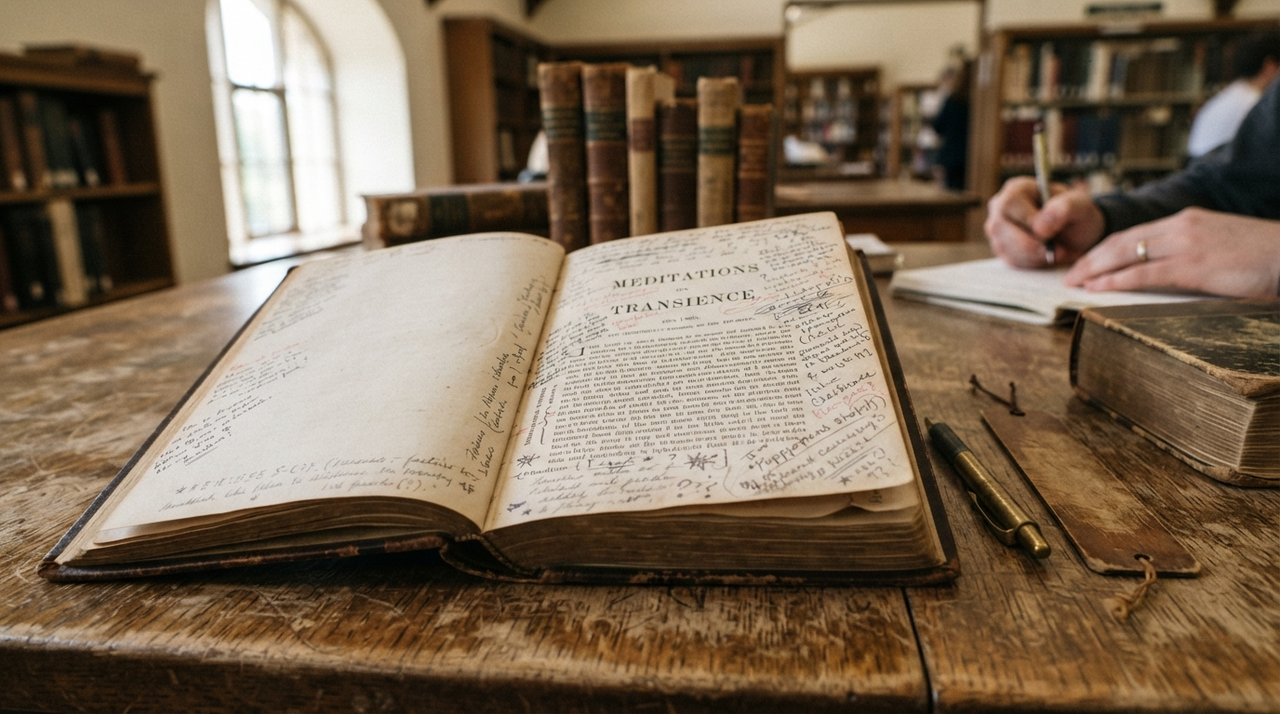
Marginalia Uncovered: The Living History of Reading Communities, Annotations, and Textual Memory
Imagine flipping open a dusty volume from centuries past, only to find a stranger's hurried scrawl in the margins: a question, a rebuttal, a doodle of a face mid-argument. These aren't mere defacements—they're the pulse of the history of reading, where books breathe through the hands of those who engage them. Marginalia, those intimate annotations scribbled alongside sacred texts, reveal how readers have long co-authored the works they cherish. In this exploration, we trace the threads of marginalia, reading communities, and textual memory, showing how books endure not as static relics, but as living dialogues across time.
The Reader as Co-Maker: Beyond Scribe and Owner
In the history of reading, distinctions sharpen our view: the scribe copies faithfully, the owner possesses, but the reader transforms. Scribes in ancient scriptoria labored to replicate texts verbatim, their errors often the only personal mark. Owners inscribed ex libris declarations—"this book belongs to"—staking claim. Yet readers, those restless co-makers, filled margins with glosses, underlinings, and fervent notes, turning passive consumption into active creation.
This alchemy appears early. Clay tablets from ancient Mesopotamia bear cuneiform wedges not just of epic tales, but of student queries etched beside them. Fast-forward to Renaissance Europe, where volcanic lawyer Volcanus annotated his Virgil with acidic wit, his ink still biting after 500 years. These acts affirm a truth: books live because people use them together, their marginalia weaving personal insight into collective textual memory. The reader doesn't just absorb; they extend the text, blurring lines between author and audience.
Echoes in the Margins: Vivid Case Studies of Marginalia
Cairo Geniza: A Treasure Trove of Everyday Notes
In the dusty attic of a Cairo synagogue, the Geniza—a repository for worn sacred texts—yielded over 300,000 fragments from the 9th to 19th centuries. Amid biblical scraps, readers left marginalia in Hebrew, Arabic, and Judeo-Arabic: shopping lists beside Psalms, romantic complaints next to Proverbs. These 11th-century notes, on vellum and paper, capture Cairo's Jewish community debating theology amid daily life, their ink fading yet voices persisting in textual memory.
Medieval Talmudic Margins: Layers of Rabbinic Debate
Turn to 12th-century Spain and Provence, where the Talmud's vast pages sprouted commentaries like vines. Rashi's glosses in the inner margins, Tosafot's dialectical ripostes on the outer—scribes arranged these in block-printed editions by the 15th century. In places like Narbonne, students added their own squeezes, visible today in manuscripts where parchment strains under accumulated wisdom. Here, marginalia formed a palimpsest of reading communities, each layer a timestamped intervention.
Islamic Ijazah Chains: Authorization Trails on Paper
In the Islamic world, from 9th-century Baghdad to Ottoman libraries, ijazah—permissions to transmit texts—graced endpapers and margins. A student might note, atop a chain of teachers back to the author, their reading under a master in Damascus, 1300 CE. These silsilah chains, on burnished paper, embodied textual memory, ensuring knowledge's pedigree while inviting reader reflections. Manuscripts like those of al-Bukhari's Hadith collections show margins blooming with such attestations, a communal seal of authenticity.
Monastic Glosses: Whispered Insights in Cloistered Scripts
Benedictine monks in 12th-century England, huddled by candlelight, glossed Virgil and Boethius on wide-margined vellum. At St. Albans, Brother Matthew Paris sketched maps and beasts beside chronicles, his quill dancing in iron-gall ink. These marginalia—part exegesis, part doodle—reveal solitary study as communal, echoing prior glossators in insular scripts.
Communities of Study: From Ancient Schools to Modern Circles
The history of reading thrives in bounded gatherings—study circles where texts spark dispute and kinship. Compare these across eras:
- Mesopotamian Edubba (c. 2000 BCE): Scribal schools in Sumer, where boys debated cuneiform laws on clay, their erasures hinting at rigorous study circles.
- Greco-Roman Philosophical Schools (4th century BCE): Plato's Academy and Aristotle's Lyceum hosted peripatetic readings of Homer, margins of papyrus rolls alive with student scholia.
- Jewish Beit Midrash (1st century CE onward): Study houses in Tiberias buzzed with paired Talmud recitation, fostering oral-marginalia later inscribed.
- Christian Cenobitic Reading (6th century CE): Benedict's Rule mandated lectio divina in monasteries like Monte Cassino, where communal readings birthed glossed Bibles.
- Modern Book Circles: Today's clubs echo these, dissecting novels over wine, digital annotations in apps mimicking ancient margins.
Each setting—clay tablet, papyrus scroll, vellum codex, printed page—frames reading communities as stewards of textual memory, their dialogues ensuring books' vitality.
Annotation Versus Authority: Censorship and Stewardship
Yet marginalia courts conflict. When does a note correct, and when does erasure preserve? In 16th-century Venice, inquisitors expurgated Hebrew books, blacking out Talmudic passages deemed heretical—stewardship, they claimed, for the faith. Readers, asserting agency, sometimes scribbled rebuttals atop the ink.
Contrast institutional authority with reader liberty: monasteries culled glosses for orthodoxy, while personal manuscripts preserved dissent. The 1559 Index Librorum Prohibitorum mandated corrections in margins of suspect works, turning readers into reluctant censors. These tensions highlight ownership's fragility—texts as shared inheritance, where removal can be care or control, annotation rebellion or refinement.
In the dance of ink and erasure, books remember both the affirmed and the silenced.
Private Journaling as Modern Marginalia
Personal journaling and books revives this tradition intimately. Where public marginalia risks communal scrutiny, journals offer private margins—bullet journals interleaving quotes from Austen with to-do lists, commonplace books harvesting wisdom like Montaigne's. Texts shape textual memory, but writing veils as much as reveals; access hinges on who reads later.
Platforms like Aetheria's SeekerJournal extend this, blending digital notes with book excerpts for reflective practice amid uncertainty. No prescription here—just recognition that such tools mirror ancient habits, fostering study circles in one's own mind, linking to broader pursuits in Books, Community, and Education.
What Notes Will You Leave?
The history of reading whispers: pick up a book, and join the chain. In Cairo's Geniza or your journal's fresh page, marginalia binds us. Texts endure through our marks, uncertainties and all. What annotation would you etch today—what question, insight, or sketch to echo into tomorrow's reading communities?