
Masters at the Bench: History of Guilds, Workshops, Apprenticeships, and Craft Institutions
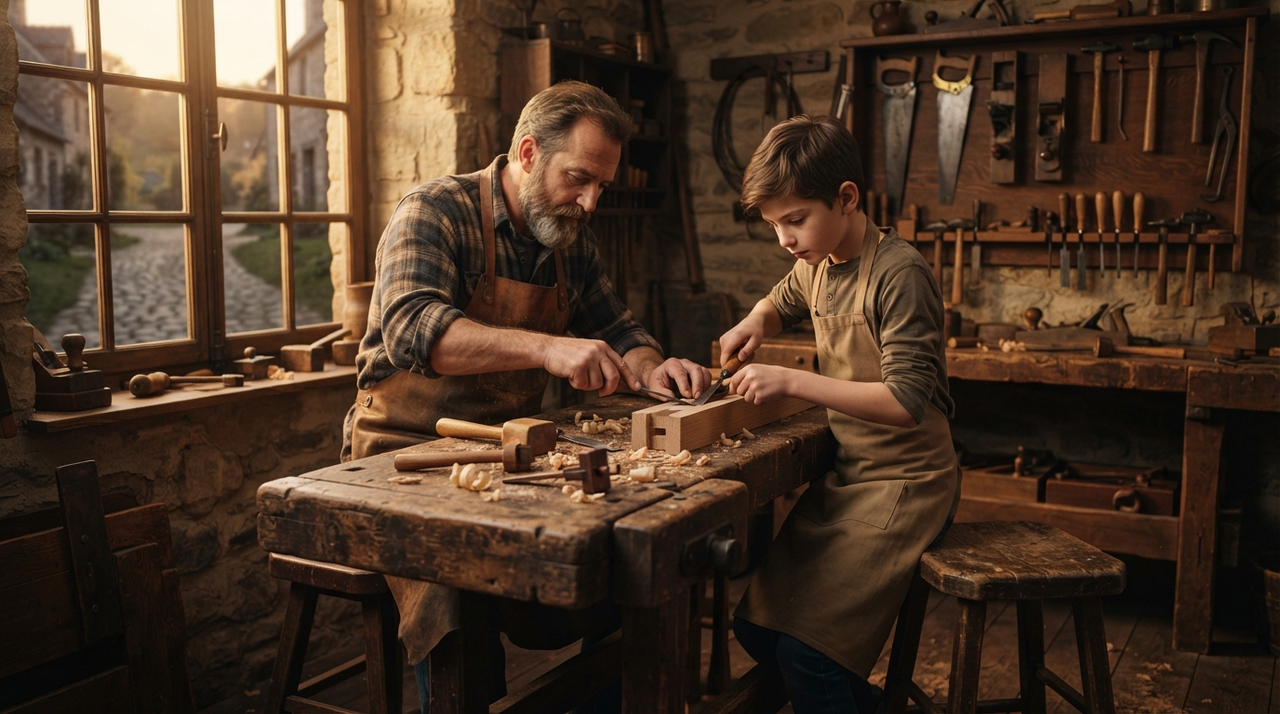
Picture a sturdy oak bench in a dim workshop, scarred by generations of tools. Two stools face each other across it. On one sits the master craftsman, hands callused from decades at the trade, eyes sharp under a furrowed brow. Opposite him perches a boy, no more than twelve, knuckles white on the edge of the bench, breath held as the master demonstrates the first precise stroke of a chisel. No contract signed in triplicate. No corporate handbook. Just the weight of tradition, the sting of correction, and the slow forging of skill. This scene repeats across millennia, from mud-brick hovels to stone guildhalls. It captures the heart of craft institutions: places where skill was not bought on the open market but earned through intimate, hierarchical transmission.
These benches were the thrones of premodern economies. Here, the history of guilds and workshops unfolds not as a tidy progression toward factories, but as diverse institutions policing who could make, who could teach, and who could sell. Household setups hummed alongside grand temple workshops. Chartered guilds enforced charters with iron rules. Inspectors patrolled markets. Each form guarded its craft against dilution, exclusion baked into their bones. To grasp this world is to see skilled work as inherited patrimony, not interchangeable labor.
Distinctions Among Craft Institutions: Not a Single Lineage
Workshops and guilds defy simple chronology. They branched in form and function across cultures, each suited to its soil. The household workshop anchored family trades, a father's tools passed to sons in the back room of a home doubling as shop. Production stayed small, intimate, output tied to daily needs. No formal charter needed; skill flowed through bloodlines or trusted neighbors.
Contrast this with temple workshops, vast operations fueled by divine or royal mandate. In ancient Near East and Egypt, priests or pharaohs directed scores of artisans under one roof, rations doled from temple granaries. These were not family affairs but state-religion hybrids, crafts like weaving or stonecutting scaled for gods' houses or kings' tombs. Palace workshops mirrored them, artisans bound to royal service, their output stamped with authority.
Chartered guilds emerged later in medieval Europe, formal bodies with royal or civic patents. They monopolized trades in cities, from goldsmiths to bakers, enforcing standards through oaths and wardens. Entry demanded mastery; sales required their hallmark. Unions, much later, arose in industrial shadows, collective bargaining over wages rather than quality control. These were no evolutionary steps. Household persistence rubbed shoulders with guilds; temple models echoed in monasteries. Each policed skill differently: families through kinship, temples through hierarchy, guilds through law.
Ancient Foundations: Mesopotamian, Egyptian, and Roman Cases
Temple Workshops in Mesopotamia and Egypt
Clay tablets from Uruk and Nippur, third millennium BCE, list crafts by name: jewelers, leatherworkers, potters. Temple archives record rations of barley and oil to named individuals, evidence of organized temple workshops. A goldsmith named Enlil-iddin received extra for a statue; weavers tallied cloth bolts for Inanna's robes. Limits defined these institutions. No free market; artisans drew sustenance from temple ledgers, output dedicated to cult. Skill transmission stayed opaque, likely familial within workshop compounds, but hierarchy ruled. The bench belonged to the temple's chosen.
Egyptian tomb reliefs paint the scene: rows of sculptors in Theban workshops, chisels flying under overseers' gaze. Papyrus from Deir el-Medina details village of tomb builders, state-paid, striking for rations when delayed. Crafts named in offering lists: coppersmiths, bowyers. Temple workshops here fused craft with eternity; exclusion meant oblivion. Women appear in beer brewing or weaving annexes, but heavy trades stayed male preserves. These craft institutions set precedents: skill as rationed privilege, policed by divine bureaucracy.
Roman Collegia: Cult and Burial, Not Monopoly
Rome's collegia gathered carpenters, dyers, fullers into associations, but trade control played second fiddle to ritual. Inscriptions from Ostia and Rome boast of feasts for Jupiter or Mercury, funds for members' funerals. A collegium fabrum invoked Vulcan; entry fees bought burial plots. Emperors like Trajan subsidized grain for collegia, binding loyalty. Yet no charters banned outsiders from selling. Collegia offered mutual aid, not guild-like exclusion. Skill passed informally, benches in private tabernae. When Vespasian regulated building trades post-fire, collegia advised, not dominated. These were social anchors, craft secondary to cult.
Medieval European Guilds: Charters, Marks, and Barriers
By the 12th century, European towns birthed guilds proper. London's goldsmiths secured a 1231 charter from Henry III, mandating assays on silver. Paris drapers regulated wool quality, fining subpar cloth. Guild wardens toured shops, smashing flawed wares. Quality marks, like hallmarks, certified output; buyers trusted the stamp over the maker.
Widow rights varied strikingly. In Cologne, a weaver's widow ran the loom till remarriage or death, employing journeymen. Nuremberg butchers allowed widows limited sales, but excluded them from slaughtering. Strasbourg permitted goldsmith widows to finish commissions. These concessions balanced continuity with male dominance. Exclusion sharpened elsewhere: women barred from most benches, save peripheral roles like seamstresses. Jews faced bans in Christian guilds; migrants needed master vouching. Guilds policed inheritance fiercely, journeymen waiting decades for mastery.
- Entry: Seven years apprentice, then journeyman wandering for experience.
- Mastery: Examined piece, plus feast for guild brethren.
- Exclusion: Fines for unlicensed work, boycotts of rivals.
This history of guilds reveals control as patchwork. Florence's Calimala guild cleaned imported cloth, banning foreign finishers. Bruges hanses coordinated Hanseatic trades without full monopoly. Variation underscores: guilds as civic pacts, not uniform cartels.
Islamic Craft Paths: The Hisba Market Inspector
Across the Islamic world, guilds flickered but never dominated like Europe's. Instead, hisba market inspectors enforced craft standards under muhtasibs, appointed by rulers or caliphs. Manuals like al-Shayzari's 12th-century Hisba detail rounds: checking bakers' scales, fining butchers for short weight, flogging adulterated spices. Goldsmiths assayed for purity; dyers tested fastness.
The hisba market inspector wandered bazaars, staff in hand, enforcing moral economy. No charters for guilds; workshops stayed familial or patron-linked. In Mamluk Cairo, textile beaters formed loose tandifs, but muhtasibs overruled. Ottoman Istanbul saw lonca guilds by 15th century, taxing members, yet hisba persisted for quality. This path diverged: state oversight via roving eyes, not stationary wardens. Craft institutions here prioritized public trust through inspection, exclusion via fines over membership oaths.
In Baghdad's markets, the muhtasib cries: "Measure with justice, or face the whip." Skill guarded by vigilance, not closed halls.
Apprenticeship History: Years, Correction, and the Child's Legal Shell
Apprenticeship bound the boy to the bench, a legal person remade. English indentures from 13th century specified seven years, board and clothing for service. Masters held paternal power: Leventhorp v. Ashwell (1462) upheld beatings as correction, not assault. French contrats d'apprentissage mirrored, child surrendering wages till term's end.
Skill built incrementally. First year: sweeping, fetching. Then tool handling, waste minimized. German sources describe journeyman wanderjahre, proving versatility. Legal status shifted: apprentice as chattel-like, suable for flight, yet inheriting master's secrets. Girls rarer, entering via widows or kin. Beatings marked discipline; guild courts mediated extremes. This apprenticeship history forged adults from children, skill as ordeal.
- Binding: Parental consent, guild approval.
- Training: Daily at bench, rote mastery.
- Progress: Tools gifted at milestones.
- Freedom: Mastery piece judged publicly.
Cross-Doors: Threads to Education, Technology, Ethics, Leadership, and Art
Education Beyond Letters
Guilds schooled bodies, not books. Apprentices memorized measures, alloys; temple workshops drilled ritual precision. Modern schooling fragments this holistic inculcation.
Technology as Guarded Lore
Masters hoarded recipes: Venetian glass secrets, Damascus steel. Workshops slowed diffusion, innovation incremental.
Ethics of the Trade
Oaths bound honesty; hisba fused piety with craft. Adulteration sinned against craft and community.
Leadership at the Bench, Not Forum
Masters led kin or charges, not cities. Guild deans advised magistrates, but benches bred technicians, not statesmen.
Art from Craft
Gothic cathedrals rose from mason lodges; Ottoman tiles from potter benches. Fine art and utility blurred.
Who Was Forbidden the Bench? An Invitation to Community
Women, often. Outsiders, routinely. The unskilled, eternally. Guild rolls tallied exclusions: no Jews in Paris butchers, no women in London armorers. Temple rosters skipped the lowly; hisba whipped the untrained. These craft institutions thrived on boundaries, skill as walled garden.
Today, firms hire coders like medieval day laborers. Yet echoes linger: coding bootcamps mimic apprenticeships, certifications ape hallmarks. Who sits forbidden now? Carry this question to Aetheria’s Community Door. Debate: revive benches for AI artisans? Poll the excluded. The stool waits.
Return to that bench. The master's stroke lands true. The boy nods, tries again. Skill endures, exclusion its shadow. In understanding these histories, we reclaim the deliberate pace of mastery.