
Origins of Psychology: From Ancient Psyche to Wundt's Leipzig Lab and William James
Imagine standing at the edge of a vast cosmic library, your fingers tracing the spine of a door labeled Psychology. As a student of existence, you wonder: where did this inquiry into the human mind truly begin? Not in sterile labs or leather-bound textbooks, but in the shadowed temples of ancient civilizations, where philosophers first wrestled with the invisible forces stirring within us. The history of psychology unfolds not as a straight line, but as a winding path through myths, meditations, and meticulous observations—a journey from the Greek psyche to the humming instruments of Wilhelm Wundt's Leipzig laboratory, and across the Atlantic to William James's introspective Harvard lectures.
This exploration through the origins of psychology invites you to peer into humanity's earliest attempts to map the inner landscape. We'll trace the psyche concept from its roots in Mesopotamian clay tablets and Egyptian papyri, through medieval scholastic debates, to the 19th-century pivot toward empirical science. Along the way, we'll distinguish rock-solid historical facts from interpretive traditions and the speculative bridges scholars build between eras. Archival records from antiquity are fragmentary—lost scrolls, translated biases—but they whisper persistent questions about consciousness, emotion, and will.
What if the mind's mysteries, pondered by scribes in Babylon, echo in every modern brain scan?
Echoes from the Dawn: Mesopotamian and Egyptian Foundations of Inner Inquiry
Long before psychology earned its name, ancient minds in the cradles of civilization grappled with the self. In Mesopotamia, around 2000 BCE, cuneiform tablets from Sumerian and Babylonian scribes documented dreams, omens, and erratic behaviors. These weren't clinical diagnoses but ritual responses to what we'd call mental disturbances—possession by spirits or imbalances in bodily humors. Priests in Uruk prescribed incantations and herbal remedies, framing the inner life as a battleground between divine forces and human frailty.
Across the Nile, Egyptian healers etched insights onto papyrus like the Edwin Smith Surgical Papyrus (c. 1600 BCE), one of the oldest medical texts. Here, the heart held pride of place as the seat of thought and emotion, while the brain was dismissed as mere cranial stuffing—a view persisting until Hellenistic influences. The ka and ba, ethereal doubles of the self, suggested an early duality: body and spirit intertwined. These traditions viewed the inner world through a practical lens—fertility rites for melancholy, amulets against phobias—prioritizing harmony with cosmic order over abstract analysis.
Cultural Frames: Ritual Harmony vs. Individual Soul
Compare these to later Western models: Mesopotamians emphasized communal rituals to restore balance, while Egyptians personalized the afterlife journey in spells from the Book of the Dead. Archival limits abound—tablets crumbled, papyri decayed—but surviving texts reveal a shared thread: the inner life as porous, influenced by gods and environment. For deeper dives into these soul-like concepts, wander to the Philosophy Door: Soul and Self.
The Greek Psyche: Birth of Philosophical Psychology
Enter ancient Greece, where the psyche concept crystallized into philosophy's sharpest tool. Homer's epics (c. 8th century BCE) portrayed psyche as breath or life-force, fleeing the body at death like a ghost. But thinkers like Empedocles (5th century BCE) layered in elements—fire for spirit, water for soul—blending physics with introspection.
Plato (427–347 BCE) elevated it further in dialogues like the Phaedo, envisioning the psyche as an immortal triad: reason ruling spirit and appetite from the chariot of the soul. Aristotle, his student, grounded it empirically in De Anima, defining psyche as the form of the body—the principle animating life, from plants' nutrition to humans' intellect. These weren't mere metaphors; they sparked debates on perception, memory, and will that echo in today's cognitive science.
- Plato's rational soul: Eternal, hierarchical, philosopher-king of the self.
- Aristotle's functional psyche: Tied to biology, observable in behavior.
Greek philosophical psychology shifted focus from external rituals to internal architecture, influencing Roman Stoics like Epictetus, who urged mastery over impressions. Yet, records from this era rely on later copies—Alexandrian libraries burned—leaving room for interpretive schools: Neoplatonists spiritualized it, while Epicureans materialised desires.
Medieval Synthesis: Faith, Reason, and the Inner Citadel
As Rome fell, medieval scholars wove Greek threads into Christian tapestries. Augustine of Hippo (354–430 CE), in Confessions, turned inward with raw honesty: memory as a vast palace, time as subjective stretch. His psyche was God's image, marred by original sin yet redeemable through grace—a bridge from pagan philosophy to theology.
Thomas Aquinas (1225–1274) harmonized Aristotle with scripture in Summa Theologica, positing the soul as substantial form, intellective and immortal. Islamic thinkers like Avicenna (980–1037) contributed via the Floating Man thought experiment: a disembodied self aware of its essence, prefiguring Descartes. These eras framed the inner life as a microcosm of divine order, with faculties like will and intellect in scholastic diagrams.
Cross-Cultural Echoes and Archival Shadows
Contrast Eastern parallels: Indian Upanishads (c. 800 BCE) probed atman (self) beyond illusions, while Chinese Confucians cultivated xin (heart-mind) through ritual. Medieval Europe's records, preserved in monasteries, outlasted many Asian counterparts due to parchment durability, but translations introduce biases. Explore records of this inner dialogue in the Writing & Memory Door.
The 19th-Century Forge: From Philosophy to Empirical Science
By the Enlightenment, philosophical psychology faced mechanists like John Locke, who blank-slated the mind with experience, and Immanuel Kant, who bounded knowledge to mental categories. But the stage was set for separation: physiology's rise, with Helmholtz measuring nerve speeds, demanded psychology claim its lab space.
Enter Wilhelm Wundt. In 1879, his Leipzig laboratory—housed in a modest university building—marked psychology's birth as an independent discipline. Students like reaction-time apparatuses and introspection protocols: report sensations from a metronome tick or color wheel. Wundt's Principles of Physiological Psychology (1874) dissected consciousness into elements, training over 180 pupils from around the world. Fact: The lab ran until 1920, pioneering tools like the tachistoscope for brief stimuli exposure.
William James: The Stream Across the Atlantic
Meanwhile, in America, William James bridged old and new. His 1890 Principles of Psychology—a two-volume tome born from Harvard lectures—painted the mind not as Wundt's static elements, but a flowing stream. Habits as neural grooves, emotions as bodily feedback loops: "The feeling of bodily changes precedes the emotion." James critiqued introspection's subjectivity, embracing functionalism—mind as adaptive tool.
Trained in medicine and philosophy, James lectured to packed halls, influencing pragmatism. His lab at Harvard, smaller than Leipzig's, emphasized real-world application: selective attention in crowded streets, the will's volitional thrust.
- Wundt: Structuralism—break mind into parts.
- James: Functionalism—how mind works in life.
Both leaned on era-specific tech—chronoscopes, esthesiometers—but diverged interpretively: Wundt's voluntarism vs. James's radical empiricism.
Weaving the Tapestry: Comparisons Across Eras and Cultures
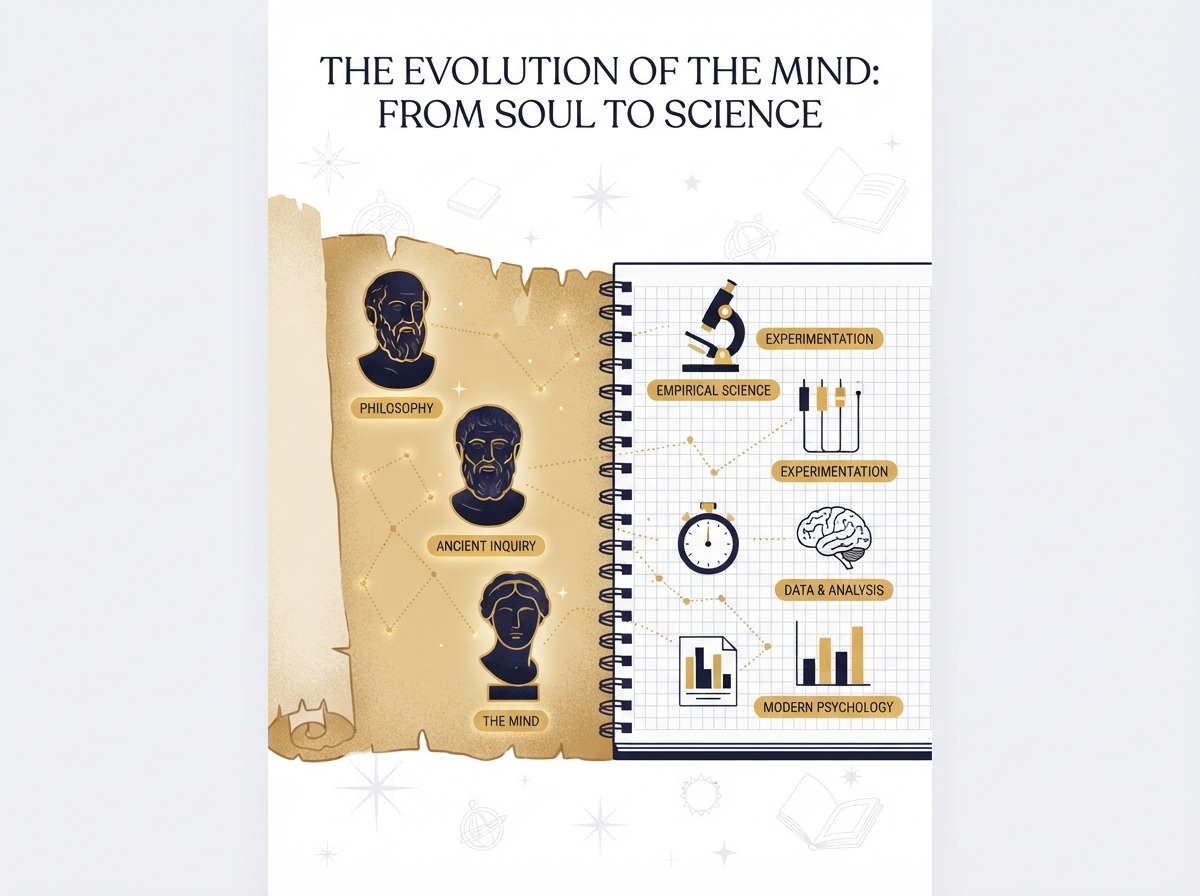
From Egyptian hearts to Wundt's graphs, framings evolved: ancients holistic and ritualistic, Greeks analytical, medievals theistic, moderns experimental. Mesopotamians externalized turmoil as demons; Plato internalized as soul strife. Speculative bridges link them—Aristotle's empiricism foreshadows Wundt—yet facts anchor: no direct lineage, but convergent inquiries.
Limitations persist: Eurocentric archives overshadow African or Indigenous traditions, where oral psychologies emphasized communal dreaming. Yet the history of psychology reveals universality—every culture charts the inner wilds.
In tracing these origins, we see not progress, but deepening questions.
Reflective Horizon: Your Next Step in the Cosmic Library
As you close this door in Aetheria's grand hall, carry the thread. The origins of psychology remind us: inquiry endures. Journal prompt: Trace a personal question about your mind back through time—which ancient echo resonates? Does your 'psyche' feel like Plato's chariot or James's stream? Scribble it down, and let the exploration continue.
(Word count: 1927)