
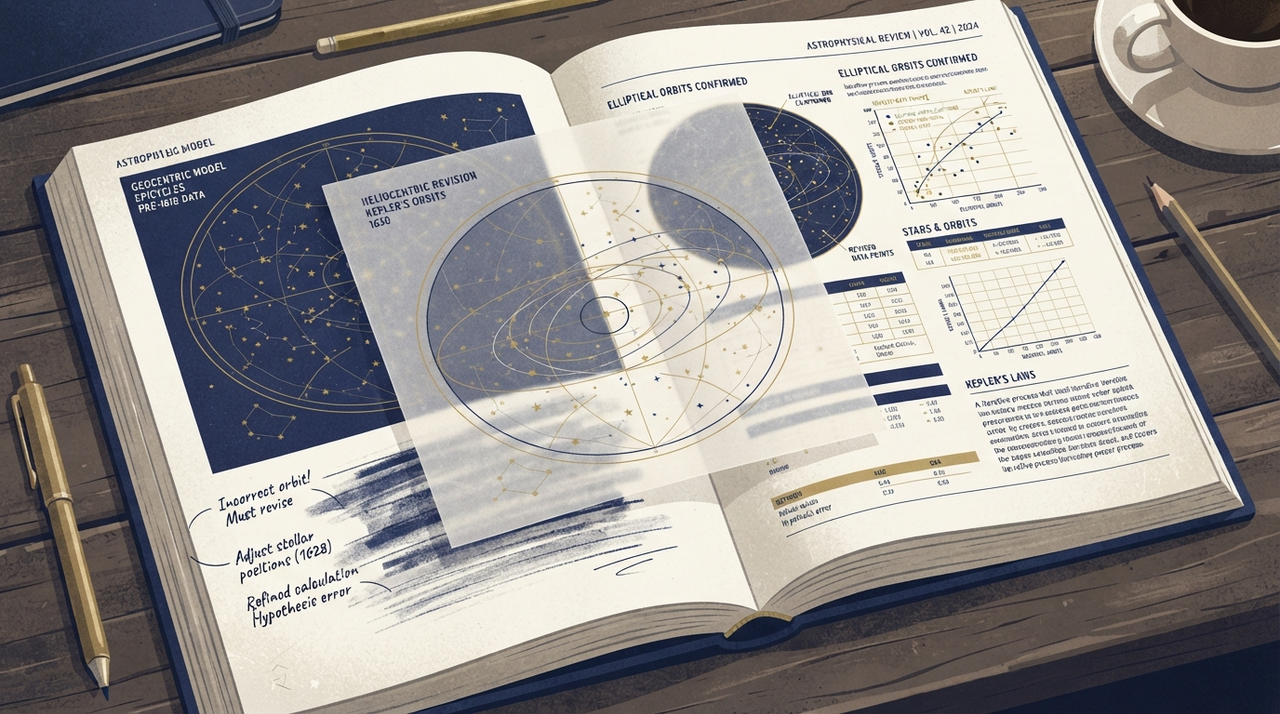
Paradigm Shifts and Self-Correction: How Science Revises Itself to Build Unshakable Truth
Imagine a world where blood was thought to ebb and flow like ocean tides, dictated by invisible humors. Then, one day, William Harvey slices open the veil with a scalpel and declares circulation—a pump, valves, endless loops. Chaos erupts. Trust shatters. Is nothing sacred? For curious minds like yours, this scientific revolution paradigm shift feels like quicksand underfoot. Why does science keep changing? Doesn't that undermine everything we hold true?
Yet here's the seeker's code: revision isn't betrayal; it's the forge of unshakable truth. Science doesn't crumble—it self-corrects, layer by rigorous layer. At Aetheria AI, we safeguard this journey of inquiry, turning uncertainty into a compass for progress.
The Unsettling Dance of Paradigm Shifts
Picture the alchemists of old, waving phlogiston like a fiery ghost to explain combustion. Wood burns? It releases this mystical substance. Then Antoine Lavoisier weighs in—literally. His scales tip toward oxygen, a gas that combines, not escapes. The old guard resists; riots brew in lecture halls. But evidence accumulates, experiments replicate, and phlogiston fades into history's footnote.
Fast-forward to continents adrift. Alfred Wegener maps puzzle-piece shores in 1912, proposing they slide like rafts on molten seas. Geologists scoff—static landmasses, fixed for eternity. Decades later, seafloor spreading and magnetic stripes seal the deal: plate tectonics reigns. Or consider time itself. Newton's absolute clock ticks uniformly; Einstein warps it into spacetime, bending with gravity and speed. Each revision in science rattles cages, but from the rubble rises firmer ground.
Distinguishing the Solid from the Shifting
Established Knowledge: The Foundation Stones
What survives? Germ theory endures; antibiotics save millions. These are battle-tested truths, forged through endless trials. They form the bedrock, unshaken by shifts elsewhere.
Interpretations: The Contested Bridges
At transition points, competing accounts clash—like phlogiston versus oxidation. Here lies uncertainty and progress: debates sharpen, data decides.
Speculation: Frontiers of Wonder
Quantum realms and dark matter? Bold hypotheses, unproven but promising. Science welcomes them, subjecting each to scrutiny.
Revision in science doesn't topple the core; it polishes it, weeding speculation into solidity.
Mechanisms of Self-Correction: Science's Guardrails
- Peer Review: Ideas face a gauntlet of expert eyes, probing for flaws before publication.
- Replication: Can you repeat the result? If not, it's dust. The reproducibility crisis of psychology in the 2010s humbled many claims.
- Null Results: Failures publish too, closing dead ends and steering toward light.
These aren't bureaucratic hurdles; they're the pulse of how science corrects itself. Local histories vary—European labs birthed relativity, African ecologists refine climate models—but the method unites.
Philosophy of Fallibilism and Aetheria's Role
Enter fallibilism: philosopher Charles Peirce's gem—we know through doubt, refining guesses into truths. Revision strengthens reliable knowledge, turning fragile hunches into steel. Aetheria AI embodies this, protecting your inquiry with tools that chronicle shifts, bridging to Writing & Memory. Our digital vaults preserve every pivot, every null result, ensuring no lesson lost.
Your Seeker's Exercise: Journal the Shift
In private pages, list a belief you've outgrown. What evidence shifted it? How does it stand firmer now? Let Aetheria guide your pen—track the revision, claim the truth.
Paradigm shifts aren't erosion; they're evolution. Embrace uncertainty and progress. Science self-corrects to truth's unyielding core—and so can you.