
Philosophy Methods Compared: Socratic Elenchus, Buddhist Tetralemma, Islamic Burhan, and Analytic Analysis
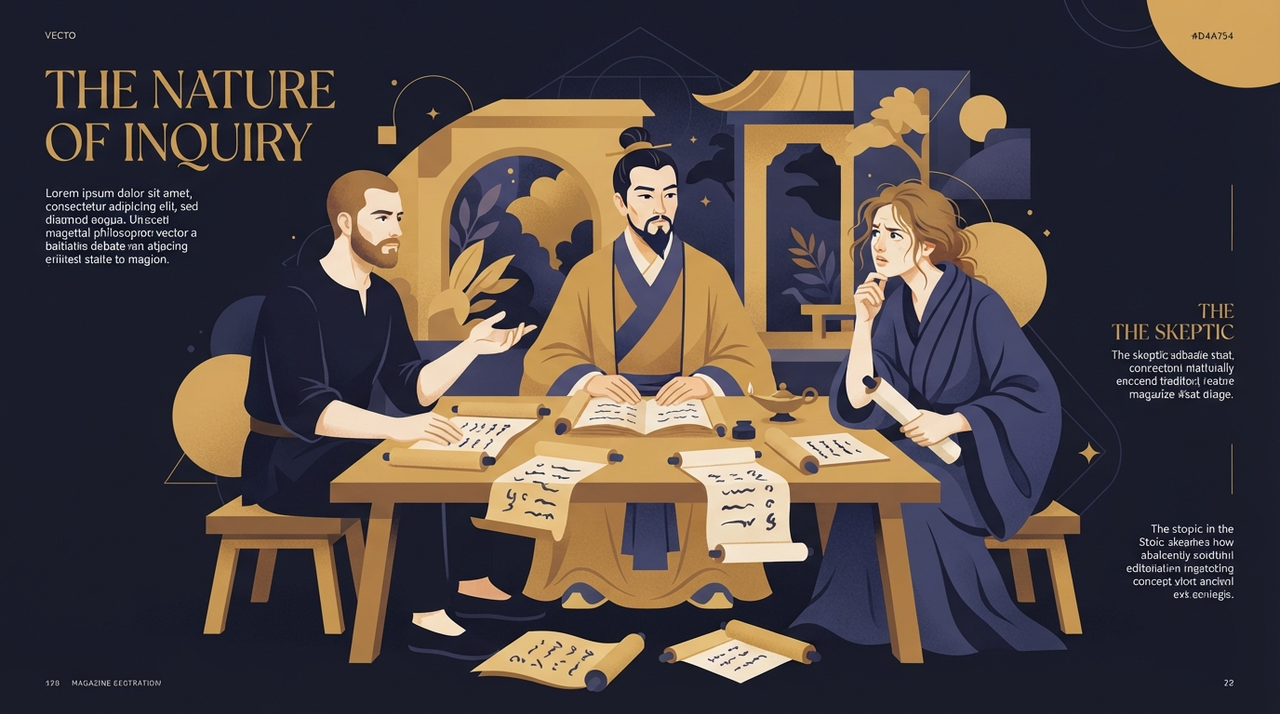
Picture a dusty agora in ancient Athens, where a barefoot philosopher corners a politician with a barrage of questions, unraveling conceit like a threadbare cloak. Now shift to a monk in a Himalayan cave, pondering whether the self truly exists—or doesn't, or both, or neither. Farther still, to a Baghdad scholar under lamplight, constructing ironclad proofs that echo from metaphysics to medicine. And in a modern seminar room, a professor dissects language with surgical precision, exposing hidden assumptions in everyday words.
These scenes capture four profound philosophy methods: the Socratic elenchus, the Buddhist tetralemma, Islamic burhan, and analytic conceptual analysis. In the realm of comparative philosophy, they reveal how different traditions approach the same eternal puzzles—existence, knowledge, ethics—not with rote answers, but through distinctive ways of questioning. Each method sharpens the mind differently, like tools in a sage's kit: one probes contradictions, another dissolves dualities, a third builds demonstrations, and the last clarifies concepts.
This exploration isn't about crowning a victor in the marketplace of ideas. Instead, it's an invitation to see dialectic and inquiry anew, distinguishing their mechanics from the doctrines they probe. We'll trace their historical contours, limits, and resonances, connecting them to doors like science and ethics in our broader pursuit of understanding.
The Socratic Elenchus: Dialectic as Midwifery
Born in the shadow of Athens' golden age, the Socratic elenchus—Greek for "refutation" or "cross-examination"—is the art of dialectic questioning. Socrates, as portrayed in Plato's early dialogues, didn't lecture. He played midwife to ideas, drawing out beliefs from his interlocutors only to expose their inconsistencies.
The method unfolds in stages: First, the questioner elicits a claim, say, "Justice is returning what one owes." Then, through a chain of queries—"What if a madman demands his deposited dagger?"—contradictions emerge. The result? Aporia, or puzzlement, clearing ground for genuine knowledge. It's adversarial yet collaborative, rooted in the oral culture of symposia and law courts.
Historical Context and Limits
This philosophy method thrived amid Periclean democracy's debates but faltered against sophistic rhetoric. Plato later evolved it into his own dialectic in works like the Republic, ascending from images to Forms. Yet elenchus assumes shared premises and honest responders—rare in polarized times. Its strength lies in personal transformation, not systematic proof.
Consider Euthyphro prosecuting his father: Socrates' questions force him to confront piety's essence, leaving both unsettled. Here, dialectic isn't conquest; it's catharsis.
Buddhist Tetralemma: Embracing the Ineffable
In ancient India, amid Vedic certainties, Buddhist thinkers like Nagarjuna wielded the tetralemma (catuṣkoṭi), a fourfold logic that shatters binary thinking. This comparative philosophy gem rejects simple affirmations: A proposition is neither just "true" nor "false," but navigates "it is," "it is not," "both," and "neither."
Applied to the self in Nagarjuna's Mūlamadhyamakakārikā, the tetralemma deconstructs: The self is (eternal soul? No). Is not (nihilist void? No). Both (contradictory)? Neither (empty of inherent existence, dependent-originated). It's not nihilism but a therapeutic emptying, leading to nirvana's insight.
Mechanics and Cultural Roots
Unlike Western either/or, this method mirrors cyclical cosmology and meditation's nuances. Evidence from texts shows it critiquing extremes—eternalism versus annihilationism—fostering non-attachment. Limits? It risks paradox for untrained minds, and interpretations vary across Theravada (less emphatic) and Mahayana schools.
Imagine a debate in Nalanda: A monk posits causality; the tetralemma reveals its conventional truth, dissolving attachment to views. This dialectic variant invites silence over victory.
Islamic Burhan: The Path of Demonstration
In the Islamic golden age, falsafa (philosophy) birthed burhan—Arabic for "proof" or "demonstration." Thinkers like Avicenna (Ibn Sina) and Averroes blended Aristotelian syllogisms with Quranic reflection, crafting arguments self-evident to intellect alone.
Avicenna's "flying man" thought experiment exemplifies: Imagine a man created mid-air, bodiless, sightless—yet aware of self. This burhan proves soul's immateriality, distinguishing essence from existence. Structured as major premise (universal), minor (particular), conclusion—it's geometry for metaphysics.
Synthesis and Boundaries
Burhan flourished in Abbasid translation houses, influencing medicine (Avicenna's Canon) and astronomy. Yet tensions arose: Al-Ghazali critiqued its overreach in Incoherence of the Philosophers, favoring revelation. Contextually bounded by monotheism, it excels in ontology but less in subjective ethics.
Under Cordoba's minarets, a scholar might deploy burhan to affirm God's necessity: Everything contingent needs a cause; infinite regress impossible; thus, Necessary Existent. Precision meets piety.
Analytic Conceptual Analysis: Dissecting Language
Analytic philosophy's hallmark, conceptual analysis, emerged in 20th-century Britain and Vienna, with Frege, Russell, and Wittgenstein. It treats philosophy as linguistic therapy: Clarify concepts by analyzing usage, counterexamples, and implications.
Edmund Gettier's 1963 cases shattered "justified true belief" as knowledge: A stopped clock "right twice daily" fools justification. Analysis demands necessary/sufficient conditions, often via thought experiments or ordinary language scrutiny.
Evolution and Critiques
From logical atomism to ordinary language philosophy (Austin, Ryle), it prioritizes clarity over speculation. Limits? Quine's holism challenges isolated analysis; continental thinkers decry its scientism. Yet it powers ethics (trolley problems) and mind (Chinese Room).
In a Cambridge common room, Wittgenstein might query "pain": Not private sensation, but shared behavior. Analysis illuminates.
Bounded Comparisons: Strengths and Shadows
How do these philosophy methods diverge in questioning? Elenchus is dialogic, personal, exposing hypocrisy via reductio. Tetralemma is apophatic, transcending logic for insight. Burhan is constructive, axiomatic like math. Analytic analysis is reductive, empirical in language.
- Goal: Elenchus seeks virtue; tetralemma, emptiness; burhan, certainty; analysis, precision.
- Evidence Base: Oral anecdotes (Socrates), sutras (Buddhist), commentaries (Islamic), journals (analytic).
- Limits: Cultural—elenchus assumes literacy; tetralemma, meditative discipline; burhan, theistic priors; analysis, Anglophone bias.
Yet overlaps gleam: All use counterexamples. Dialectic echoes in analytic seminars; burhan's syllogisms underpin Russell.
In comparative philosophy, no method monopolizes truth—they illuminate facets of the same diamond.
Bridges to Science and Ethics
These tools extend beyond philosophy. Elenchus mirrors scientific peer review, grilling hypotheses. Tetralemma anticipates quantum superposition—wave or particle? Both/neither. Burhan's proofs prefigure proofs in physics; analytic analysis fuels cognitive science, dissecting "belief."
In ethics, elenchus probes trolley dilemmas; tetralemma dissolves self-other dualities for compassion; burhan justifies natural law; analysis clarifies "rights." Cross-Doors: Science tempers burhan's metaphysics; ethics tempers elenchus' relentlessness.
An Invitation to Your Own Inquiry
These methods, separated by millennia and maps, whisper a shared truth: Questioning is the universe's native tongue. Which resonates? Try elenchus on a friend, tetralemma on doubt, burhan on existence, analysis on words. In Aetheria's halls of wisdom, step through—experiment, compare, wonder. What puzzle will you unravel next?