
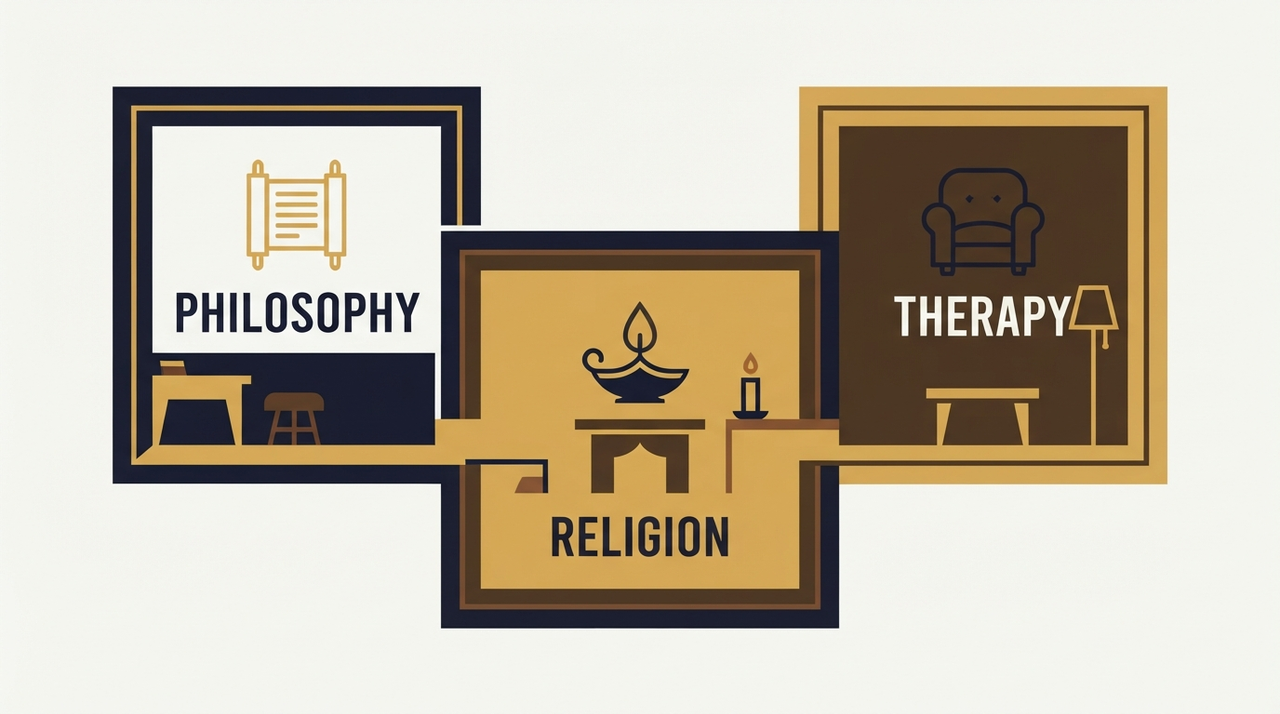
Philosophy Versus Therapy: Frames for Personal Change in Religion, Psychology, and Beyond
Imagine sitting in a quiet room, a thick book of ancient wisdom open before you. You seek clarity on how to live amid chaos. Across town, someone else unburdens their fears to a trained listener, chasing relief from inner storms. Both pursue personal change, yet one turns to philosophy, the other to therapy. In our rush to optimize every corner of life, these paths blur. Traditions once held distinct now compete as self-help tools. Readers of the Aetheria Personal Growth Door know this pressure all too well. They crave frames kept clear: philosophy versus therapy, religion and psychology, each with its own purpose.
Why does this matter? Mixing frames risks shallow results. A philosophical question posed as a therapeutic exercise might miss both wisdom and healing. Here, we explore frames for personal change without forcing one into another's mold. What is each for? Who speaks with authority? What marks success? And what might you wisely refuse?
Philosophy Versus Therapy: Aims That Do Not Overlap
Philosophy invites you to wrestle with life's big questions. Think of it as a solitary climb, rope in hand: texts from thinkers past guide you toward virtue, wisdom, and clear sight. Its aim? Not quick fixes, but a transformed way of seeing. Success lies in moments of insight - a sudden grasp of what matters most, or resolve to act despite fear. Authority rests in the tradition itself: read, reflect, argue alone or with fellow seekers. No license required.
Therapy's Clinical Horizon
Therapy, by contrast, operates in the clinic's measured light. Born of modern psychology, it targets distress: anxiety that paralyzes, grief that lingers too long. Professionals - licensed, trained, bound by evidence and ethics - hold authority here. Success shows in reduced symptoms, better function in daily life. Yet limits persist. Not every ache yields to talk or technique; harms can arise from mismatched care or over-reliance.
Philosophy versus therapy sharpens when you ask: Am I chasing health metrics or a fuller life? Borrow therapy's language into philosophy, and virtue becomes "self-care." Slip philosophical musings into therapy, and sessions drift from symptom relief. Each frame serves best when named plainly.
Religion and Psychology: Formation Meets Measurement
Religion shapes souls through community and rite. Picture a gathering under vaulted ceilings, voices rising in shared creed. Its frame for personal change builds character via authority vested in tradition, elders, scripture. Success? Alignment with a higher call - perhaps steadfast love, or awe before mystery. You might refuse parts that clash with conscience, yet the communal bond endures.
Psychology's Evidence-Bound Path
Psychology, rooted in observation and trial, measures change against baselines of well-being. Religion and psychology diverge here: one leans on revelation and fellowship, the other on data and dialogue. Neither completes the other. Religion is no primitive psychology; psychology, no final map of the soul. A believer might enter therapy for acute pain without surrendering faith's deeper work. Yet confuse the frames, and sacred rites turn into mood boosters, or sessions into sermons.
In the Aetheria Personal Growth Door, these tensions invite curiosity. Cross into Psychology for clinical nuance, Religion for communal depth, Philosophy for solitary rigor, Ethics for moral clarity, Health for bodily wisdom. Name your frame first.
Choosing Frames Wisely: Authority, Success, and Refusal
- What is it for? Philosophy clarifies existence. Therapy eases suffering. Religion forms the whole person in community.
- Who is authorized? Thinkers and texts for philosophy. Licensed experts for therapy. Tradition-bearers for religion.
- What counts as success? Virtue embodied, symptoms lessened, life reordered toward the divine - none reducible to the rest.
- What may you refuse? Philosophy's abstractions if they numb action. Therapy if it pathologizes normal struggle. Religion's demands if they wound the spirit.
Uncertainty lingers. No frame promises total change; each has blind spots. A person might weave them - Stoic exercises alongside counsel, prayer beside reflection - but only after discerning entry points.
An Invitation in the Aetheria Personal Growth Door
Before borrowing a neighbor's tools, pause. Which frame are you truly in? This question, central to frames for personal change, frees you from self-help's blur. Philosophy versus therapy, religion and psychology: honor their distinctions, and change deepens. Step through the Aetheria Personal Growth Door not to conquer, but to question well. What frame calls you next?