
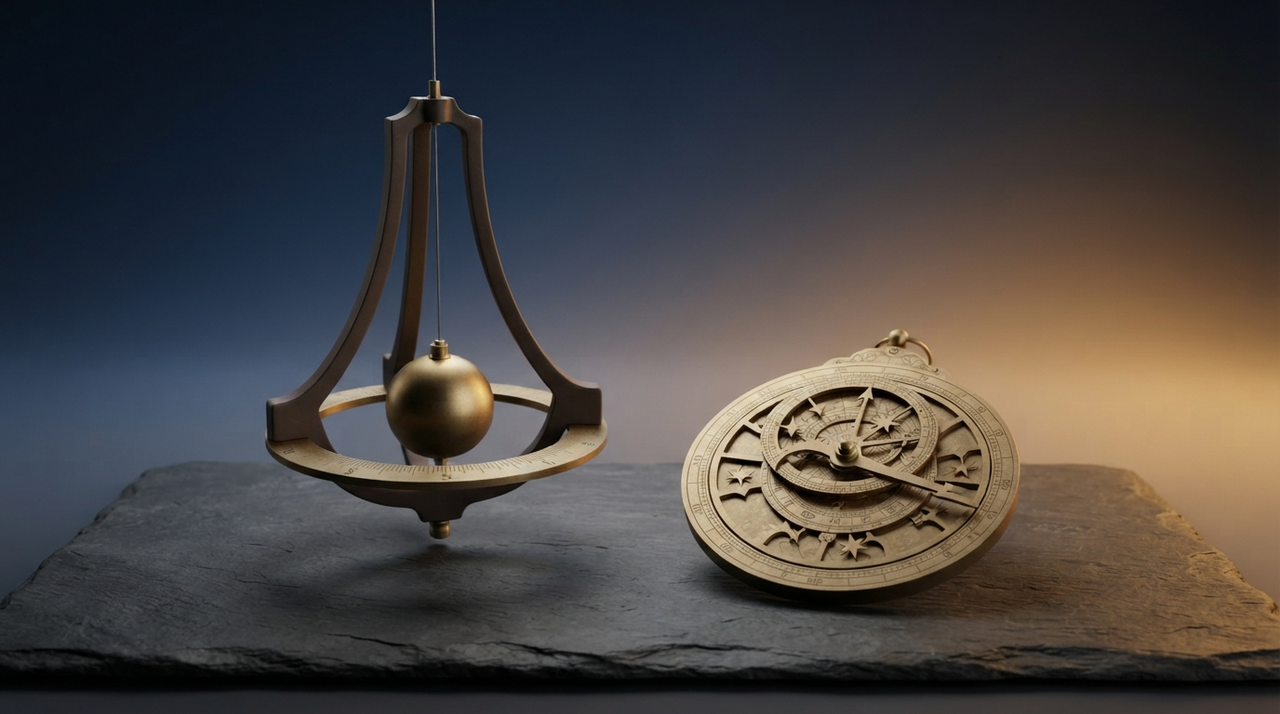
Physics Epistemology Unveiled: The Seeker's Code to Knowledge Through Observation, Models, and Rigorous Testing
Picture a seeker standing at the edge of a cosmic cliff, gazing into the void. Below lies the universe's machinery—stars wheeling in silent ballets, atoms dancing in invisible fury. Physics promises keys to this realm, laws etched in math that feel as unyielding as granite. Yet for every certainty, a horizon beckons, whispering of mysteries unsolved. This tension is the heart of physics epistemology: how we claim to know what we know.
In Aetheria's Knowledge Library, we enter physics not as conquerors, but as humble observers. Knowledge here isn't dogmatic decree; it's a living code, refined through centuries of scrutiny. It feels certain because it withstands storms of doubt—yet remains open, inviting your own gaze.
Welcome to the Seeker's Code, a disciplined path through observation and measurement, the crafting of models in physics, and relentless testing. This is the scientific method in physics, unveiled for those stepping through Physics Door.
The Seeker's Code: A Blueprint for Cosmic Inquiry
At its core, physics epistemology rests on the Seeker's Code—a cycle as elegant as an orbit. Begin with raw encounter: the world as it presents itself. Then distill it into models, those luminous simplifications that reveal patterns. Predict boldly with numbers. Test without mercy. What survives enters the canon; the rest dissolves into lesson.
This isn't idle philosophy. It's how humanity tamed gravity's pull and pierced the atom's veil. Galileo didn't proclaim from a tower; he rolled balls down planks. Cavendish didn't dream of gravity's strength; he balanced needles in quiet rooms. Their legacy? A method that turns wonder into wisdom.
Step One: Disciplined Observation and Measurement
Observation isn't casual glancing—it's vigilant witnessing, armed with tools. In the late 1500s, Galileo Galilei grew weary of Aristotle's armchair claims that heavy objects fall faster. He sought truth in motion. Constructing an inclined plane—a smooth wooden ramp—he released bronze balls of varying sizes. Timing their rolls with his pulse (later, a water clock), he measured distances and speeds meticulously.
What emerged? Acceleration constant, independent of mass. No divine intervention, no qualitative poetry—just data: positions at intervals, graphed into a parabola. This is observation and measurement in action: repeatable, quantitative, stripping away bias. Galileo's reports, published in Two New Sciences, weren't treatises but lab notebooks—sketches, tables, uncertainties acknowledged.
Crafting Models in Physics: From Chaos to Clarity
Raw data whispers; models shout. A model idealizes: friction vanishes, spheres become points, air thins to vacuum. Newton's gravity? Planets as massless test particles orbiting a sun, paths as conic sections. Imperfect, yet prophetic.
Consider the 1798 Cavendish experiment. Henry Cavendish suspended a torsion balance—two lead spheres on a rod, twisting delicately. Nearby massive weights tugged them, revealing gravity's constant G. His model? Isolated system, inverse-square force, torques balanced. Measurements spanned nights, damping vibrations, averaging swings. The result: G ≈ 6.74 × 10⁻¹¹ m³ kg⁻¹ s⁻², anchoring Newtonian gravity to Earthly scales.
Prediction and the Power of Numbers
Models don't merely describe; they foretell. Plug in values—predict eclipses, electron orbits, black hole shadows. Einstein's general relativity modeled light bending around the sun; 1919's solar eclipse confirmed it, stars shifting as predicted to arcseconds.
Here lies the alchemy: qualitative hunch becomes equation. But models are maps, not territory—useful fictions demanding trial.
Rigorous Testing: The Forge of the Scientific Method in Physics
Testing is the crucible. Predictions meet reality in controlled clashes. Does the model hold? Tweak, iterate, or discard.
- Replication: Others must repeat. Michelson-Morley null result on ether? Echoed worldwide, birthing relativity.
- Error Bars: Modern reports quantify doubt—systematic errors, statistical spreads. Particle physics demands 5-sigma certainty.
- Community Norms: Peer review sifts, conferences debate, journals archive. arXiv preprints accelerate, but verification reigns.
“Measure what is measurable, and make measurable what is not so.” — Galileo, echoing the seeker's vow.
Distinguishing the Pillars of Knowledge
Not all physics claims equal. Established physics stands firm: conservation of energy in isolated systems, unchallenged since 1840s Mayer-Joule synthesis, verified from pendulums to protons.
Interpretation probes meaning: Does quantum wavefunction collapse imply consciousness? Debated, but formalism predicts flawlessly.
Speculation ventures untested: multiverses, extra dimensions. Lacking direct test, they orbit frontiers—hypotheses awaiting their Cavendish.
This triad guards against overreach, keeping physics epistemology humble yet bold.
Echoes Across Aetheria's Doors
The Seeker's Code resonates beyond Physics Door. In The First Laws, trace conservation's thread from thermodynamics to cosmology. Wisdom Traditions reveal parallel paths—ancient measurement in contemplative disciplines, distilling insight through disciplined gaze.
Even Sacred Places align: pyramids' alignments, Stonehenge solstices—proto-observations encoding celestial models, tested by millennia's stars.
Your Path Forward: Embrace the Open Horizon
Physics epistemology isn't a closed book but a lantern for the seeker's night. It certifies wonders like GPS satellites orbiting by relativity, while frontiers like dark energy pulse unsolved. You've glimpsed the code—now wield it.
Step back into inquiry. Drop a ball, time its fall. Question: Does your measurement match g=9.8 m/s²? What model emerges? The universe awaits your test.
Journal Prompt: Recall a moment of personal observation—a falling leaf, a rippling pond. Craft a simple model. Predict an outcome. How might you test it? What does this reveal about your inner seeker's code?
In Aetheria's Cosmic Library, knowledge unfolds eternally. What door calls next?