
Planetary Retrograde and Synodic Periods: Babylonian Diaries and Maya Venus in Ancient Astronomy
The Dance of the Wanderers: A Celestial Puzzle
Imagine lying on the baked clay plains of ancient Mesopotamia, eyes fixed on the night sky. A bright point of light—Mars, the red wanderer—suddenly halts its eastward trek among the stars, reverses course, then resumes. This baffling planetary retrograde motion puzzled early sky-watchers, yet it became the cornerstone of ancient astronomy. Across oceans and millennia, the Maya in Mesoamerica wrestled with similar riddles, especially for Venus, their Morning Star.
At the heart of these observations lies the synodic period: the time it takes a planet to return to the same position relative to the Sun and Earth, as seen from our vantage. For outer planets like Mars, this cycle reveals retrograde loops; for inner Venus, it marks dramatic sky appearances. Neither Babylonians nor Maya had telescopes—only naked eyes, patience, and clay or bark-paper records. Their legacies, preserved in Babylonian diaries and Maya Venus tables, bridge raw observation to mathematical timekeeping.
Babylonian Diaries: Chronicles of the Planets
Tracking Retrograde: Mars in the Diaries
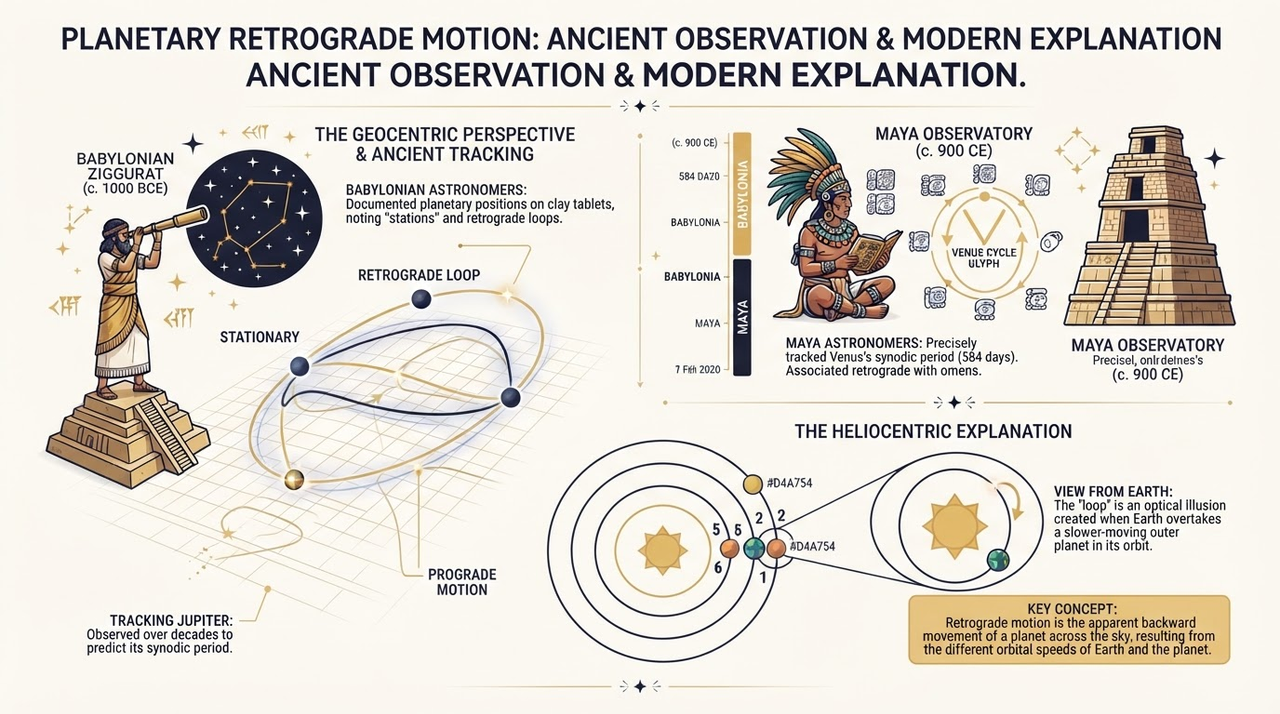
From the 7th century BCE, Babylonian astronomers etched daily celestial logs onto clay tablets—over 1,500 survive today. These Babylonian diaries meticulously noted planetary positions against fixed stars, lunar phases, and eclipses. Mars, with its 780-day synodic period, featured prominently. Scribes recorded its planetary retrograde arcs, lasting up to 80 days, using a sexagesimal (base-60) system that endures in our hours and minutes.
Methods were simple yet rigorous: observations from temple ziggurats, cross-checked against star catalogs like the MUL.APIN. They plotted ephemerides—predicted positions—revealing arithmetic progressions for synodic cycles. Limits abounded: cloudy nights, horizon haze, and naked-eye resolution capped precision to about 1 degree. Yet, these diaries quantified retrograde as Earth overtaking slower Mars in orbit, a geometric insight predating Copernicus.
- Daily logs included planet longitudes, speeds, and stations (retrograde start/end).
- Synodic tables predicted Mars returns every 779.94 days, accurate to hours.
- Evidence stayed observational; later Hellenistic astrologers overlaid zodiacal meanings.
From Data to Prediction
Babylonians transitioned from mere watching to modeling. Goal-year texts averaged past synodic periods for forecasts, linking to their lunisolar calendar. This fed into timekeeping mastery, where planetary math intertwined with months and saros eclipse cycles.
Maya Venus: Synodic Majesty in Codices
The Dresden Codex and Venus Cycles
In the Yucatán rainforests, Maya priests charted Venus with supernatural zeal, but rooted in empiricism. The Dresden Codex, a 13th-century bark-paper survivor, devotes pages to Maya Venus tables. Its 584-day synodic period—from heliacal rising to rising—aligns appearances as Morning or Evening Star, with planetary retrograde near inferior conjunction invisible to the eye.
Tools included stelae alignments and E-group observatories at sites like Uaxactún. Scribes tallied 65 Venus cycles (8 years) syncing with 260-day tzolk'in and 365-day haab calendars—a 99.4-year grand cycle. Precision hit 1-2 days over centuries, despite tropical storms obscuring views half the time.
The codex's almanac lists exact dates for Venus stations, blending astronomy with ritual timing for wars and rites—evidence of function, not mysticism alone.
Mathematical Elegance and Boundaries
Maya math used vigesimal (base-20) with positional zeros, enabling tables that corrected drift via intercalations. They distinguished true solar year from Venus period, foreshadowing elliptical orbits. Limits? No outer planet details like Mars; focus stayed Venus-centric. Post-conquest, Spanish friars dismissed much as idolatry, but surviving codices prove pure astronomy beneath.
Bridging Observation, Time, and Mathematics
Babylonian diaries and Maya Venus records exemplify ancient astronomy's evolution: from logging planetary retrograde quirks to harnessing synodic periods for calendars. No telescopes, yet they built predictive systems rivaling modern ephemerides in scope.
Separate the wheat from chaff—raw data fueled timekeeping doors, where Babylonian Goal-Years echo Maya Long Count precision. Mathematics doors open too: sexagesimal harmonics, vigesimal cycles. Astrology? A later veneer on empirical bones.
Today, as seekers of cosmic patterns, we inherit their gaze. Next clear night, trace Venus's path. The ancients did—and in doing so, measured the universe's rhythm.