
Quantum Entanglement Explained: Bell Inequality, Aspect & Zeilinger Experiments, and Key Interpretations
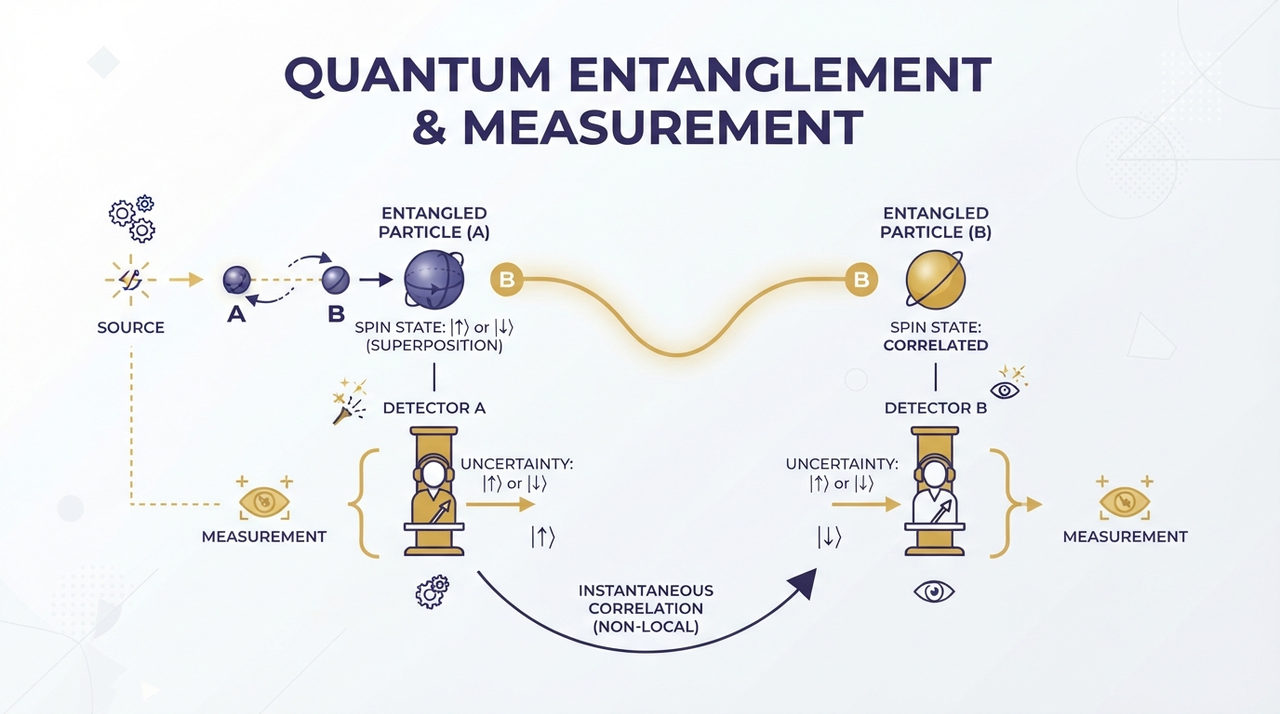
Picture two particles born together in a lab, then hurled across vast distances—thousands of kilometers apart. Measure one, and the other snaps into alignment instantaneously, as if defying space itself. This is quantum entanglement, a phenomenon that has puzzled physicists and philosophers alike since the 1930s. It's not science fiction; it's the weird heart of quantum mechanics, challenging our intuitions about reality. But what does it really mean? Enter the Bell inequality, groundbreaking experiments by Alain Aspect and Anton Zeilinger, and rival quantum interpretations that wrestle with the measurement problem. This neutral exploration unpacks the evidence and debates, bridging physics to philosophy without hype.
The Enigma of Quantum Entanglement
Quantum entanglement occurs when particles become correlated such that the quantum state of each cannot be described independently, even when separated by light-years. Einstein famously dubbed it "spooky action at a distance," fearing it implied faster-than-light influences. Yet, quantum theory insists no information travels superluminally—outcomes remain random, correlations merely perfect.
Consider photons entangled in polarization: one horizontal, the other vertical, but undetermined until measured. Probe one, and its twin "knows" instantly. This isn't classical correlation, like two gloves separated—one left, one right. In quantum terms, they're in superposition until the measurement problem intervenes: what collapses the wave function?
Bell Inequality: Testing Local Realism
Challenging Einstein's Worldview
In 1964, John Bell devised an inequality to pit quantum mechanics against "local realism"—the idea that particles have definite properties (realism) unaffected by distant events (locality). Bell's theorem: if local hidden variables govern outcomes, correlations between entangled particles must obey mathematical bounds.
Quantum predictions? They violate the Bell inequality. For entangled spins or polarizations, measured correlations exceed classical limits. No loopholes in nature's ledger—quantum mechanics triumphs over local realism.
Pioneering Experiments: Aspect and Zeilinger
Alain Aspect's 1982 Breakthrough
French physicist Alain Aspect closed key loopholes in 1982 using calcium atoms emitting entangled photons. Detectors 12 meters apart switched settings randomly during flight, preventing pre-arranged signaling. Results: stark violation of Bell inequality, with statistical significance beyond doubt. No local realism could explain it.
Anton Zeilinger's Long-Distance Feats
Building on Aspect, Anton Zeilinger's Vienna group pushed boundaries. In 1998, they entangled photons over 600 meters via fiber optics; later, across 144 kilometers on Canary Islands, using telescopes. Loophole-free tests in 2015 confirmed violations up to 98% beyond Bell limits. These experiments cement quantum entanglement as empirical fact, fueling quantum tech like secure encryption.
- Aspect: Rapid random switching, locality loophole shut.
- Zeilinger: Vast distances, detection efficiency boosted.
- Shared verdict: Quantum nonlocality reigns.
Key Quantum Interpretations: Navigating the Measurement Problem
Experiments prove quantum entanglement, but why? Quantum interpretations diverge on the measurement problem—wave function collapse.
Copenhagen: Pragmatic Orthodoxy
Niels Bohr's view: Quantum states are probabilistic tools. Measurement forces collapse; no deeper reality. Entanglement correlations emerge post-measurement. Critics call it shutdown—reality only upon observation?
Many-Worlds: Branching Universes
Hugh Everett's 1957 idea: No collapse. Every outcome branches into parallel worlds. Entangled measurements split realities, preserving unitarity. Philosophers ponder: Are we in a multiverse of decohered worlds?
QBism: Subjective Bayesianism
Quantum Bayesianism (QBism) treats wave functions as personal beliefs, updated by measurements. Entanglement reflects observers' shared information, not objective spookiness. Ties to philosophy: knowledge as subjective yet intersubjective.
These views connect to philosophy's Doors—questioning consciousness's role without claiming it "causes" collapse, and probing reality's fabric.
Philosophical Ripples and Limits
Bell tests shatter local realism, inviting philosophy: Is the universe holistic? Does observation carve reality? Yet, no faster-than-light signaling—correlations defy causation, preserving relativity. Entanglement hints at interconnectedness, echoing Eastern thought, but demands caution against mysticism.
For consciousness enthusiasts: QBism flirts with subjectivity, Many-Worlds sidesteps it, Copenhagen invokes it vaguely. Neutral lens: Experiments evidence correlations; interpretations speculate mechanisms.
Correlation, Not Causation: A Reflective Close
Quantum entanglement, via Bell inequality violations in Aspect and Zeilinger's labs, reveals a non-local dance. Yet, as students of physics and philosophy know, perfect sync isn't causation—it's quantum correlation, probabilistic and profound. Ponder this: In measuring one particle, do we glimpse the universe's hidden weave? The math says yes; the meaning? Yours to interpret.