
Reconstructing Ancient Households: Household Archaeology, Oikos, Bitum, Courtyard Houses & Ration Lists
Picture a small clay tablet unearthed from the ruins of Nippur in southern Mesopotamia, dated to around 2100 BCE. Scratched into its surface in cuneiform script, it records a list of names tied to a single bītum, the Akkadian term for a household. There is Lu-Inanna, the head, receiving full rations of barley. Beside her name appear dependents: a son, two daughters, a slave woman named Ninlil, and an unnamed infant. The quantities dwindle down the list, marking status and need. This ration list from the Ur III period offers a snapshot of who shared resources under one roof. It proves co-residence and economic interdependence. Yet it cannot reveal if Lu-Inanna cradled the infant with tenderness, if the son quarreled with his sisters over chores, or if the slave woman plotted escape. Household archaeology begins here, with such fragments, teaching us to read houses, lists, and legal records without assuming the modern nuclear family lurks in every shadow.
These artifacts draw us into the quiet work of reconstruction. Scholars sift through architecture, texts, and traces of daily life to map ancient households. The goal stays modest: discern patterns of production, consumption, and obligation, while resisting the urge to project contemporary ideals of kinship backward. A courtyard house in ancient Ur, with its central open space flanked by rooms for cooking, sleeping, and storage, hints at shared routines. But who warmed themselves by its hearth? Who claimed its grain stores? Methods from household archaeology provide tools to answer, step by step.
Local Terms for the Household: Beyond Universal Labels
Words shape our inquiries. In ancient Greece, oikos encompassed more than blood ties. It meant the estate itself: land, livestock, slaves, and free kin working it together, often under a cult of ancestors. Aristotle described the oikos as the basic unit of the polis, a productive sphere blending people and property. Shift to Mesopotamia, and the Sumerian é or Akkadian bītum carried similar breadth. A Mesopotamian bitum was both the physical dwelling and the social institution within, listed in contracts as liable for debts or harboring fugitives.
Egypt spoke of pr, the house as a productive unit headed by a man or woman, including servants and extended kin. In China, jia denoted the household as a moral and economic entity, tracked in imperial censuses for taxation. By medieval Europe, parish registers shifted toward household versus family, listing all under one roof, from apprentices to widows. These terms resist easy equation. An oikos was not a bitum, just as neither matches the isolated nuclear unit of twentieth-century suburbia. Family history methods start by honoring these distinctions, letting local languages guide the evidence.
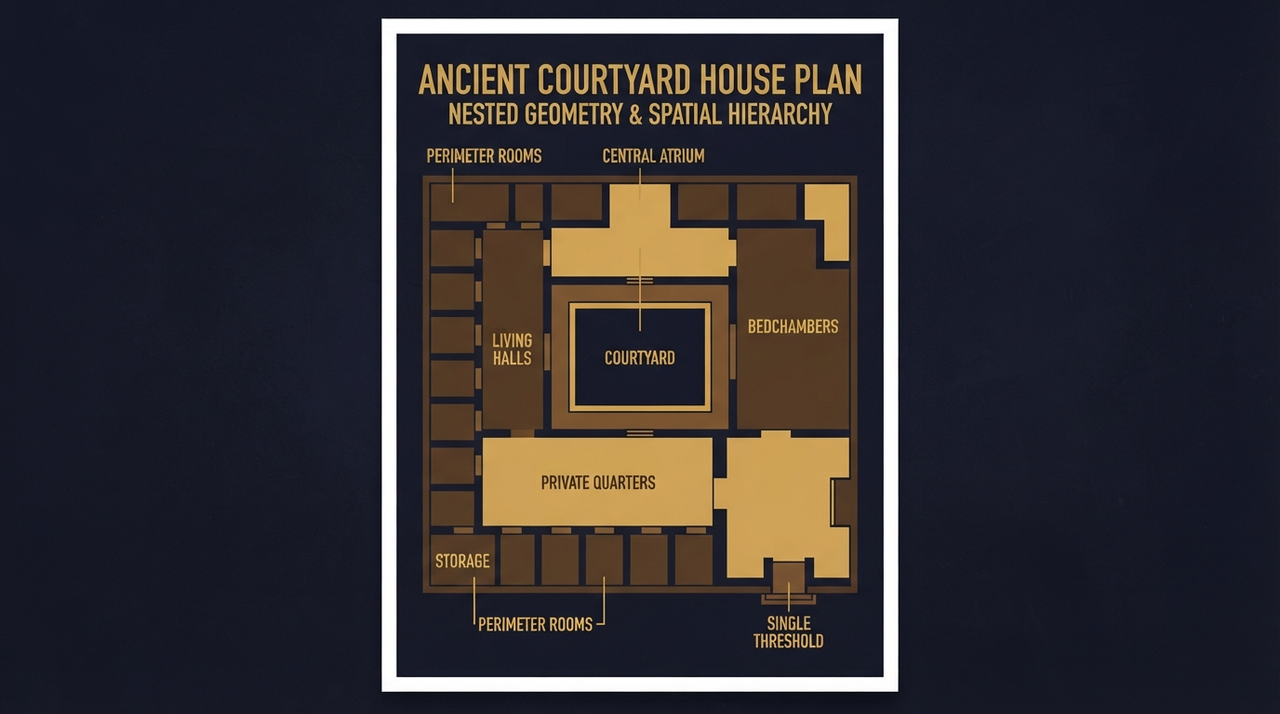
Consider a courtyard house from Old Babylonian Sippar. Its plan shows a walled compound: entry gate, central court, private rooms clustered around. Texts label it a bītum, but inhabitants varied. One might house a widow, her grown sons, their wives, and orphaned nieces. Another sheltered a merchant, his slaves, and transient laborers. The architecture sets boundaries; terms like oikos or bitum fill them with institutional weight.
Methods of Household Archaeology: Reading Houses and Lists
Architecture and Activity Areas
Household archaeology turns to the built environment first. Excavators map courtyard houses, ubiquitous from the Levant to Mesoamerica. In these designs, a walled court serves as the household's heart: open for light, air, and communal tasks, screened from streets. Rooms radiate outward: hearths for cooking, benches for weaving, niches for storage jars. Scholars identify activity areas through micro-remains. Charred grains near a oven signal bread-making. Grinding stones clustered in a corner point to women's work, though gender assumptions demand caution.
At Amarna in Egypt, courtyard houses yield clues to household scale. Larger ones boast multiple mills and ovens, suggesting ten or more people. Smaller plots, with single hearths, imply tighter groups. Storage pits brim with emmer wheat or lentils, marking self-sufficiency or surplus for trade. These patterns reveal production units, not emotional bonds.
Cuneiform Ration Lists and Census Records
Texts sharpen the picture. Mesopotamian ration lists, often from temple or palace archives, enumerate personnel by bitum. A tablet from Puzriš-Dagan lists shepherds, their flocks, and household allotments. Women weavers receive less barley than men, children half again. Census and household lists from Nippur tally able-bodied men for corvée labor, grouping them by house. Roman censuses, like those from Roman Egypt, declare familia under one patriarch: wife, children, slaves, clients.
- Who gets named? Household heads, often men, dominate. Dependents appear as extensions.
- Slaves feature prominently in oikos lists, blurring lines between kin and property.
- Omitted voices abound: infants too young for rations, elderly past productivity, transient visitors.
Later European parish registers track baptisms, marriages, and burials by household, revealing servants outnumbering kin in many homes. Each method carries bias, favoring the visible and taxable.
Oral Traditions and Legal Texts
Law codes and oral memories add layers. Hammurabi's stele assigns liability to the bitum: if a slave flees from it, the house pays. Inheritance clauses in Egyptian wills divide fields among pr members. Oral household memory, preserved in epics like Gilgamesh, recounts multi-generational estates. These sources privilege conflict and transfer over quiet coexistence.
Key Questions: Mapping Household Dynamics
Reconstruction hinges on pointed questions. Who eats from one pot? Ration lists answer: those listed share grain, oil, wool. In a Ur III tablet, a bitum feeds twenty: family, artisans, captives. Shared meals imply coordination, not affection.
Who inherits? Legal texts clarify. Greek wills partition the oikos among sons, daughters marrying out. Mesopotamian adoptions create heirs for childless bītum. Inheritance binds property to people across generations.
Who bears legal liability? The household head answers for debts, crimes within walls. A Roman census holds the paterfamilias accountable. Who may leave? Slaves rarely; kin through marriage or flight. Co-residence does not equal kinship. A workshop slave shares the courtyard house but not the bloodline. Kinship claims no monopoly on co-residence: strangers join for labor or alliance.
These queries ground family history methods in evidence. A courtyard house's doorways control access; a list's rations measure belonging.
Debates in Household Reconstruction
Scholars once projected the nuclear family onto antiquity, echoing mid-twentieth-century ideals. Lewis Henry Morgan's evolutionary schemes cast ancient households as primitive nuclei. Yet evidence resists. Stem families appear in medieval English records: parents, one married heir, siblings departing. Joint households cluster in Indian censuses, multi-generational under one patriarch.
Temple and palace households challenge domestic labels. In Uruk, the Eanna temple's bitum-like units housed thousands: priests, singers, oxen tenders. These were institutions, scaled-up households producing for gods. Household archaeology distinguishes them by size and output: palace storerooms dwarf courtyard houses.
Debate persists on variability. Were oikos units flexible, absorbing widows or orphans? Roman villa lists suggest yes, blending kin and freedmen. Mesopotamian bitum flexed with economy: war swelled slave numbers; peace shrank them.
The Limits of Evidence in Household Archaeology
No method pierces every veil. Archaeology names affection rarely; a toy in a corner hints at play, but not parental joy. Law codes detail coercion: slaves branded, debtors bound to bitum. Daily care hides. Who nursed the fevered child in that Amarna house? Texts ignore it.
Bias compounds. Ration lists favor institutions; private bītum evade records unless litigated. Courtyard houses preserve elites; peasant huts erode. Gaps invite humility. Household archaeology maps structures, not souls.
Cross-Disciplinary Connections
Households link fields. Anthropology probes shared pots worldwide. Archaeology unearths courtyard houses from Teotihuacan to Pompeii. Ancient civilizations reveal oikos in Homer, bitum in Enuma Elish. Business history traces household production: weaving for trade, brewing for sale. Health records who tended the sick: often slaves or kin in the pr. These doors open wider inquiry.
An Invitation to Walk the Evidence
Take that Nippur tablet again. Lu-Inanna's bitum: twenty se of barley for her, ten for the slave, five for the babe. Map it to a courtyard house plan from nearby. Court for communal grinding, back room for the infant's cradle. Ask: Who inherits if Lu-Inanna dies? Law suggests the son. Who leaves? The daughters at marriage. This method equips you.
Bring your question to the Relationships Door. Trace a census line or house outline. Let evidence lead, projections fade. In this cosmic library, households emerge as lived experiments in coexistence, neither utopia nor trap, but human arrangements yielding to time.
We seek not final truths, but clearer questions. The past's houses stand open, waiting.