
Resilience History: Rebuilding After Change Through Ordinary Struggle and Life Transitions
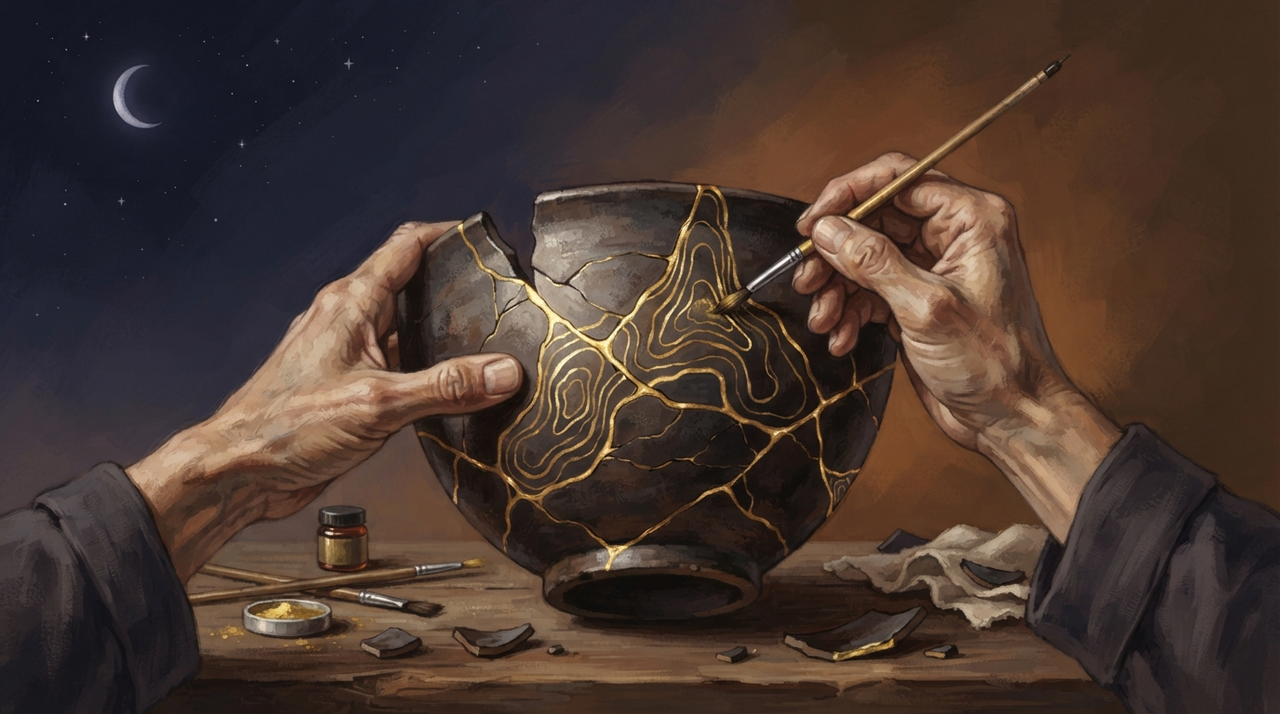
Imagine a potter in 15th-century Japan, piecing together a shattered bowl not to hide the cracks, but to highlight them with lacquer and gold. This is kintsugi, a craft lineage born from necessity in the tea ceremony world of Iga and Mino provinces, where breakage was commonplace amid kilns and daily use. Not a metaphor for personal mending, but a tangible practice reminding us that rebuilding after change often emerges from the hands of communities adapting to what breaks.
Resilience history invites students of existence to trace this not as a solitary heroic trait, but as situated, relational rebuilding amid ordinary struggle and life transitions. Here, in Aetheria's Knowledge Library, we explore personal growth and adversity through lenses of psychology, philosophy, culture, and more—always with curiosity about what endures as our foundation stone.
The Psychological Lens: Coping in the Everyday
Psychological research on coping and adaptation reveals resilience as a process shaped by context, not an innate superpower. Studies from the mid-20th century onward, like those emerging from post-World War II Europe, highlight how ordinary people navigated displacement through social networks and routine adjustments. Think of Londoners during the Blitz, sustaining morale not through exceptional grit, but shared shelters and rationed teas—small acts visible in Mass-Observation archives.
This resilience history underscores uncertainty: access to community resources, period-specific hardships, and personal circumstances all factor in. Adaptation isn't linear; it's punctuated by setbacks, where persistence alone falters without flexibility.
Philosophical Reflections: Fragility and Endurance
Enduring the Break
Philosophers from Stoics like Epictetus in ancient Rome to 20th-century thinkers like Hannah Arendt pondered human fragility amid upheaval. Arendt, writing in the shadow of totalitarianism, saw endurance in the 'banality of action'—everyday persistence in public life despite private fractures. Here, rebuilding after change appears relational, tied to shared spaces where individuals rediscover agency.
Yet philosophy cautions: blind persistence can entrench suffering. Nietzsche's notion of amor fati—loving one's fate—warns against romanticizing struggle, urging discernment between what to repair and what to release.
Cultural Practices: Communal Repair Across Traditions
Cultures offer grounded examples of ordinary struggle met with collective response. In Japanese kintsugi workshops of the Momoyama period, artisans from specific kilns collaborated, turning breakage into heirlooms—a lineage sustained by master-apprentice bonds, not individual genius. Similarly, communal laments in ancient Mesopotamian rituals or West African griot traditions gathered voices to voice loss, weaving grief into communal memory without rushing repair.
- These practices highlight place and community: kintsugi tied to tea masters' aesthetics, laments to seasonal gatherings.
- Cross-door to Anthropology: how tools and rituals encode adaptation.
- Links to History: eras of scarcity birthing such crafts.
Biographical Traces and Spiritual Interpretations
Lives Reassembled
Biographies illuminate life transitions without mythologizing. Consider diarists like Samuel Pepys amid the 1666 Great Fire of London, noting soot-streaked rebuilds alongside plague fears—mundane tallies of bricks and debts. Spiritually, traditions like Sufi poetry from Rumi's 13th-century Persia evoke the heart's quiet mending through devotion, or Christian contemplative orders rebuilding monasteries post-Reformation, stone by stone in rural enclaves.
Explore further in Religion's archives: endurance as relational to the unseen, always provisional.
Counterevidence: When Persistence Falters
Not every fracture calls for repair; some demand letting go.
History shows persistence misguided: Arctic explorers like Franklin's 1845 expedition, where unyielding advance into ice led to tragedy, versus Inuit adaptations favoring retreat. Or factory workers in 19th-century Manchester clinging to trades amid industrialization, delaying necessary pivots. Personal growth and adversity demands seeing when holding on exhausts, urging communal wisdom over solo tenacity.
A Reflective Next Step
As students of existence, mark your foundation stone: after a break—be it relocation, loss, or shift—journal what remains. Not for cure, but clarity. What threads persist through the ordinary? In this resilience history, rebuilding unfolds not in triumph, but in the quiet tracing of continuities amid change.