
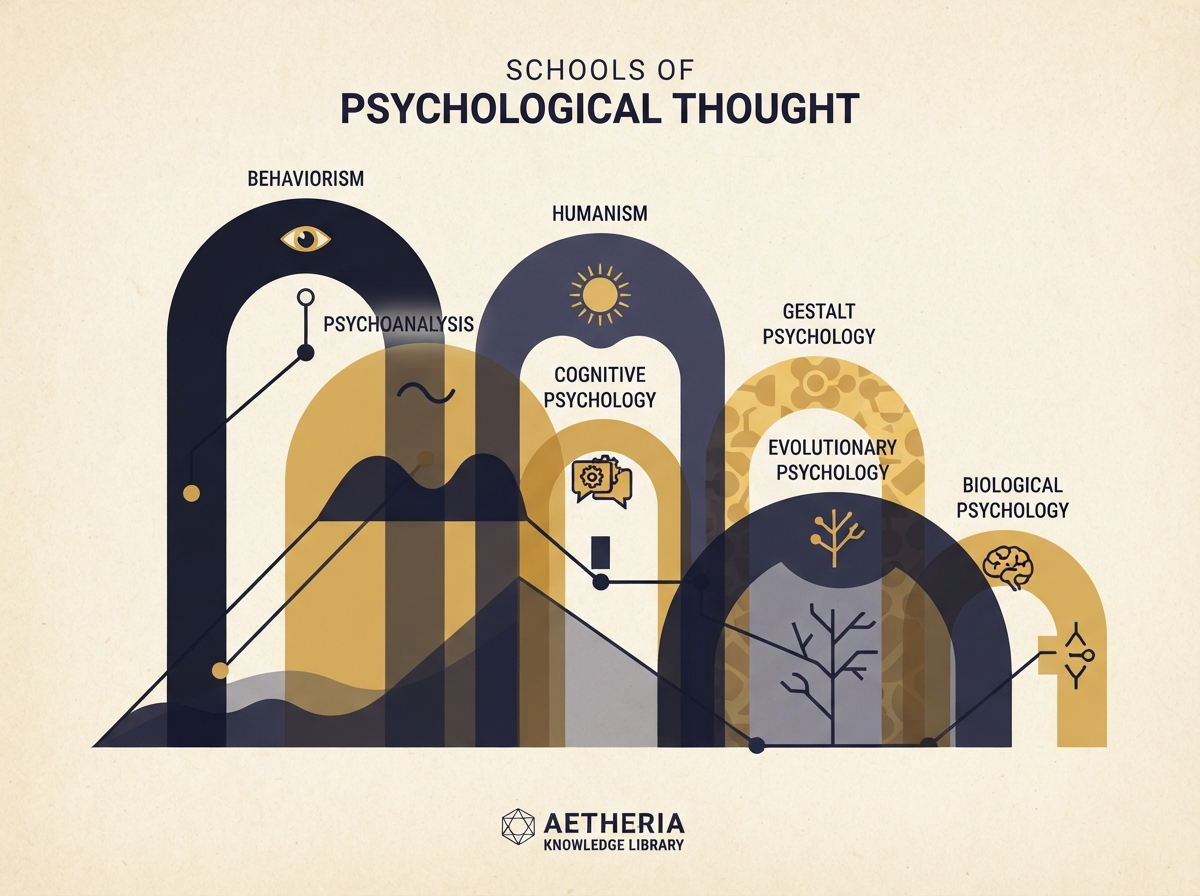
Schools of Psychology Unveiled: From Structuralism and Functionalism to Behaviorism, Psychoanalysis, Humanistic Psychology, and the Cognitive Revolution
Picture a dimly lit laboratory in 1890s Leipzig, where young minds sit rigidly, eyes closed, whispering descriptions of a fleeting sensation—a flash of red, a whiff of lemon, the prick of a pin. This wasn't mysticism; it was the birth of schools of psychology, where pioneers dissected the human mind like cartographers mapping uncharted lands. Psychology isn't a monolith, a single theory etched in stone. It's a vibrant tapestry of competing frames, each era's thinkers posing bold questions about what makes us tick. Structuralism asked, "What are the mind's basic building blocks?" Functionalism countered, "How does the mind adapt to survive?" Later waves—from the shadowy realms of psychoanalysis to the rat mazes of behaviorism, the soaring ideals of humanistic psychology, and the computational spark of the cognitive revolution—shifted the lens again and again.
In this Aetheria Journal exploration, we journey chronologically through these schools of psychology, unpacking their central questions, favored methods, enduring insights, and blind spots. We'll distinguish rock-solid findings from speculative leaps, note historical missteps with nuance, and trace threads to broader inquiries like consciousness, neuroscience, and philosophy. No quick-fix diagnoses or personality quizzes here—just a neutral compass for readers hungry to compare structuralism functionalism, behaviorism psychoanalysis humanistic psychology, and the cognitive revolution. By the end, you'll see why psychology thrives on tension, inviting you to pit two schools head-to-head in your own reflections.
Structuralism: Breaking the Mind into Atoms
Edward Titchener, a British psychologist who transplanted Wilhelm Wundt's ideas from Germany to Cornell University, launched structuralism around 1890. Imagine volunteers in his lab, trained to report raw sensations without interpretation—like chemists isolating elements. This school zeroed in on one piercing question: What are the elementary components of conscious experience?
Core Question and Methods
Structuralism treated the mind as a structure built from sensations, images, and affections (emotions). Its gold-standard method? Introspection—systematic self-observation under controlled conditions. Subjects described mental "atoms": a color's hue, a sound's pitch, a feeling's intensity. Titchener cataloged over 44,000 such elements, aiming for a periodic table of the psyche.
Established findings include early validation of sensory thresholds and attention's limits, paving neuroscience's path. But much was theory: the atomistic model assumed consciousness could be fully decomposed, a speculation untestable beyond reports.
What It Left Out and Historical Echoes
Individual differences? Ignored. Unconscious processes? Nonexistent. Practical applications? Scarce. Critics slammed introspection's subjectivity—how do you verify someone else's inner report? By the 1920s, structuralism faded, but it spotlighted consciousness as subjective experience, linking to philosophical debates on qualia (those ineffable "what it's like" feelings).
No grand harms here, just academic rigor yielding to evolution. Yet it underscored psychology's institutional roots in labs, far from clinics.
Functionalism: The Mind in Motion
Across the Atlantic, William James—Harvard's philosopher-poet—ignited functionalism in his 1890 tome Principles of Psychology. John Dewey and James Rowland Angell amplified it, asking: How does the mind function to help us adapt to our environment? No static dissection; this was Darwinian psychology, viewing consciousness as a stream flowing toward survival.
Core Question and Methods
Functionalism favored observation of habits, instincts, and problem-solving. James evoked the mind as a "blooming, buzzing confusion" tamed by selective attention. Dewey tested ideas in labs, like his famous frog reflex experiments, probing utility over structure. Methods blended introspection with animal studies and education experiments—pragmatic tools for real-world flow.
Solid contributions: Pioneering educational psychology (Dewey's progressive schools) and habit formation insights, now neuroscience staples via neuroplasticity. Speculation crept in with overbroad "stream of consciousness," hard to quantify.
What It Left Out and Cross-Door Ties
Deep structure? Dismissed as irrelevant. It overlooked pathology, focusing on the healthy adapter. Historically, it fueled American optimism but clashed with Europe's introspection cult, birthing psychology's East-West divide.
Links abound: To philosophy's pragmatism (mind-body as functional unity) and consciousness studies (James's radical empiricism prefiguring phenomenology). In neuroscience, it anticipates brain function mapping.
Psychoanalysis: Diving into the Unconscious
Sigmund Freud, Viennese neurologist turned mind explorer, unveiled psychoanalysis around 1900 amid scandalous case histories. Picture Anna O. on the couch, her "talking cure" birthing a revolution. Contested from the start—disciples like Jung splintered off—the school grappled with: What hidden forces from childhood and the unconscious drive behavior?
Core Question and Methods
Freud mapped id (instincts), ego (reality), superego (morals), with slips, dreams, and free association as windows to repression. Methods: Clinical case studies, like Dora's hysteria unpacked as disguised wishes. Findings stand: Defense mechanisms (denial, projection) validated in modern therapy; unconscious biases echo in cognitive neuroscience.
Theory dominated—penis envy, Oedipus complex—speculative constructs fueling cultural firestorms. Reception swung from adulation (1920s salons) to ridicule (pop-Freud cartoons).
Blind Spots, Harms, and Philosophy Links
Overemphasis on sex and pathology sidelined positives; gender biases (women as "mutilated males") drew feminist ire, contextualized by Victorian norms but harmful in clinics. Empirical tests lagged until later.
It revolutionized consciousness views—unconscious as dynamic force—and philosophy's mind-body dualism, influencing existentialism. Ties to neuroscience emerge in Freud's early neuron sketches.
Behaviorism: The Black Box Era
John B. Watson's 1913 manifesto rang like a manifesto: Psychology as the prediction and control of behavior, sans mentalistic fluff. B.F. Skinner refined it with operant conditioning. Question: How do stimuli and responses shape observable actions?
Core Question and Methods
Banishing introspection, behaviorism used mazes, pigeons in Skinner boxes, Little Albert's fear conditioning. Classical (Pavlov/Watson) and operant (Skinner) paradigms yielded gold: Reinforcement schedules underpin habit apps today; extinction cures phobias.
Established: Learning universals across species. Speculation: Mind as empty slate, denying innateness (debunked by Chomsky).
Overreach and Institutional Shadows
Left out: Thoughts, feelings—hence the "black box." Harms contextualized: Watson's child-rearing advice (minimize cuddles) echoed eugenics-era control zeal; Skinner's Walden Two utopias flirted with dystopia. Yet it professionalized applied psych, from ads to therapy.
Philosophy link: Strict materialism. Neuroscience absorbs its conditioning via dopamine pathways.
Humanistic Psychology: Reaching for Self-Actualization
Post-WWII, amid behaviorism's chill, Carl Rogers and Abraham Maslow launched the "third force." Rogers's client-centered therapy, Maslow's hierarchy of needs—question: What unleashes human potential beyond pathology or stimuli?
Core Question and Methods
Favored empathy, unconditional positive regard, peak experiences. Rogers recorded sessions for congruence analysis; Maslow studied exemplars like Einstein. Findings: Therapeutic alliance predicts outcomes (meta-analyses confirm); self-actualization motivates.
Speculative: Universal hierarchy overlooks cultures. Left out: Biological drives, measurable rigor.
Cultural Bloom and Consciousness Ties
No major harms—more 1960s counterculture balm—but vagueness limited science. Excels in subjective consciousness, echoing philosophy's phenomenology (Husserl). Influences positive psych, neuroscience's well-being circuits.
The Cognitive Revolution: Minds as Information Processors
By the 1960s, Noam Chomsky's language critiques and computer metaphors toppled behaviorism. Ulric Neisser coined "cognitive psychology" in 1967. Question: How do mental processes—memory, perception, decision-making—handle information?
Core Question and Methods
Experiments galore: Reaction times, memory spans (Miller's 7±2), AI-inspired models. Findings: Schemas, heuristics—bedrock for cognitive behavioral therapy. Speculation toned down by data.
Synthesis and Lingering Gaps
Overlooked emotions initially (fixed by affective science). No harms, but reductionism irks humanists. Bridges neuroscience (fMRI maps cognition), philosophy (computational mind-body), consciousness (global workspace theory).
Weaving the Tapestry: Lessons from the Schools
These schools of psychology—structuralism functionalism, behaviorism psychoanalysis humanistic psychology cognitive revolution—aren't relics; they pulse in today's integrations. Eclectic therapies blend Freudian insight with Skinnerian techniques; AI at Aetheria draws cognitive models to simulate minds. Harms teach caution: Overreach invites backlash, biases demand scrutiny.
Cross-doors illuminate: Consciousness blooms in humanistic subjectivity, neuroscience grounds behaviorism and cognition, philosophy arbitrates mind-body across all.
"The mind is not a vessel to be filled, but a fire to be kindled." Echoes of these schools remind us: Psychology evolves by questioning its frames.
Your next step? Grab two—say, behaviorism's precision versus humanistic warmth—and read them side-by-side. What emerges? A fuller portrait of the human enigma, ever unfolding.