
Spirituality vs Religion: Scholarly Definitions, Categories, and What Really Counts
Imagine standing at the edge of an ancient forest, where the trees whisper secrets older than stone. One path leads to towering cathedrals and scripted rituals; another meanders through personal revelations and quiet meditations. This fork mirrors the timeless tension between religion and spirituality. But what do scholars really mean when they draw these lines? In a world hungry for meaning, understanding the spirituality definition and religion vs spirituality debate isn't just academic—it's a map for the soul's journey.
This exploration draws from scholarly traditions, sifting through definitions shaped by anthropologists, theologians, and philosophers. We'll navigate scholarly categories, probe lived religion, and ask: What truly counts as spiritual? With humility about the limits of any single lens, let's venture in.
Defining Religion: Institutions, Communities, and Rituals
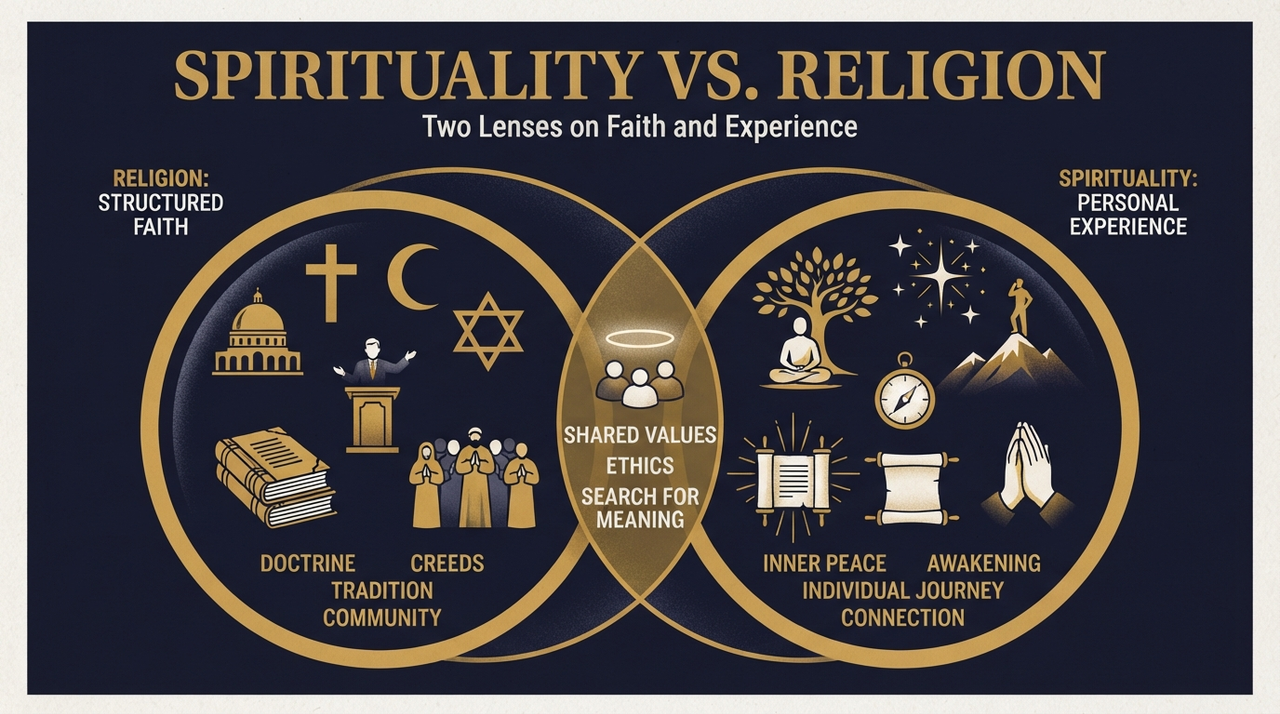
Scholars like Émile Durkheim viewed religion as a collective phenomenon—a set of beliefs and practices linking individuals to the sacred through shared symbols. Think organized doctrines, clergy-led services, sacred texts like the Bible or Quran, and communal rites from baptism to Hajj. Religion thrives in historical communities, evidenced by artifacts, temples, and enduring traditions.
Yet definitions vary. Clifford Geertz emphasized religion's role in crafting worldviews that make existence meaningful. It's not just rules; it's a cultural system fostering belonging. Evidence mounts from archaeology—Stonehenge's solstice gatherings to medieval monasteries—proving religion's deep roots in human society.
The Role of Historical and Scholarly Interpretation
Interpretations evolve. Modern scholars distinguish "official" religion from folk practices, acknowledging how reception shifts across eras. What counted as heresy in one century becomes canon in another, reminding us definitions aren't fixed.
The Spirituality Definition: Personal Quest for the Transcendent
Spirituality, by contrast, often defies institutional bounds. William James, in his classic Varieties of Religious Experience, described it as individual encounters with the divine—ineffable moments of unity or awe. It's the lone hiker sensing cosmos in a sunset, or the meditator dissolving into breath.
Contemporary definitions, like those from psychologist Kenneth Pargament, frame spirituality as a search for the sacred, encompassing ultimate concerns beyond the mundane. Unlike religion's structures, spirituality flexes across traditions, from Sufi whirling to Zen silence.
Mysticism and Esotericism: Spirituality's Deeper Currents
- Mysticism: Direct, unmediated union with the divine, as in Teresa of Ávila's ecstatic visions or Rumi's poetry. Scholars categorize it by types—nature, theistic, monistic—based on experiential reports.
- Esotericism: Hidden knowledge paths like Hermeticism or Kabbalah, emphasizing initiation and symbolism over public doctrine.
These overlap with religion but prioritize interiority, with evidence in personal journals and oral traditions rather than grand edifices.
Religion vs Spirituality: Nuanced Comparisons
The religion vs spirituality divide isn't absolute. Many are "spiritual but not religious," per Pew surveys, blending personal practice with loose affiliations. Yet religion often births spirituality—think monastic mystics within Christianity.
Scholarly caution flags universals: Asian traditions like Daoism blur lines, where ritual and insight intertwine. Uncertainties abound—primary sources from antiquity are fragmentary, and Western biases shape categories. Modern usage amplifies spirituality as individualistic, a reception shift post-1960s counterculture.
As historian Leigh Schmidt notes, spirituality emerged as religion's "other," claiming purer authenticity amid institutional distrust.
Scholarly Categories and Lived Religion: Bridging Theory and Practice
Scholarly categories include lived religion, Robert Orsi's term for everyday enactments—grandma's rosary prayers or a yoga class invoking chakras. It values practitioner perspectives over elite doctrines, evidenced in ethnographies of pilgrimage or grief rituals.
What Really Counts? Evidence, History, and Reception
Counts what endures scrutiny: archaeological traces, textual corpora, communal continuity. Spirituality leans on subjective testimony, trickier to verify. Connections ripple to ethics—spiritual insights inform moral compasses—and religion's structured ethics door.
- Historical community: Sustained groups practicing over generations.
- Scholarly interpretation: Consensus across disciplines.
- Modern use: Adaptive relevance today.
Navigating the Doors: From Spirituality to Broader Horizons
This spirituality door opens to religion's communal embrace and ethics' practical wisdom. No tradition flattened here—Buddhist sanghas, Indigenous ceremonies each shine uniquely. Sources limit us; more voices await discovery.
What path calls you? Dive deeper with Aetheria AI's explorations—step through the Religion Door for rituals' power or Ethics Door for lived virtue. Your journey beckons; what sacred whisper will you heed next?