
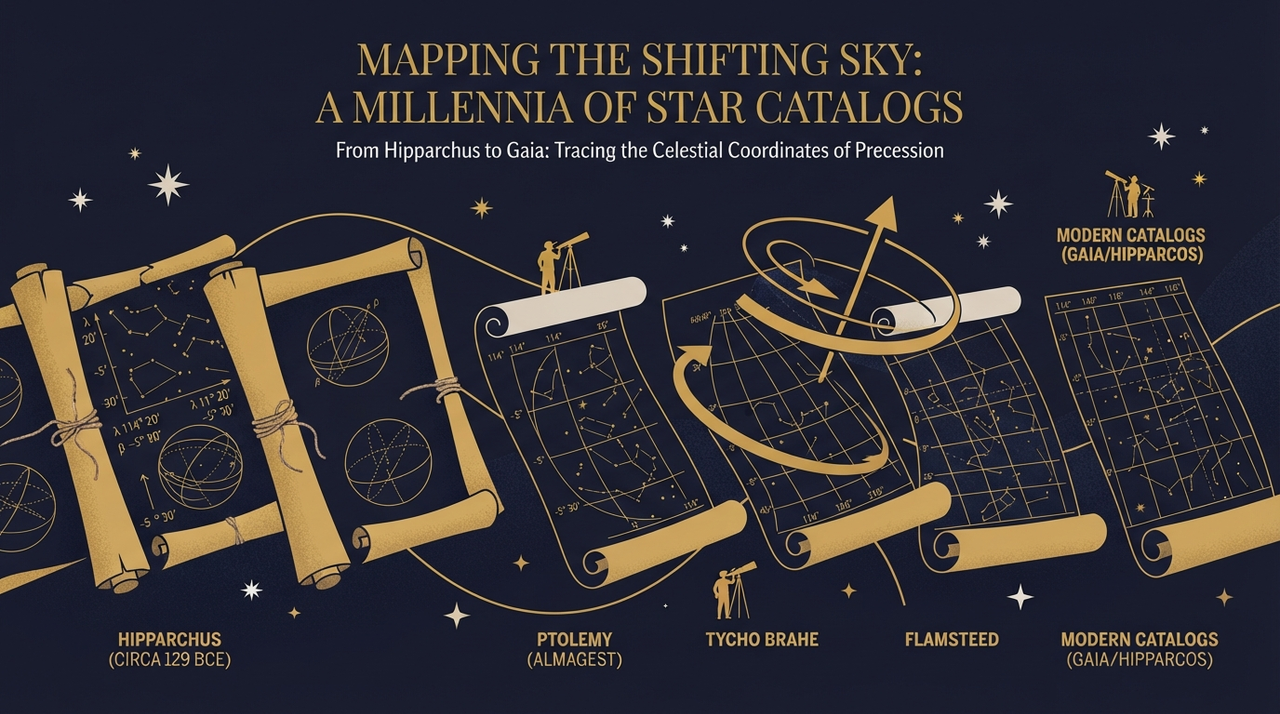
Star Catalogs & Precession: Hipparchus' Discovery, Ptolemy's Almagest, and Islamic Astronomy's Legacy
Imagine standing on a Rhodian hillside in 134 BCE, eyes fixed on the night sky as a brilliant star drifts inexplicably from its familiar throne among the constellations. This was Hipparchus, the Greek astronomer whose gaze pierced the veil of cosmic constancy, uncovering precession—the slow wobble of Earth's axis that reshapes the heavens over centuries. His revelation, preserved in fragile star catalogs, ignited a chain of celestial scholarship echoing through Ptolemy's Almagest, the meticulous zij of Islamic astronomy, and even distant Chinese records. For students of astronomy history and ancient texts, these documents are not mere relics but living portals to humanity's quest to map the stars.
This exploration delves into Hipparchus' groundbreaking work, Ptolemy's synthesis in the Almagest, and the golden age of Islamic astronomy, while grappling with the gritty realities of manuscript transmission. We'll distinguish raw textual content from later scholarly overlays, noting scribal quirks and source constraints, all while linking to broader themes like the Writing Memory Door—how ink on parchment eternalizes sky knowledge—and the Language Door, where translations bridge eras and empires.
Hipparchus' Star Catalog and the Dawn of Precession
Hipparchus of Nicaea didn't just observe; he compared. Around 150–127 BCE, he compiled the first comprehensive star catalog, listing roughly 850 stars with unprecedented precision in longitude, latitude, and magnitude. But his true genius shone in detecting precession. By cross-referencing his positions with older Babylonian eclipse records and earlier Greek observations—like those attributed to Timocharis and Aristillus from a century prior—he noticed a systematic drift.
Spica, for instance, had shifted westward by about 36 arcminutes since Timocharis' time. Hipparchus calculated the precession rate at 1° per 100 years, a value remarkably close to modern 50.3 arcseconds annually. None of his original catalog survives intact; fragments persist in Ptolemy's Almagest and later commentaries. Here lies the first lesson in ancient texts: what we read are echoes, filtered through copyists' hands, demanding we parse manuscript variants from interpretive glosses.
Ptolemy's Almagest: A Celestial Symphony
The Star Catalog That Defined Eras
Claudius Ptolemy's Almagest, composed around 150 CE in Alexandria, stands as the cornerstone of pre-modern astronomy. Books VII and VIII house his famed star catalog of 1,022 entries, blending Hipparchian data with his own tweaks. Stars gleam with coordinates tied to the ecliptic, magnitudes from 1 to 6, and constellations illustrated in vivid detail—though Ptolemy admitted some positions were interpolated from fewer naked-eye fixes.
Precession features prominently in Book VII: Ptolemy refines Hipparchus' model, quantifying the axial nutation's impact on equinoxes. Yet, the Almagest's manuscripts—Greek originals from the 9th century, Arabic translations galore—reveal scribal practices like latitude-longitude swaps or rounding errors, common in monastic scriptoria. Distinguishing Ptolemy's words from medieval emendations requires collating codices like the Vienna Marcianus Graecus.
Islamic Astronomy's Zij: Precision Perfected
From Baghdad to Samarkand
The Abbasid era transformed star catalogs through zij—astronomical handbooks blending Indian, Persian, Greek, and original observations. Al-Khwarizmi's Zij al-Sindhind (c. 825 CE) introduced Hindu sine tables alongside Ptolemaic stars, while Al-Battani's Zij (c. 900 CE) corrected precession to 54 arcseconds per year using meticulous timings.
Ulugh Beg's 15th-century Zij-i Sultani, from his Samarkand observatory, cataloged 1,019 stars with sub-arcminute accuracy, outshining Ptolemy. These Islamic astronomy treasures, penned in Arabic script on fine paper, preserved Hipparchus and Ptolemy while advancing them. Manuscript transmission here shines: zij circulated via scholarly networks, with colophons dating copies precisely, though later Ottoman recensions added tables without note.
Global Echoes: Chinese Records and Manuscript Realities
Across the Silk Road, Chinese astronomers chronicled precession in star atlases like the Dunhuang manuscript (c. 700 CE), mapping 1,565 stars, and later imperial catalogs under the Tang and Song dynasties. These texts, on silk or bamboo, noted equinox shifts independently, converging with Hipparchus' insights.
Yet source limits persist: dating relies on internal astronomical events, scribal errors like transposed characters abound, and interpretations vary—was precession explicit or inferred? This ties to the Writing Memory Door, where durable scripts lock sky patterns against time's erosion, and the Language Door, as Syriac intermediaries ferried Greek to Arabic, then Latin, evolving meanings subtly.
Legacy in the Margins: Manuscripts as Living Sky Knowledge
Today's understanding hinges on digitized manuscripts—Vatican Arabic 1058 for the Almagest, Istanbul Topkapi for Ulugh Beg's zij—but beware conflating content with commentary. Hipparchus' raw data lurks in Ptolemy's tables, unadorned by modern bias. These texts affirm sky knowledge as vibrant, transmitted faithfully despite gaps, inviting us to retrace ancient eyes upward.
As you ponder the next alignment, remember: star catalogs and precession aren't extinct lore but enduring threads, woven through Hipparchus, Ptolemy, and Islamic savants, urging us to write our own cosmic memory.