
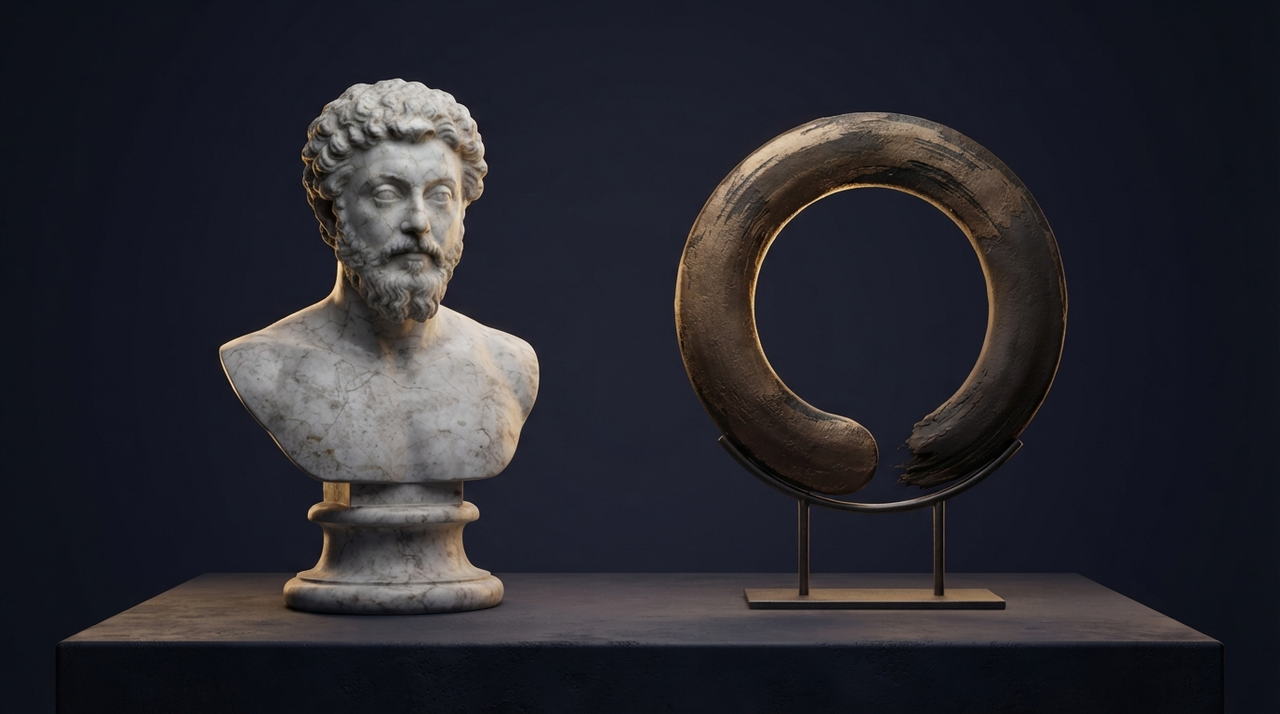
Stoicism vs Buddhism: Marcus Aurelius & Nagarjuna on Suffering, Sunyata, and Indifferents
Imagine a Roman emperor, cloaked in the chill of a frontier tent, scribbling reflections by lamplight amid barbarian wars and plague. Now picture a South Indian monk, centuries earlier, dissecting the fabric of reality in verse, challenging kings and scholars alike. Marcus Aurelius and Nagarjuna, worlds apart in time and tongue, both stared into the maw of suffering—that uninvited guest shadowing every human breath. In this comparative philosophy deep-dive, we pit Stoicism vs Buddhism, not to crown a victor, but to honor two rigorous paths. Students of existence, as we are, let's unpack their responses without the lazy syncretism that dilutes both. We'll draw from the Stoa’s foundational pillars—Zeno’s physics, Epictetus’s Enchiridion, Marcus’s Meditations—against Buddhism’s Four Noble Truths and Nagarjuna’s Mulamadhyamakakarika. Protect the journey: these are distinct communities, wielding different languages for separate soteriologies.
The Universal Sting of Suffering: A Shared Starting Point
Suffering doesn’t discriminate. In the Stoic worldview, it crashes as externals beyond our grasp: illness, loss, the whims of fortune. Marcus, journaling during the Antonine Plague that claimed millions, saw it as inevitable, yet conquerable through inner citadel. Buddhism names it dukkha—the First Noble Truth—not mere pain, but the pervasive friction of impermanent existence, from birth’s cry to death’s silence.
Here’s the fork: Stoics diagnose suffering as a mismatch between impressions and assent. We assent wrongly to externals as goods, birthing distress. Buddhists trace it to craving (tanha), clinging to a self that’s illusory. Neither promises escape from pain’s raw bite—Marcus endured gout and grief; the Buddha, back pains under the Bodhi tree—but both offer tools to transmute it. This Stoicism vs Buddhism tension sets the stage: one fortifies the mind, the other dissolves the illusion fueling the fire.
Historical Echoes: From Stoa Porch to Deer Park
Zeno of Citium founded Stoicism around 300 BCE on Athens’ Painted Stoa, blending Cynic grit with Socratic logic and Heraclitean flux. Cleanthes hymned Zeus as logos governing all; Epictetus, a lame ex-slave, distilled it into the Enchiridion’s dichotomy of control. Marcus embodied it as philosopher-king, 161-180 CE.
Buddhism arose earlier, Siddhartha Gautama teaching the Four Noble Truths circa 500 BCE at Sarnath’s Deer Park—a sacred place still drawing pilgrims. Nagarjuna, 2nd century CE, revived Madhyamaka amid Abhidharma debates, his Mulamadhyamakakarika (Fundamental Verses on the Middle Way) wielding reductio ad absurdum against essentialism.
Marcus Aurelius and the Stoic Arsenal Against Suffering
Marcus didn’t theorize in ivory towers; his Meditations are raw memo to self, forged in campaigns from Danube winters to Parthian sands. Suffering? “The impediment to action advances action. What stands in the way becomes the way,” he writes—a mantra born of emperors facing betrayal and mortality.
Key Stoic Concepts: Assent, Indifferents, and Oikeiosis
Scholarship anchors Stoic physics in assent (sunkatathesis): impressions (phantasia) arise; we judge them. Wrong judgment—deeming externals vital—breeds vice. Established texts like Epictetus’s Enchiridion clarify: “Men are disturbed not by things, but by the views they take of them.” Practice meant daily scrutiny: Marcus reminds himself, “If you are distressed by anything external, the pain is not due to the thing itself, but to your estimate of it.”
- Preferred Indifferents: Health, wealth—valuable but not goods. True good is virtue alone (arete). Oikeiosis, the “appropriation” process, starts with self-love, expanding to family, cosmos. We pursue indifferents wisely, detached from outcome.
- Dichotomy of Control: Epictetus divides: body, reputation (not ours); will, choice (ours). Suffering shrinks to moral failure.
Caution: We distinguish theory from lived practice. Stoic texts prescribe, but how Marcus felt loss—his children’s deaths—is speculation. No diaries gush emotion; he models dispassion. This physics isn’t metaphysics for salvation but hygiene for eudaimonia here-and-now.
In the Stoic forge, suffering tempers the soul, indifferents mere shadows on the cave wall of virtue.
Nagarjuna and the Buddhist Blade of Emptiness Sunyata
Nagarjuna, the “second Buddha,” didn’t soothe; he deconstructed. His Mulamadhyamakakarika—27 chapters of dialectical poetry—targets suffering’s root: reification. From royal court to monastic debate halls, he argued all phenomena lack svabhava (inherent nature), hence emptiness sunyata.
Sunyata as Dependent Origination, Not Nihilism
Scholarly consensus: Sunyata means pratityasamutpada—dependent arising. Things exist conventionally (carriage from wheels, etc.) but empty of independence. Popular misreading as nihilism? Nagarjuna refutes: “We do not deny causality... but assert dependent origination.” Suffering arises from grasping at self (anatman), impermanent (anicca) aggregates.
Four Noble Truths frame it: Dukkha (suffering), samudaya (craving), nirodha (cessation via insight), marga (Eightfold Path). Nagarjuna radicalizes: No inherent sufferer, suffered, path. Liberation pierces delusion, not fortifies ego.
- Madhyamaka Dialectic: Tetralemma—neither A, nor not-A, nor both, nor neither—dissolves extremes.
- Two Truths: Conventional (karuna ethics) and ultimate (sunyata wisdom).
Practice? Vipassana unpacks aggregates; Nagarjuna’s heirs meditated in places like Nalanda, echoing the Great Journey Door of training toward liberation.
Emptiness sunyata isn’t void, but freedom: suffering’s chains, forged in false essence, shatter under scrutiny.
Stoicism vs Buddhism: Head-to-Head on Suffering, Indifferents, and Sunyata
No collapsing these giants. Stoics build: Suffering tests virtue amid logos-ordered cosmos. Buddhists dismantle: Suffering fabricates via ignorance of sunyata.
Indifferents vs Emptiness: Preferences or Projections?
Stoic indifferents are real—health preferable, pursued via oikeiosis. Yet neutral to happiness. Marcus: Live according to nature, selecting indifferents without attachment. Sunyata? All, including “indifferents,” empty. No inherent preference; craving them perpetuates samsara. Nagarjuna might query: What’s the svabhava of a “preferred” health? Dependent on conditions, thus empty.
Practice diverges: Stoic prohairesis (moral choice) affirms agency within fate. Buddhist sila-samadhi-prajna yields no-self insight, agency illusory.
Responses to Suffering: Fortification or Dissolution?
- Stoic: Assent correctly. Marcus amid death: “Death smiles at us all; all we can do is smile back.” Cosmos rational; align.
- Buddhist: See dukkha’s emptiness. Nagarjuna: Causation empty, yet conventional path ends craving.
Comparative philosophy reveals: Stoics assume persistent self navigating indifferents; Madhyamaka empties self, world. Soteriologies? Stoic sage flourishes in life’s arena; arhat transcends cyclic woe.
Death & afterlife? Stoics: Soul disperses in ekpyrosis fire, virtue eternal. Buddhists: Rebirth till nirvana’s peace—see our Death & Afterlife Door.
Respecting the Divide: Distinct Languages, Communities, Paths
Stoics spoke Greek/Latin physics to Hellenistic elites, Rome’s legions. Buddhists Sanskrit/Pali dialectics for sangha wanderers. No fusion: Zeno’s pantheism clashes Nagarjuna’s non-substantialism. Seeker's Code demands this rigor—oversimplification betrays both.
Yet curiosity bridges: Both demand unflinching gaze at suffering. Marcus’s tent-meditations parallel Nagarjuna’s verse-logic. Humane lesson? Plural paths for students of existence.
Your Reflective Next Step: Journaling the Tension
Protect the journey: Don’t mash Stoicism and Buddhism into smoothie self-help. Instead, journal: “Today’s suffering—what Stoic assent reframes it? What sunyata dissolves?” Hold Marcus’s fortitude beside Nagarjuna’s void. In this Stoicism vs Buddhism mirror, glimpse your own. What remains? A seeker’s quiet fire.