
Substantivist vs Formalist Debate: Markets, Prices, and Polanyi's Ancient Economy Unveiled
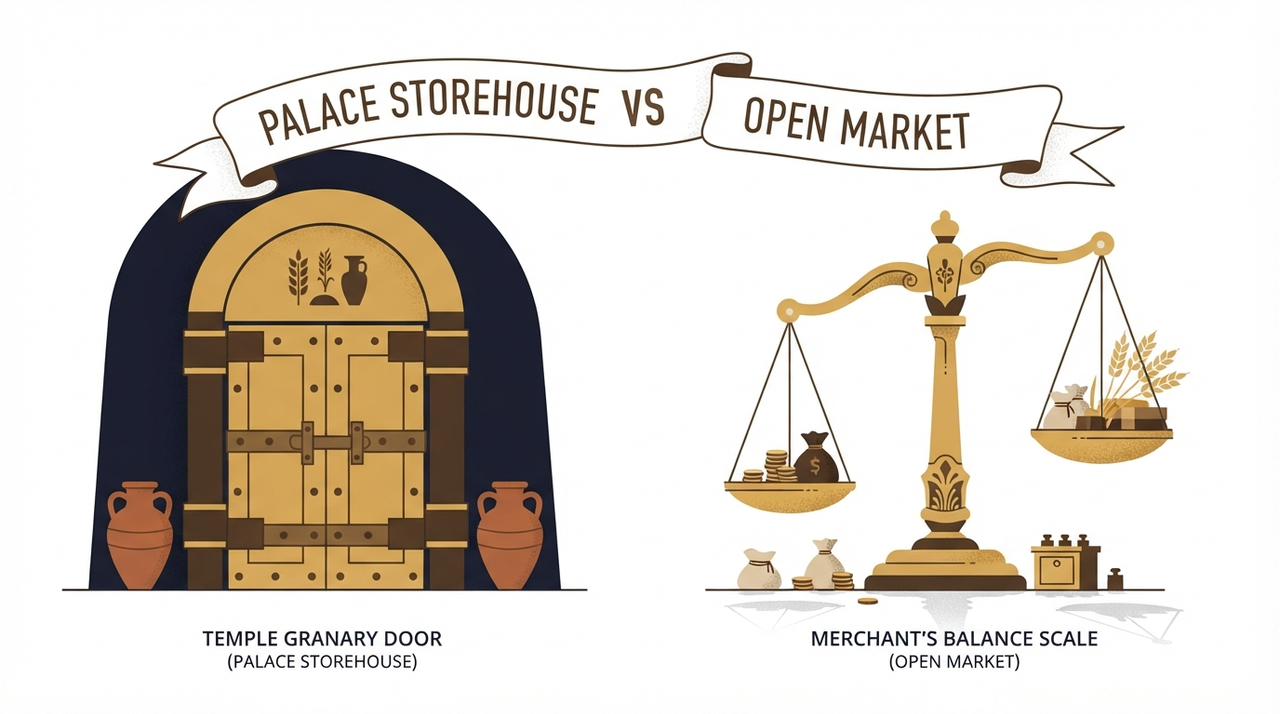
Imagine the sun-baked streets of ancient Kanesh, a bustling Anatolian hub around 1900 BCE. At one end of the city, heavy wooden doors guard the temple granary, where priests tally barley allotments under the watchful eye of the gods. No haggling echoes here. Rations flow by decree, measured in sila against labor owed or divine favor granted. A few blocks away, a merchant balances his scale, tin ingots glinting against copper scraps. He eyes a caravan trader from Assur, whispering terms for the next wool shipment. Profit whispers in the air, or so it seems.
These scenes, drawn from cuneiform tablets unearthed in the 20th century, capture the heart of the substantivist formalist debate. Were those scales tilting toward timeless market forces, or did they merely mimic choice within rigid social bonds? Readers weary of slogans like "markets are eternal" or "palaces ruled all" deserve more: a careful sifting of institutions, where temple storehouses and trader stalls stand side by side, unmerged, revealing what each illuminates and obscures.
The Scholarly Tools: Substantivism and Formalism Emerge
This clash arose not in antiquity, but amid mid-20th-century anthropology and economic history. Karl Polanyi, in his landmark 1957 work Trade and Market in the Early Empires, championed substantivism. He argued that in premodern societies, land, labor, and money operated as "embedded" elements within social institutions. Exchange rarely followed the impersonal logic of supply and demand. Instead, it served reciprocity, redistribution, or outright administration. Polanyi's Polanyi ancient economy framework painted markets as rare, latecomers, absent from most ancient worlds.
Formalists fired back, insisting that human nature drives maximization everywhere. Drawing from neoclassical economics, they saw prices, scarcity, and individual calculation at work in ancient texts. Why deny merchants the same profit-chasing instincts as today? The substantivist formalist debate thus became a battle over universals: Were markets a thin veneer over administered trade, or did price signals pulse through even palace-dominated economies?
Neither side claimed to channel ancient voices. These were lenses, forged in the West after two world wars, to probe the history of markets. Substantivists stressed context; formalists, continuity. Both reshaped how we read fragile clay tablets.
Probing the Evidence: Temples, Tablets, and Trading Posts
Old Assyrian Trade: Scales in the Shadow of Institutions
Kanish tablets, numbering over 23,000, offer the first test case. Assyrian merchants shipped tin and textiles from Mesopotamia, returning with Anatolian silver and wool. Formalists highlight fluctuating prices: tin might fetch 10 shekels one month, 12 the next, responding to caravan arrivals. Contracts specify penalties for late delivery, evoking market discipline. One trader laments high wool costs, bargaining down from 4 to 3.5 shekels per mina. Profit margins appear calculable, with agents advancing loans at 20-30% interest.
Substantivists counter: These were family firms, backed by Assur's city assembly. Risks pooled through partnerships, not solo ventures. Prices quoted? Often fixed by tradition or palace edict, with trade administered via quotas. The temple granary loomed large; gods owned much land, doling out seed and rations. Merchants navigated embedded hierarchies, not free markets.
Babylonian Prices and Palace Rations: Fixed or Fluid?
Shift to Hammurabi's Babylon, circa 1750 BCE. Law codes list barley at 1 shekel per 180 liters, silver at fixed ratios to grain. Formalists see price lists as evidence of responsive markets: drought spikes sesame oil to 1 shekel per sila, while barley dips post-harvest. Private sales of houses and fields show bargaining, with witnesses sealing deals.
Yet palace archives reveal administered trade. Rulers set grain prices via royal decree, buying low and selling high to stabilize society. Workers received barley rations: 1 sila daily for laborers, 2 for overseers. No auctions here; the state as granary monopolist. Substantivists note how temple estates absorbed surpluses, redistributing via festivals. Prices existed, but as anchors in a web of obligations, not signals for profit.
The Greek Agora: Civic Space or Market Square?
Fast-forward to classical Athens. The agora buzzed with pottery stalls and fishmongers. Aristophanes jokes about overpriced radishes; Xenophon praises retail as honorable. Formalists tally: Solon's coinage reforms eased exchange, and grain imports fluctuated with Black Sea yields, pushing prices up 50% in shortages.
Substantivists demur. The agora was civic heart, not commodified zone. Weights and measures were public, standardized by the polis. Grain trade? Often state-regulated, with laws capping profits at 1/30th during famines. Land stayed inalienable for citizens; labor bound by slavery or xenia hospitality. Polanyi called it a "port of trade," buffered from full market logic.
Song Dynasty Echoes: A Later Lens
China's Song era (960-1279 CE) offers a counterpoint, with vibrant markets in Hangzhou. Paper money circulated; guilds set standards. Formalists revel in price indices from tax records, tracking rice from 100 cash per shi in boom years to 300 in scarcity. Yet substantivists point to state granaries stabilizing prices, and Confucian ethics embedding trade in social harmony. Not ancient Near East, but a reminder: even advanced systems blend frames.
Strengths, Overreaches, and Hidden Patterns
The substantivist formalist debate shines light on real tensions. Substantivism excels at exposing administration's grip. Palace ledgers show ration systems feeding thousands: Egyptian peret harvests funneled to pharaohs, Mycenaean Linear B tablets assigning oxen by palace need. It reveals administered trade as backbone, where merchants served elites, not vice versa. Overreach? Dismissing all price variation as illusion ignores merchant agency. Assyrian letters brim with risk hedging, akin to modern futures.
Formalism uncovers individual calculus amid structures. Babylonian loan defaults suggest self-interest; Greek shipowners speculated on voyages. It rightly challenges anachronism: why assume ancients lacked maximization? Pitfall: selection bias. Surviving texts favor elites and traders; peasant barters or communal feasts vanish. Independent convergence explains similarities, transmission (via trade routes) others. No single frame captures all.
- Substantivism makes visible: Institutional embedding, social protections.
- Formalism reveals: Price responsiveness, entrepreneurial sparks.
- Both hide: Daily micro-exchanges, cultural nuances.
Cross-Doors: Echoes in Economics, Anthropology, Ethics, and History
Economics: Beyond Supply Curves
Neoclassical models assume disembedded markets; Polanyi's critique warns of backlash, as in today's gig economy debates. Ancient rationing prefigures universal basic income trials.
Anthropology: Diverse Exchange Forms
From Trobriand kula rings to Inca mit'a labor tax, substantivism maps reciprocity. Formalists add: Even gifts carry calculated prestige.
Ethics: Human Flourishing in Trade
Aristotle prized oikonomia (household management) over chrematistike (profit chase). The debate asks: Does market logic enrich or erode community?
History: Rethinking Origins
No pristine capitalism, but proto-markets evolved fitfully. The history of markets gains nuance, rejecting binaries.
Standing at the Stall and the Storehouse
Return to Kanesh. Stand by the merchant's scale: Feel the pull of scarcity, the thrill of a deal struck. Then pivot to the temple granary door: Hear the measured pour of grain, securing life beyond whim. Sources invite both. In Aetheria's Business Door, merge neither. Carry these dual visions to Community: What institutions blend administration and agency today? The debate endures, a seeker’s prompt to probe deeper.
In the clay of antiquity, markets and palaces coexist, neither sovereign. Our task: See clearly, choose wisely.