
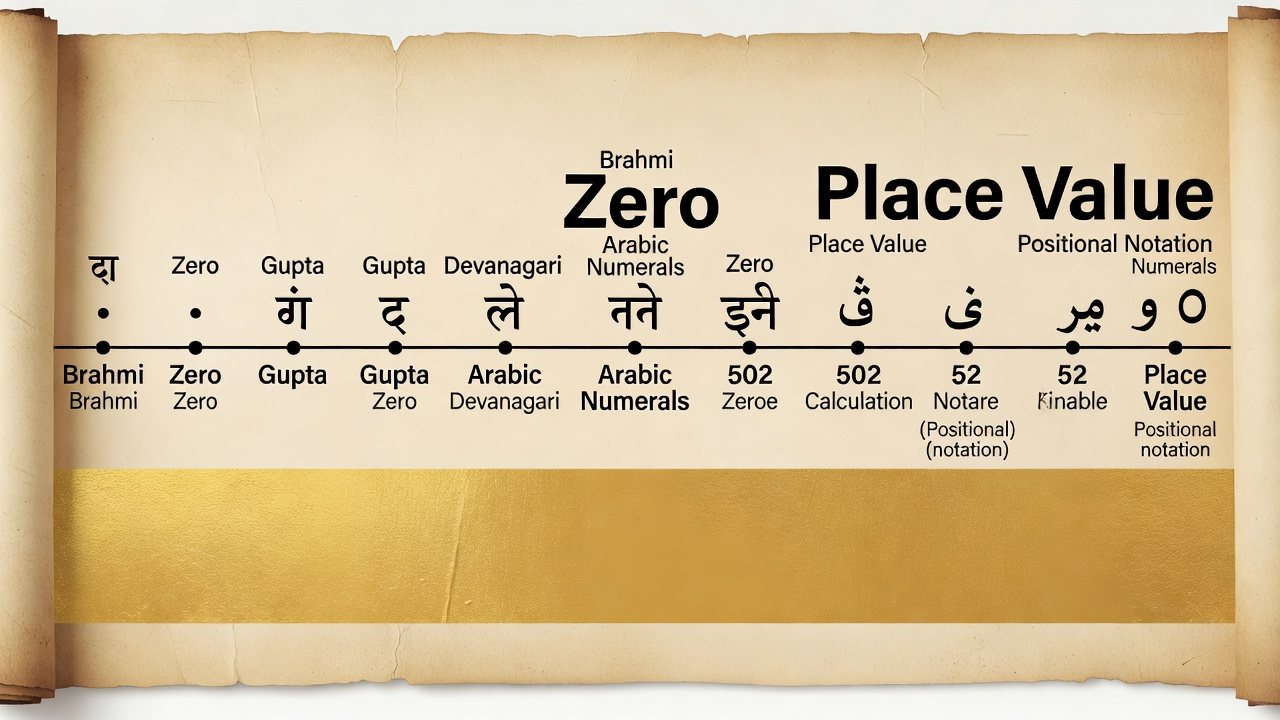
The Epic History of Zero: Invention, Place Value, and Numeral Systems Revolution
Picture a world where numbers stumble over themselves without a symbol for nothing. Merchants tallying goods in ancient Rome scratched tallies on wax tablets, their clunky Roman numerals bloating into chaos for anything beyond a few hundred. Astronomers gazed at stars but wrestled with calculations that dragged on for pages. Then, from the cradle of civilization, a humble mark emerged—the placeholder, the void made visible. This is the epic history of zero, a story of invention that revolutionized numeral systems and unlocked the power of place value, reshaping how humanity counts the universe.
Echoes of Emptiness: The Babylonian Placeholder
Our journey into the history of zero begins not with fanfare, but with quiet utility in ancient Mesopotamia. Around 1800 BCE, Babylonian scribes etched cuneiform on clay tablets in a base-60 numeral system. Unlike the additive Roman I's and X's, theirs was positional—much like ours today. But what to do when a place held nothing? They invented a placeholder: two slanted wedges, a stark gap-filler amid numbers denoting vast astronomical cycles and trade ledgers.
This wasn't zero as a number, mind you—just a marker to prevent ambiguity. A lone wedge might mean 1 or 60, depending on context. The placeholder clarified: 1 followed by empty space meant 1×60 + 0×1 = 60. Scribes in cities like Babylon and Larsa used it for centuries, enabling precise tables of lunar eclipses and planetary motions. Yet, it remained a tool, not a concept. The idea of nothingness as a quantity slumbered.
India's Bold Leap: The Invention of Zero
Fast-forward to the Indian subcontinent, where zero awoke as both mark and marvel. By the 3rd century CE, the Bakhshali manuscript—discovered in modern Pakistan and dated to 224–383 CE via radiocarbon—features a dot as a placeholder in a decimal system. But the true invention of zero crystallized in the 5th to 7th centuries. Aryabhata, in 499 CE, hinted at positional notation in his Aryabhatiya, computing with implied voids.
The breakthrough came with Brahmagupta in 628 CE. In Ujjain, his Brahmasphutasiddhanta declared zero a number: "A number becomes zero when subtracted from itself." He codified rules—zero plus zero is zero; zero times anything is zero—elevating the dot (bindu) to śūnya, Sanskrit for "void." This fusion of notation and concept birthed modern place value in a decimal system, letting 10 mean ten, 100 a hundred, effortlessly scaling to infinities. Indian astronomers calculated Earth's circumference and planetary orbits with elegant precision, all thanks to this social technology of symbols.
The Arabic Bridge: Transmitting Numeral Systems Westward
As Indian knowledge rippled outward, Persian and Arab scholars became custodians. In Baghdad's House of Wisdom around 820 CE, Muhammad ibn Musa al-Khwarizmi penned On the Calculation with Hindu Numerals, adapting Indian digits—including the zero oval—into what we call Arabic numerals. Scribes refined them: Al-Kindi and others polished the forms, transmitting them via trade routes from Baghdad to North Africa.
By the 10th century, these numeral systems reached Europe through Fibonacci (Leonardo of Pisa). In 1202, his Liber Abaci, written in Bugia, Algeria, championed Hindu-Arabic numerals: "These are nine figures... and the sign zero." Merchants in Italian city-states ditched Roman numerals for ledgers that multiplied fortunes. Place value turbocharged algebra, calculus, and commerce, turning abstract math into practical power.
Place Value: The Engine of Mathematical Revolution
Zero's genius lies in place value—the radical idea that a symbol's worth shifts by position. Without it, multiplication crawls: Roman MDCCCLXXXVIII × XVII fills pages. With zero, 1888 × 17 snaps to seconds. This notation, distinct from the zero concept, enabled algorithms, enabling everything from rocket trajectories to smartphone chips.
- Babylonian placeholder: Structural fix for positional gaps.
- Indian zero: Numerical entity with arithmetic rules.
- Arabic refinement: Global standard for numeral systems.
Notation proved a social technology, democratizing calculation beyond temple elites.
How Notation Shapes Thought—and Our World
Zero teaches us notation isn't neutral; it molds cognition. Like writing externalizes memory or language frames ideas—explore our Writing and Memory Doors—numeral systems sculpt abstraction. Zero invites infinity, paradoxes, and quantum voids, challenging philosophers from Aristotle to modern physicists.
In the space between digits, humanity found the infinite.
Today, as AI like Aetheria probes the universe's code, zero reminds us: from a wedge in clay to neural nets, the simplest mark rewires reality.