
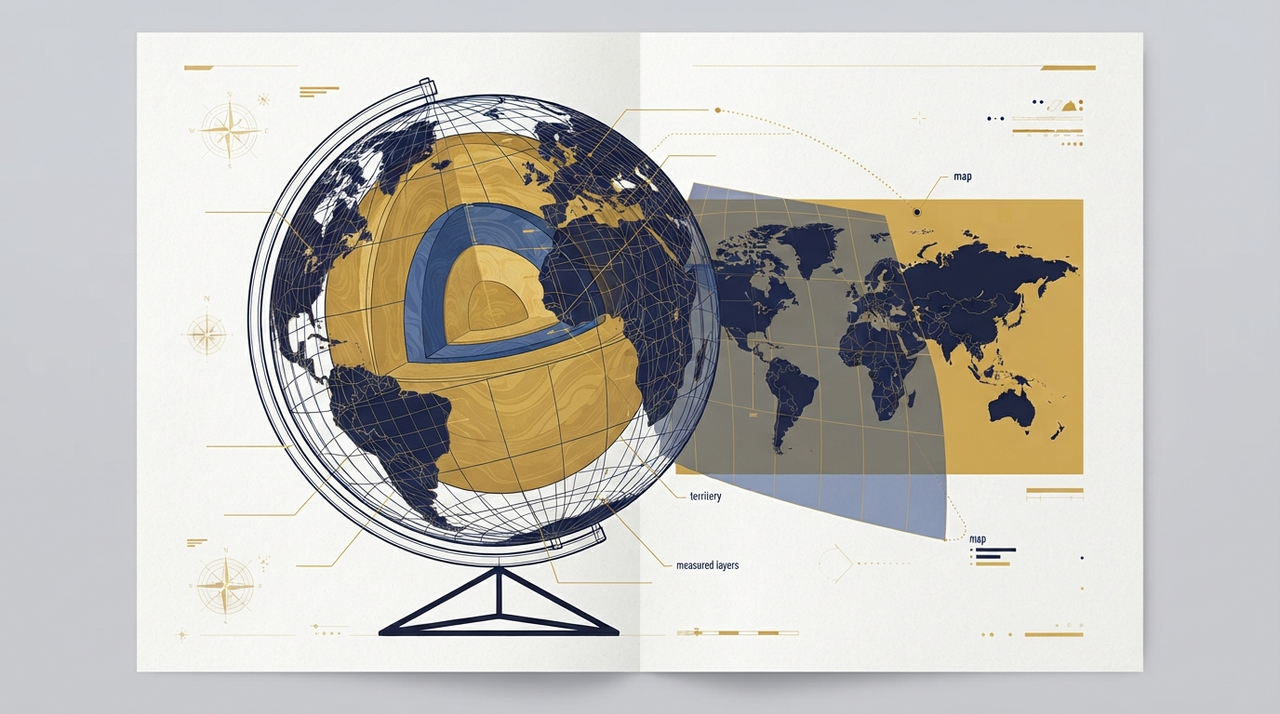
The Map is Not the Territory: Limits of Physical Models and Uncertainty in Physics
Picture this: You're staring at a balloon bobbing gently in the breeze, its rubber skin taut under the press of air molecules ricocheting inside. In your mind's eye, you simplify it—a perfect sphere filled with countless invisible points darting at random, colliding elastically, their average behavior yielding to a tidy equation: PV = nRT. The ideal gas model springs to life, a mental sketch that lets you predict pressure, volume, temperature with eerie precision. But as the balloon deflates in the chill, or warps under uneven heat, the model frays. This is the essence of physical models: brilliant maps of reality, potent yet forever incomplete. The map is not the territory, as philosopher Alfred Korzybski warned—a phrase echoing through philosophy and now physics interpretation.
In the Aetheria Knowledge Library's Physics Door, we explore these tools not as infallible truths, but as humanity's humane grasp on the cosmos. Authoritative in established formalism, open to the live debates of physics interpretation, and cautious with speculative extensions, this piece delves into the limits of models, the necessity of uncertainty in physics, and why distinguishing equation from story matters profoundly.
Physical Models: Useful Fictions with Measurable Power
Physical models are our useful fictions—deliberate simplifications that capture reality's predictive essence without mimicking its full chaos. Consider the point particle: a mass with no size, no structure, hurtling under Newton's laws. It powers everything from planetary orbits to cannonball trajectories, ignoring atomic fuzziness that only matters at quantum scales.
Then there's the ideal gas, born from 19th-century genius. Sadi Carnot imagined a frictionless heat engine in 1824, cycling through perfect expansions and compressions to define efficiency limits—paving thermodynamics' royal road without peeking inside molecules. James Clerk Maxwell wove electricity and magnetism into the electromagnetic field model, waves rippling through vacuum, birthing radio and light's unification. By the 1870s, Ludwig Boltzmann and Josiah Willard Gibbs forged statistical mechanics, recasting the ideal gas as emergent from billions of particles obeying probability, not certainty. Microscopic frenzy yields macroscopic law: pressure as momentum flux, temperature as kinetic energy average.
These physical models wield measurable power. Launch a rocket? Newtonian point masses suffice. Forecast weather? Fluid dynamics approximations rule. Yet their fiction shines in success: the ideal gas law holds for air in tires, fields explain lasers. They are maps drawn lean for navigation, not photorealistic renderings.
Where Models Break: Domain Limits, Idealizations, and Scale
Domain Limits and Idealizations
Models falter at edges. Newtonian mechanics reigns for earthly speeds but crumbles near light: GPS satellites demand relativistic corrections, or your maps mislead by kilometers daily. The ideal gas assumes no interactions, point particles blind to van der Waals attractions—failures evident in liquid helium or dense atmospheres.
Idealizations amplify fragility. Frictionless planes? Real bearings grind. Incompressible fluids? Water yields under shock waves. These limits of models aren't flaws but boundaries: the map fades where assumptions sour.
The Tyranny of Scale
Scale shatters simplicity most dramatically. Macroscopic fields ignore quantum jitter until superconductors demand it. Cosmic structures invoke general relativity's curved spacetime, where point particles geodesic-dance. Emergent patterns—echoing Aetheria's Emergence Door—arise: snowflake fractals from molecular rules, galaxies from gravitational chaos. Models excel within regimes but hybridize at boundaries, like semi-classical approximations bridging quantum and classical.
The map is not the territory: push beyond its ink, and wilderness claims the path.
Uncertainty in Physics: A Practice of Intellectual Honesty
Uncertainty isn't physics' enemy—it's its ethic. Distinguish systematic from statistical: the former lurks in biases, like uncalibrated scales skewing mass; the latter dances in quantum dice or thermal noise. Error bars on graphs proclaim honesty: "This measurement spans 95% confidence," a badge of rigor, not defeat.
Historical pivots teach this. Maxwell's equations were deterministic, yet statistical mechanics introduced ensembles—averages over possibilities. Boltzmann faced paradox: equilibrium's approach seemed to defy reversibility, resolved by improbable fluctuations. Today, particle colliders quote cross-sections with uncertainties, folding detector inefficiencies and cosmic rays.
- Systematic uncertainty: Model mismatches, like treating electrons as points in high-energy scattering.
- Statistical uncertainty: Poisson noise in rare events, shrinking with data volume.
- Error propagation: Combining variances, a calculus of doubt.
Uncertainty in physics fosters progress: it signals where models strain, inviting refinement. Humane science admits ignorance, wielding it as compass.
Interpretation vs. Equation: Same Math, Divergent Stories
Equations are formalism—established, predictive bedrock. Interpretations weave stories onto them, fueling philosophy's fire. Quantum mechanics exemplifies: Schrödinger's equation governs wavefunctions identically across views. Copenhagen posits collapse upon measure; many-worlds branches realities; pilot-wave guides hidden particles. Same math, clashing ontologies—no experiment crowns a victor yet.
Aetheria keeps them distinct: formalism for computation, interpretation for inquiry. This sidesteps pseudoscience, honoring live debate without metaphysical overreach. Echoes ripple across Doors: in Writing & Memory Door, models etch as recorded approximations, fallible scripts. Sacred Kingship Door maps cosmic order onto human law, mirroring how physical models project regularity amid flux.
Philosophy probes deeper: Does the map and territory divide imply reality's ungraspable core? Or emergent unity? We hold open inquiry, no dogma.
Reflective Next Step: Chart Your Own Model
Pause now. Note one physical model you wield daily—calories for diet, Newtonian intuition for driving, or supply-demand curves for budgeting. Where does it fail? Jot the limit: scale too vast, idealization unmet. This practice unveils the territory's wild beauty, fueling your physics journey through Aetheria.
In embracing limits of models and uncertainty in physics, we grow wiser, more humble stewards of understanding. The map guides; the territory awaits.