The Physics Door: Foundations of Natural Philosophy, Cosmology, and Eternal Laws
Imagine a shepherd on a Mesopotamian hillside, 4,000 years ago, his eyes fixed on the wheeling stars. The night sky unfolds like a vast scroll, predictable yet mysterious—Orion's belt rising each winter, the moon's phases waxing and waning with unerring rhythm. No telescopes, no equations scribbled in the sand. Just raw wonder, the first stirrings of measurement: counting nights until the solstice, marking shadows with a stick. This is where physics begins—not in sterile labs, but in humanity's gaze upon the eternal dance of the cosmos.
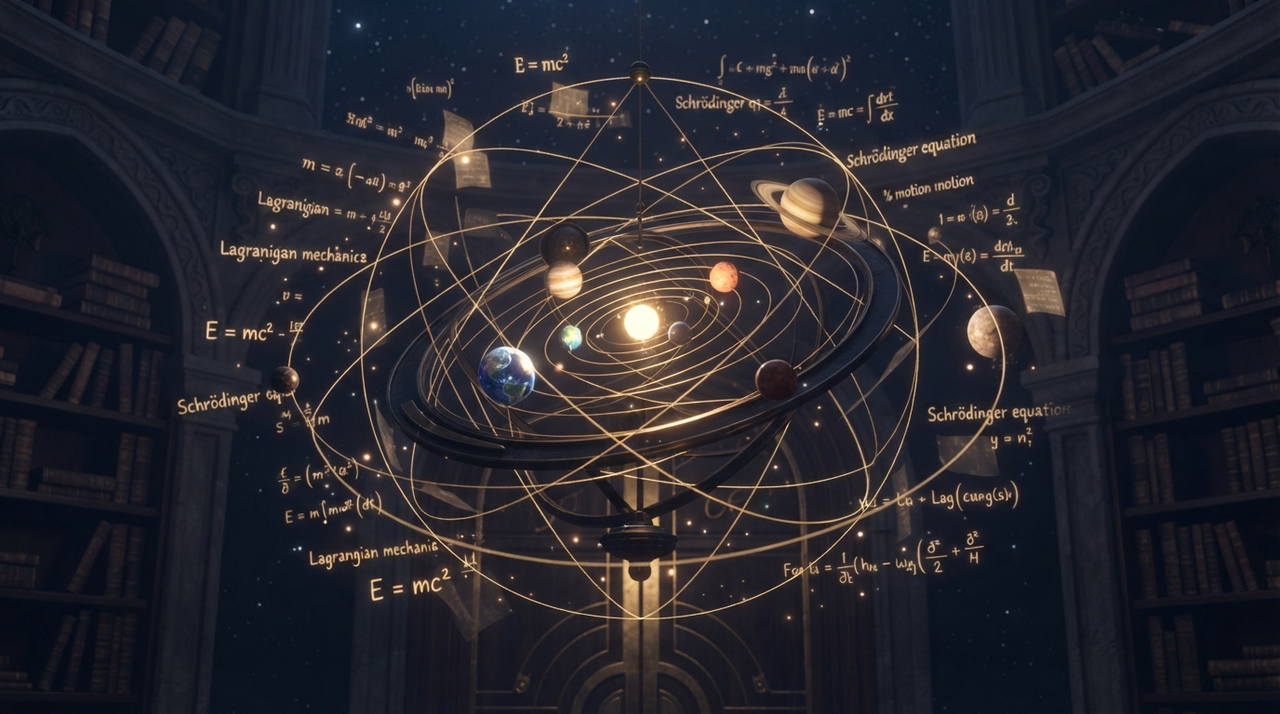
In the Aetheria cosmic library, the Physics Door swings open to this ancient inquiry. Here, natural philosophy meets the hard edge of observation, probing the foundations of what endures amid ceaseless change. It's the realm of laws of nature, those steadfast relations that govern falling apples and orbiting planets alike. For seekers—those intellectually curious souls drawn to the underlying order—this door offers a cornerstone: not final answers, but the tools to measure reality's pulse.
Step through, and you'll find cosmology's grand sweep intertwined with everyday motion. Physics isn't abstract dogma; it's human hands timing pendulums, eyes charting eclipses. From these foundations, we glimpse eternal laws, yet always with humility—measurements are firm, interpretations provisional. Welcome to the Physics Door, where wonder sharpens into precision.
What This Door Actually Holds
At its core, the Physics Door cradles timeless questions: What persists through chaos? What changes, and why? What does a 'law of nature' truly mean? Physics seeks patterns in the measurable—the reliable relations between forces, masses, energies. A law, like gravity's inverse-square pull, isn't a moral decree but a predictive shorthand: drop a stone, and it accelerates at 9.8 m/s² near Earth's surface, every time, under the same conditions.
Methods define the work: observation first, then measurement. Ancient sundials gave way to Galileo's inclined planes; today, particle accelerators smash protons at near-light speeds. Modeling follows—equations like F=ma capture motion's essence. Testing refines: predict, experiment, adjust. Crucially, distinguish the bedrock from the scaffold. Established measurements endure: the speed of light at 299,792 km/s in vacuum, Planck's constant at 6.626 × 10⁻³⁴ J·s. These are etched in reality, replicated across labs worldwide.
Interpretive frameworks, however, shift. Newtonian mechanics models macroscopic worlds brilliantly but falters at quantum scales or cosmic velocities. Relativity reframes space and time as curved by mass; quantum mechanics reveals probability waves where particles once stood firm. These aren't 'truths' overthrowing physics but lenses sharpening our view. Cosmology, too, rests here: Big Bang models extrapolate from cosmic microwave background radiation—a measured 2.7 K echo—yet debate rages on dark energy's nature. The Door holds facts first, theories as maps.
A Brief Lineage
Physics emerges from natural philosophy's cradle in antiquity. Egyptian priests tracked Nile floods with nilometers, measuring seasonal rhythms tied to Sirius's heliacal rising. Mesopotamian clay tablets preserve eclipse predictions, lunar cycles etched in cuneiform—raw data, not myth. Greek thinkers formalized: Thales predicted a solar eclipse in 585 BCE; Archimedes calculated spheres' volumes; Aristotle cataloged motion, though his teleology muddied cause with purpose.
Islamic observatories in 9th-13th century Baghdad and Samarkand advanced this: Al-Battani refined solar year measurements to within minutes; Ibn al-Haytham's optics dissected light rays experimentally, laying groundwork for lenses. Renaissance ignited empiricism—Galileo rolled balls down ramps, disproving uniform fall; Kepler sifted Tycho Brahe's naked-eye Mars observations into elliptical orbits.
Newton's 1687 Principia unified: three laws of motion, universal gravitation from apple and comet alike. Records preserve his calculus derivations, not legends. The 19th century wired the world—Faraday's induction coils birthed electromagnetism; Joule quantified heat-work equivalence. Then revolutions: Einstein's 1905-1915 relativity measured time dilation in muon decays; Planck's 1900 quantum hypothesis fit blackbody radiation curves. Heisenberg's uncertainty, Schrödinger's wave equation followed, predicting spectra with eerie precision. Primary ledgers—Michelson-Morley interferometry null results, Hubble's redshift plots—anchor these, not later embellishments. No mysticism; just measurements marching forward.
How Seekers Work Here
Seekers tread carefully: prioritize primary sources. Newton's Principia demands patience—its geometric proofs reveal fluxions' birth. Watch units: a velocity of 9.8 m/s² vanishes in feet-per-second frames without conversion. Frames matter too—Galilean relativity shrugs at constant motion, but special relativity contracts lengths at 0.99c.
Probe claims: Does it predict? Newton's laws hurl satellites accurately; quantum field theory nails electron magnetic moments to 12 decimals. Explanatory power? Weaker—gravity 'just is,' dark matter inferred from galactic rotations, not directly seen. Common pitfalls abound: quantum 'observer effects' misinterpreted as consciousness magic (it's measurement disturbance); relativity twisted to solipsism (clocks genuinely slow in motion). Entropy isn't 'disorder' but multiplicity; no violation in life's order. Journal assumptions: Is this scale-appropriate? Macro physics ignores quantum jitter; vice versa risks nonsense.
- Cross-check predictions against data: Does general relativity's perihelion precession match Mercury's orbit? (It does, to arcseconds.)
- Question analogies: 'Energy conservation' holds in closed systems, not pop 'vibes.'
- Favor replication: Heroic solo claims fade; consensus builds on shared measurements.
Humility rules: Physics maps the measurable, silent on the untestable.
Connections Across the Foundations
No Door stands alone in Aetheria. Physics dialogues with Philosophy's metaphysical roots: causality assumes repeatable effects; realism posits observer-independent laws. Natural philosophy queries 'why these laws?'—fine-tuning sparks teleology debates, though measurements like the cosmological constant's tiny value (Λ ≈ 10⁻¹²⁰) invite interpretation sans proof.
Science emerges from physics' method: hypothesize, test, falsify—Galileo's torch passed to Pasteur's labs. Mathematics speaks physics fluently: differential equations model waves; group theory symmetries underpin particles. Yet math's abstractions (imaginary numbers in quantum mechanics) demand physical anchoring—does the wavefunction collapse, or merely decohere?
The four Foundations converse: Philosophy questions physics' ontology; physics furnishes science's data; science iterates models mathematically. Cosmology bridges—Big Bang's horizon problem yields to inflationary math, philosophically pondering multiverses. Together, they weave inquiry's tapestry, each testing the others' weave.
Where to Begin Your Inquiry
- Naked-eye sky records: Babylonian Venus tablets (MUL.APIN compilations) log 21-year cycles—verify against Stellarium software. Measure your solstice shadow like Anaximander.
- Classical texts on motion: Galileo's Two New Sciences (1638)—replicate his ramp experiments with marbles, timing free-falls. Newton's Optics queries light's nature sans prisms.
- Modern accessible experiments: Build an Atwood machine from pulleys and weights; chart acceleration vs. mass ratio. Pendulums reveal g's constancy; apps like Phyphox turn phones into spectrometers.
- Comparative creation accounts' cosmologies: Juxtapose Genesis's firmament with Enuma Elish's watery abyss and steady-state vs. Big Bang models—note shared expansion motifs against measured redshifts.
Start small: one measurement, one question. Precision begets wonder.
The universe is under no obligation to make sense to you—but it does reward the measurer.
Enter the Physics Door in our Aetheria community: share a measurement that shifted your gaze, debate a law's reach. Journal marker: What quantity—speed, force, wavelength—revealed order today? Seeker's Code reminds: neutrality guards the journey; let data whisper, not shout.
The stars still wheel. Measure on.