
The Political Power of Ancient Standards: Mesopotamian Weights, Egyptian Cubits, and Qin Dynasty Unification
Why Standards Were Never Just Technical
Picture a bustling marketplace in ancient Babylon, circa 1800 BCE. A merchant hefts a clay lump etched with cuneiform— a shekel weight—against a sack of barley. This isn't mere convenience; it's a quiet assertion of power. Who controls the weight dictates the trade, the taxes, the empire's reach. The history of standards reveals that measurement systems were profoundly political tools, weaving together artifacts like weights and rods, practices such as stamping seals, and vast institutional infrastructures from palace archives to market inspectors.
Far from neutral progress, standardization embodied policy arguments about ownership, labor, and access. It enforced hierarchies, rewarded compliance, and punished deviation. In the interoperability ancient world, these systems bridged—or broke—empires, echoing today's debates on technical standards. This exploration uncovers the standardization and power dynamics in Mesopotamia, Egypt, and Qin China, distinguishing clay tokens from royal decrees while questioning their ethical legacies.
Mesopotamian Weights and Measures: Marketplace Convergence
The Old Babylonian Mina and Shekel System
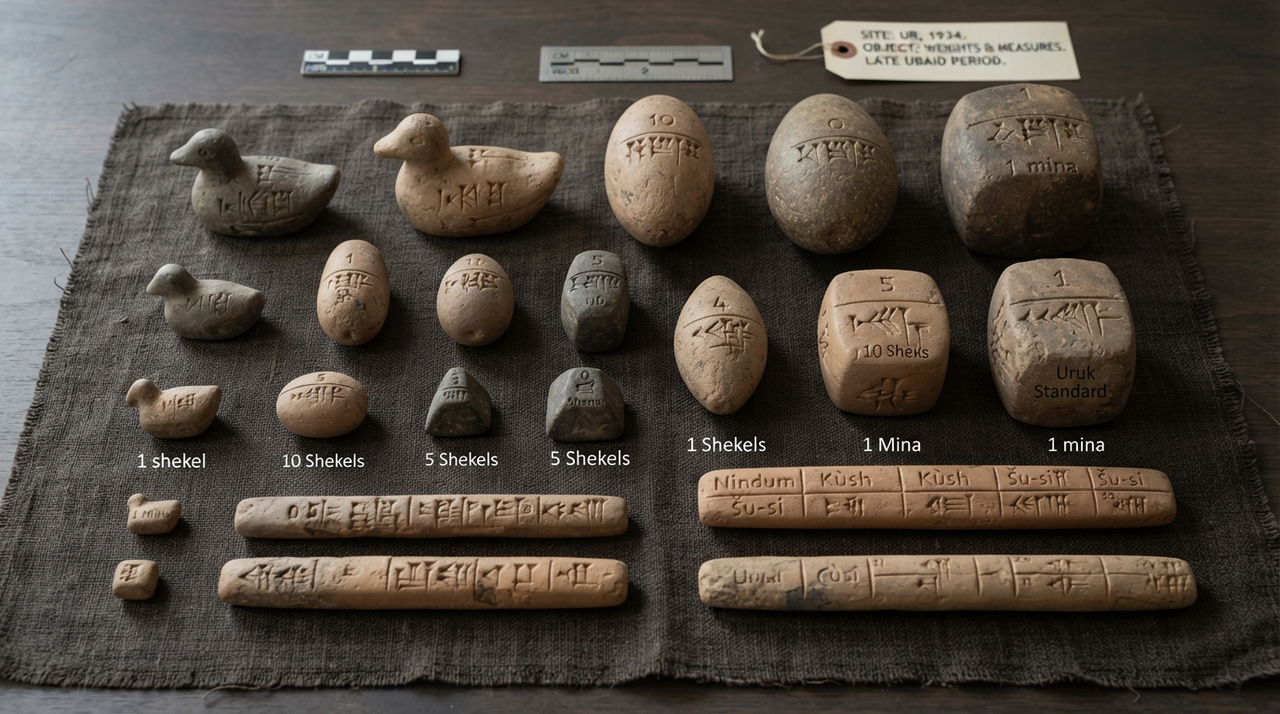
By the 18th century BCE, under Hammurabi's shadow, Mesopotamian city-states like Babylon fostered the Mesopotamian weights measures. The mina (about 500 grams) divided into 60 shekels, a sexagesimal marvel rooted in Sumerian traditions. Clay weights, often lion-shaped or inscribed, weren't uniform by decree but converged through market pressures and temple oversight.
Palace archives in Mari and Nippur brimmed with records of weighings, where scribes tallied grain levies. Market inspectors, armed with standard exemplars, stamped approved goods. Yet power lurked: elites owned calibrated sets, while laborers bartered approximations. Local variations persisted— a shekel in Larsa might skew heavier—highlighting uncertainty. Museum pieces today, like the British Museum's duck weights, bear witness to this fragile technical standards history.
This bottom-up path intertwined with economics (trade flows), law (contract enforcement), and writing (cuneiform tallies preserving memory).
Egyptian Royal Cubit: Imperial Precision from the Nile
New Kingdom Standardization Under Pharaohs
Contrast this with Egypt's New Kingdom (1550–1070 BCE), where the royal cubit—roughly 52.3 cm—reigned supreme. Carved black granite rods, marked in palms and fingers, emanated from pharaonic workshops. Pharaohs like Ramses II mandated their use for pyramid construction, Nile flood gauges, and tribute collections.
Institutional muscle flexed through vizier-led inspectors patrolling Thebes' markets. Practices involved stretching cords along cubit rods for building alignments, embedding the standard in monumental labor. Artifacts from Luxor temples show wear from endless use, but regional cubits (short vs. long) betrayed local tweaks. Power here was top-down: divine kingship justified control, linking measurement to cosmology and corvée drafts.
In Egypt, the cubit didn't just measure stone; it measured obedience.
This system bolstered law (land surveys), economics (harvest taxes), and memory (hieroglyphic inscriptions).
Qin Dynasty Unification: The Ultimate Decree
Weights, Measures, and the Legalist Hammer, 221 BCE
Fast-forward to 221 BCE: Qin Shi Huang's unification of China. After conquering the Warring States, he imposed uniform weights (the catty, evolving from earlier chou), measures, currency, and script via imperial edict. Bronze standards, cast centrally, were dispatched empire-wide, enforced by eunuch overseers and draconian laws.
Practices shifted dramatically—local scales melted down, markets recalibrated overnight. The pathway? Pure decree, not convergence. Functions spanned taxation, military logistics, and Great Wall provisioning. Counterevidence lingers in Han-era texts noting rural holdouts. Today, Xi'an's museums display these bronzes, symbols of standardization and power.
- Chronology: Mesopotamia (early), Egypt (middle), Qin (late).
- Pathway: Market vs. decree.
- Power Dynamics: Elite access persisted everywhere.
Comparative Shadows: Interoperability and Its Limits
Mesopotamia's organic interoperability ancient world clashed with Egypt's ritual rigidity and Qin's iron fist. All quelled chaos but amplified inequalities—women traders navigated biased scales, laborers bore imprecise burdens. Ethical lenses vary: was this efficiency or exploitation? Uncertainty endures; papyri and tablets show persistent local hacks.
Cross-connections abound: to Technology Door's economics (trade barriers dissolved), law (standardized penalties), writing & memory (enduring archives).
Echoes Today: Journal Your Invisible Standards
Ancient standards remind us: metrics aren't apolitical. From USB ports to ISO currencies, they shape power. Pause—what invisible standards govern your day? Grab a notebook: list three, trace their origins, question their sway. In curiosity lies true measure.