
Trade Beyond Goods: History of Exchange from Assyrian Caravans to Silk Road and Fair-Trade Coffee
Imagine a dusty trail winding from the Mesopotamian city of Assur toward the Anatolian highlands, circa 1950 BCE. A caravan of donkeys laden with woolen textiles and tin ingots plods forward, driven by traders whose fortunes hinge not just on the weight of their cargo, but on whispered reputations and sealed clay tablets. This scene, etched into the history of trade, reveals exchange as more than the movement of goods—it's a delicate negotiation of meaning across boundaries, where trust is forged, values translated, and worlds intertwined.
In the exchange and business that spans millennia, markets have never been mere pits of barter. They embody institutional practices—from caravanserai laws to port charters and reputation networks—alongside the lived work of mediation. Legal structures evolve, labor relations shift, and communities adapt or resist. This article traces the history of trade through Old Assyrian donkey caravans to Anatolia, the sprawling Silk Road trade, Indian Ocean monsoon merchants of the 9th to 14th centuries, and today's fair-trade coffee chains from Huila, Colombia, to neighborhood roasters. Along the way, we compare pathways, functions, trust mechanisms, measurement standards, credit systems, and cultural translations, keeping places, periods, ownership, labor, assumptions, and affected communities in sharp focus. Globalization appears not as destiny, but as a contingent weave of human choices.
Dawn of Distant Deals: Old Assyrian Caravans to Anatolia
In the early 2nd millennium BCE, Assyrian merchants from Assur, a bustling trade hub on the Tigris River, dispatched annual donkey caravans—up to 200 animals strong—across 800 rugged miles to Kanesh (modern Kültepe, Turkey). These were family-owned enterprises, often partnerships between brothers or fathers and sons, trading tin from distant Iran and wool textiles dyed in Assur for Anatolian silver, copper, and gold.
Trust flowed through kinship and agent networks. A merchant dispatched his son or hired retainer to live in Kanesh for years, overseeing sales from a colony of Assyrian expatriates. Over 20,000 clay tablets from Kanesh archives detail contracts: "Pushtumwa will provide 1 shekel of silver for each textile." Measurement relied on standardized weights and balanced scales, but disputes arose over quality—were lapis lazuli beads truly from Afghanistan? Credit extended via tallies on tablets, repaid in metals, with interest rates hovering around 20-30% for loans.
Labor was hierarchical: donkey drivers, lowly porters sweating under loads of 100-150 pounds, contrasted with elite traders negotiating in palace courtyards. Local Anatolian communities benefited from imported luxuries but chafed under Assyrian enclaves that bypassed Hittite oversight. Counterevidence abounds—karums (trading posts) collapsed amid political upheavals, showing trade's fragility. Here, market exchange was intimate, embedded in family and colony life, translating Mesopotamian commercial law into Anatolian customs.
This era prefigures broader business and culture fusions, akin to sacred market boundaries explored in our Sacred Places collection.
Webs of the Overland: Silk Road Trade
Caravanserais and Reputation Networks
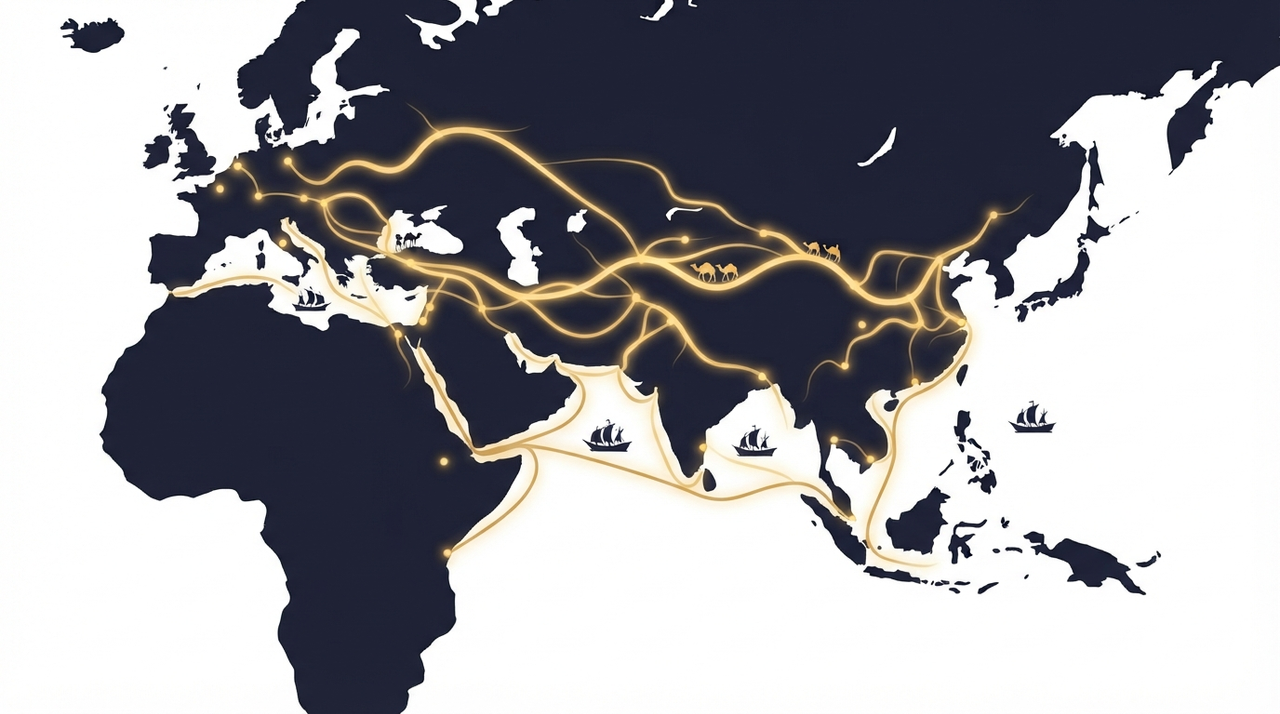
Fast-forward to the 2nd century BCE through the 14th century CE: the Silk Road unfurls from Chang'an (Xi'an) in Han China, across Central Asian steppes, Persian bazaars, to Antioch and Venice. Silk from Chinese mulberry groves, spices from India, glass from Syria, and horses from Ferghana traversed relays of caravans—camels supplanting donkeys for desert endurance.
Pathways fragmented into segments: no single merchant traversed the full 4,000 miles. Ownership diversified—Sogdian middlemen from Samarkand dominated, their polyglot traders speaking Parthian, Sogdian, Chinese, and Turkish dialects. Trust shifted from family to reputation networks; a Sogdian defaulter in Bukhara was shunned from Lanzhou to Baghdad. Institutions like caravanserais—fortified inns mandated by rulers like the Abbasid caliphs—enforced laws: fixed tariffs, safe storage, even arbitration courts.
Measurement standardized via Islamic gold dinars and Chinese cash coins, but translation challenges persisted—was Byzantine silkware equivalent to Tang porcelain? Credit via suftaja bills of exchange, precursors to modern letters of credit, allowed cashless relays. Labor included camel herders from nomadic tribes, often in debt peonage, and urban porters guilds. Communities along the route flourished—Samarkand's Registan became a cultural crossroads—but Mongol invasions (13th century) disrupted flows, highlighting vulnerabilities.
Echoing bills of lading as memory devices, delve deeper in Writing & Memory.
Monsoon Currents: Indian Ocean Merchants, 9th-14th Centuries
Parallel to overland trails, maritime Silk Road trade pulsed with Indian Ocean monsoon merchants. From 9th to 14th centuries, dhows and junks harnessed seasonal winds—northeast in winter from Arabian Gulf to India, southwest in summer back from Coromandel Coast to East Africa. Ports like Hormuz, Calicut, Quilon, and Kilwa buzzed with Gujarati Hindus, Tamil Cholas, Arab Muslims, and later Chinese fleets under Zheng He.
Ownership spanned castes and faiths: Paradesi Jews in Cochin, Bohra Muslims in Cambay. Trust via port charters—Chola inscriptions granted tax exemptions for resident foreigners—and caste guilds enforcing ethical trade. Measurement used cowrie shells from Maldives as currency alongside silver tankas; spices weighed in man units varying by port, demanding constant recalibration.
Credit through hundis (promissory notes), with translators vital for Tamil-Arabic-Persian haggling. Labor was brutal: enslaved rowers on Swahili coasters, free divers for pearls off Bahrain. Affected communities—Malabar pepper farmers gained markets but lost to monoculture pressures; East African Swahili city-states rose on ivory and gold exports. Differences sharpen: maritime speed outpaced caravans, but piracy (e.g., Chola naval raids) introduced risks absent overland. Empire intertwined, as in our Politics Door.
Ethical Echoes: Fair-Trade Coffee from Huila, Colombia
Leap to the present: in Huila's Andean foothills, smallholder coffee farmers in cooperatives like Federación Nacional de Cafeteros harvest arabica beans under shade-grown canopies. Cherries travel by truck to ports like Buenaventura, shipped to U.S. or European roasters certified by Fairtrade International.
Pathways digitize: blockchain traces beans from finca to cup. Ownership collectivized—co-ops own processing mills, contrasting Assyrian families. Trust via third-party audits verifying minimum prices ($1.40/lb green coffee, above commodity), premiums for sustainability. Measurement precise: moisture meters, cupping scores (80+ for specialty), QR codes linking to farm data.
Credit through co-op advances; translation cultural—storytelling labels convey farmer voices to urban consumers. Labor emphasizes family farms, women-led groups, but precarity lingers with climate volatility. Neighborhood roasters in Brooklyn or Berlin pay direct-trade premiums, fostering relationships. Yet counterevidence: certification costs burden tiniest producers, and global price crashes test resilience.
Across eras, market exchange evolves, blending business and culture.
Comparative Currents: Trust, Tools, and Transformations
- Chronology and Pathways: Donkeys yielded to camels, dhows, containers—speed and scale ballooned, but each route hugged ecological niches.
- Functions and Differences: Assyrians bartered staples; Silk Road luxuries; oceans bulk commodities; coffee ethics. Trust: kin → reputation → guilds → certifications. Measurement: clay weights → coins → spectrometers. Credit: tallies → bills → fintech.
- Counterevidence: Plagues halted Silk Road; monsoons failed voyages; coffee rust blight hits Huila—trade falters without adaptation.
- Community Contexts: Anatolian palaces hosted traders; Swahili towns multiculturalized; Colombian co-ops empower indigenous groups, yet displace traditions.
Institutions varied: Assyrian oaths before Shamash god; caravanserai pacts; monsoon port shahbandars; fair-trade standards. Mediation's labor—interpreters, weighers, notaries—humanizes the abstract.
Beyond the Bazaar: What Trade Carries
Step back from these threads. Trade carries not only tin, silk, pepper, coffee—but scripts of trust, metrics of value, echoes of labor, and fragments of culture. From Assyrian tablets to fair-trade apps, it negotiates otherness, binding distant lives in fragile mutuality. In an era of fractured supply chains, this history of trade whispers: exchange endures through the meanings we invest, not the goods alone.
What invisible cargoes does your morning brew bear from Huila's hills?