
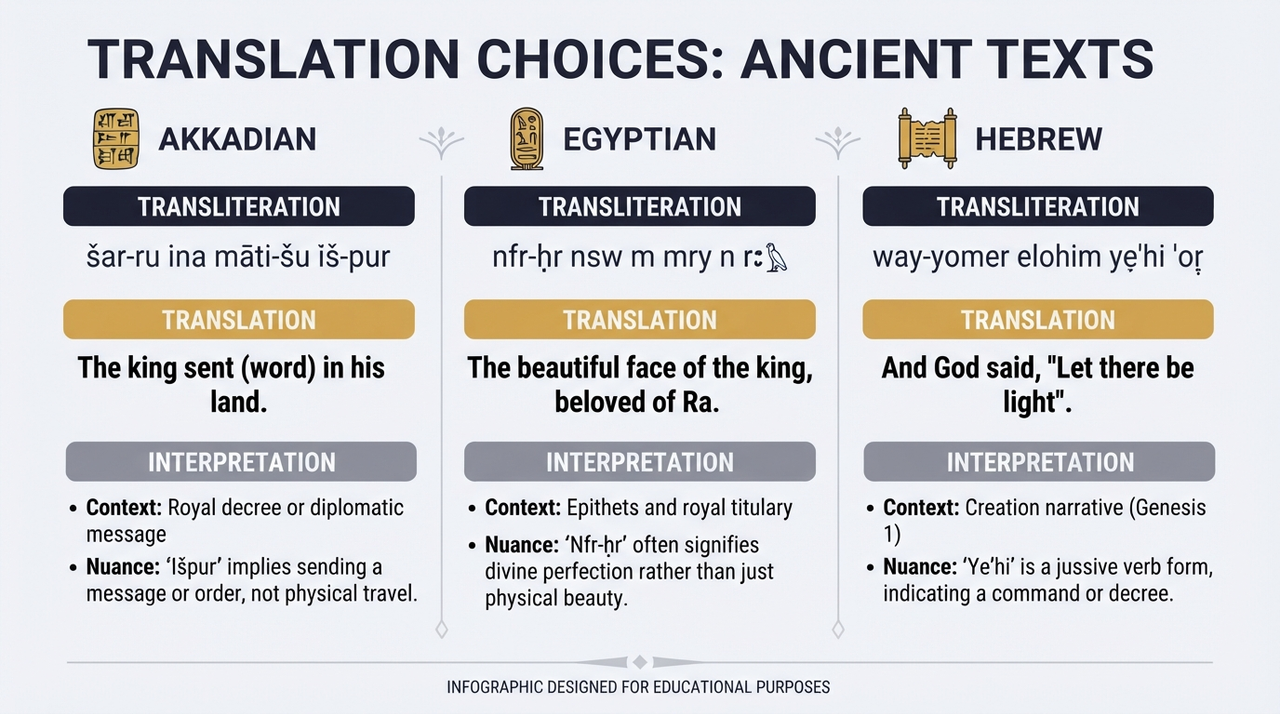
Translation Theory Exposed: Why Choices in Akkadian, Egyptian Hieroglyphs & Hebrew Bible Aren't Transparent
The Illusion of Clarity in Ancient Scripts
Picture this: a dusty archaeologist unearths a cracked clay tablet in the ruins of ancient Nineveh, its wedge-shaped Akkadian signs whispering tales of cosmic battles. Or envision pyramid builders etching hieroglyphs into a noble's coffin, spells meant to defy death. Fast-forward to a Dead Sea cave, where scrolls of Hebrew script recount the dawn of creation. These artifacts promise unfiltered access to minds lost in time. But here's the twist—translation theory reveals that what we read isn't a transparent record of ancient thought. It's an interpretive act, riddled with translator choices on lexicon, grammar, genre, theology, and audience.
For seekers delving into ancient texts across traditions, understanding these layers unlocks deeper wisdom. Archaeology gifts us primary evidence—tablets, papyri, inscriptions—but bridging the gap to meaning demands human judgment. Let's peel back the veil.
Decoding the Layers: From Script to Sense
Translation isn't magic; it's method. First, transliteration Romanizes scripts—like rendering Akkadian ��arru as "sharru," preserving form without meaning. Transcription normalizes phonetics for pronunciation. True translation conveys sense, while commentary adds context. Each step invites choices.
Primary Evidence vs. Interpretation
Archaeological finds are raw data: cuneiform tablets, hieroglyphic walls, parchment fragments. Scholarly interpretation reconstructs grammar and lexicon from dictionaries built on sparse parallels. Modern devotional readings layer theology atop this. Limits of certainty loom large—erased signs, homonyms, cultural gaps. Translation theory spotlights these opacities.
Akkadian Translation: Enuma Elish's Chaotic Choices
The Enuma Elish, Babylon's creation epic from around 1800 BCE, pulses with drama. Marduk slays Tiamat, birthing the world from her corpse. But Akkadian translation choices shift the tone. The word rištu—is it "primeval" or "first"? Translators debate if it's mythology or cosmology. Grammar bends polytheistic hymns into monotheistic echoes for some audiences. Genre? Epic praise or ritual script? These decisions color whether we see savage gods or divine order, reminding us archaeology yields tablets, not truths.
Egyptian Hieroglyphs: Coffin Texts' Enigmatic Spells
In Middle Kingdom tombs (c. 2000 BCE), Coffin Texts hieroglyphs invoke afterlife journeys. Signs like the ankh (life) intermingle with rebuses—pictures as puns. Translator choices explode here: Is nfr "beautiful" or "effective"? Grammar lacks vowels; hieroglyphs omit many. Context—funerary rite or wisdom lit?—swings theology from Osiris worship to personal salvation. Damaged coffins amplify uncertainty. What seems a clear spell becomes a mosaic of possibilities, far from transparent.
Hebrew Bible Translation: Genesis and the Firmament Debate
Genesis 1 opens the Hebrew Bible with bereshit bara elohim: "In the beginning, God created." But Hebrew Bible translation hinges on choices. Rakia—"firmament" evokes a solid dome (KJV), or "expanse" suggests sky (moderns). Lexicon ties to ancient Near East vaults; grammar debates tenses. Genre: myth, history, poem? Theology pivots on audience—ancient Israelites versus today's readers. Septuagint Greek and Vulgate Latin amplified divergences. Primary Masoretic text meets variant scrolls, underscoring interpretive leaps.
Navigating Uncertainty in Translation Theory
Across Akkadian translation, Egyptian hieroglyphs, and Hebrew Bible translation, translator choices aren't neutral. Lexical ambiguities multiply (one word, ten senses); grammar evolves without records; genres blur; theology projects modern lenses. Archaeology unearths fragments—90% of ancient texts lost—leaving scholars to interpolate. Yet this opacity invites wonder: ancient voices challenge us to listen humbly.
At Aetheria AI, we bridge worlds. Explore our Religion and History Doors for interactive deep dives into primary sources, side-by-side translations, and AI-powered insights. Join the seekers—uncover the choices, embrace the mystery. What ancient text calls to you next?