
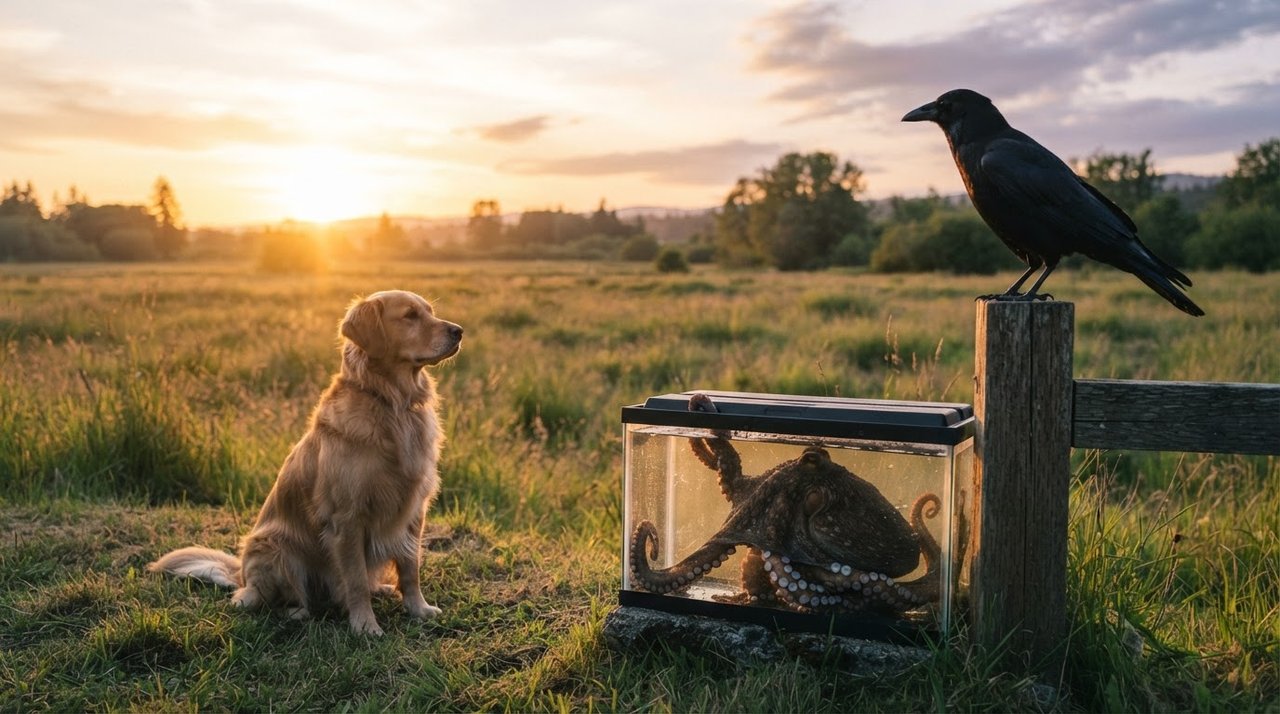
Unlocking Animal Consciousness: Mirror Tests, Tool Use, and Sentience Evidence
Imagine a chimpanzee staring intently at its reflection, gently touching a red mark on its forehead that only appears in the mirror. Does this flicker of recognition hint at animal consciousness—a glimmer of self-awareness amid the wild? For centuries, humans have pondered animal awareness, but advances in comparative cognition now offer tantalizing evidence. From mirror tests to ingenious tool use, these clues challenge us to rethink sentience without slipping into anthropomorphism.
This exploration dives into the heart of animal consciousness, weighing behaviors against the elusive inner experience. We'll scrutinize key markers, flag methodological pitfalls like selection bias, and bridge to wider environmental and scientific inquiries—inviting you, the curious mind, to compare carefully.
The Mirror Test: Probing Self-Recognition in Animal Awareness
Developed by Gordon Gallup in 1970, the mirror self-recognition test places a mark on an animal's body, visible only via reflection. Passing means using the mirror to investigate the mark—suggesting recognition of the self as distinct from others. Chimpanzees, orangutans, bonobos, and some dolphins ace it, touching spots they can't see directly. Elephants and magpies show partial success, wiping marks or removing stickers after mirror exposure.
Yet caution tempers excitement. Not all self-aware species pass; cleaner wrasse fish recently sparked debate with apparent mark-touching. Failures abound—dogs sniff the mirror image, mistaking it for another canine. This highlights comparative cognition's selective lens: tests favor visual species, potentially biasing against olfactory or auditory self-concepts in dogs or bats.
Tool Use Mastery: Corvids, Cephalopods, and Cognitive Fireworks
Corvids: Feathered Engineers
New Caledonian crows craft hooks from twigs to extract grubs, even bending wire into tools without prior training. They plan ahead, selecting the right stick length for future meals. Such flexibility screams problem-solving prowess, fueling arguments for advanced animal consciousness.
Cephalopods: Oceanic Innovators
Octopuses dismantle jars for food, jet through tubes to escape tanks, and mimic textures for camouflage. Veined octopuses gather coconut shells as portable shelters, carrying them until needed. These feats in decentralized nervous systems—brains distributed across arms—push boundaries of sentience, revealing awareness untethered from vertebrate norms.
Pain Responses and the Echoes of Sentience
Animals don't just react to harm; they remember and avoid it. Crayfish learn to associate lights with shocks, enduring longer when painkillers dull the sting—mirroring opioid effects in mammals. Fish rub injured sides against gravel, while rats freed from traps prioritize helping cage-mates over cheese. These integrated responses suggest not mere reflexes, but felt experience akin to sentience.
Enter integrated information theory (IIT), which approximates consciousness via phi (Φ)—a measure of how a system's parts generate irreducible information. High-Φ brains in birds and octopuses align with complex behaviors, offering a quantitative proxy for animal awareness beyond anecdotes.
Behavior vs. Experience: Navigating Comparative Pitfalls
Here's the crux: sophisticated behavior dazzles, but does it prove inner sentience? A robot could mimic crow tool use without feeling triumph. Comparative cognition demands we distinguish observable actions from private qualia—the "what it's like" to be that animal. Selection bias lurks: studies spotlight charismatic species like primates, sidelining insects or fish despite their nociceptors and learning.
Cultural contexts enrich the view. Indigenous Australian communities view dingoes as kin with spiritual awareness; Himalayan Buddhists revere corvids as messengers. These perspectives remind us animal consciousness isn't solely Western lab fare.
Bridging to Environment and Science Doors
Animal awareness ties to environmental stewardship—sentient crows thriving in balanced ecosystems signal health. Scientifically, it parallels AI consciousness debates at Aetheria AI, where we probe machine sentience through similar lenses. These threads weave through our Consciousness, Environment, and Science Doors, urging holistic understanding.
As dusk falls, watch a crow cache food or an octopus shift colors. Approach with open inquiry: what silent awareness unfolds? In this careful comparison lies the unlock to deeper animal consciousness—and our own.