
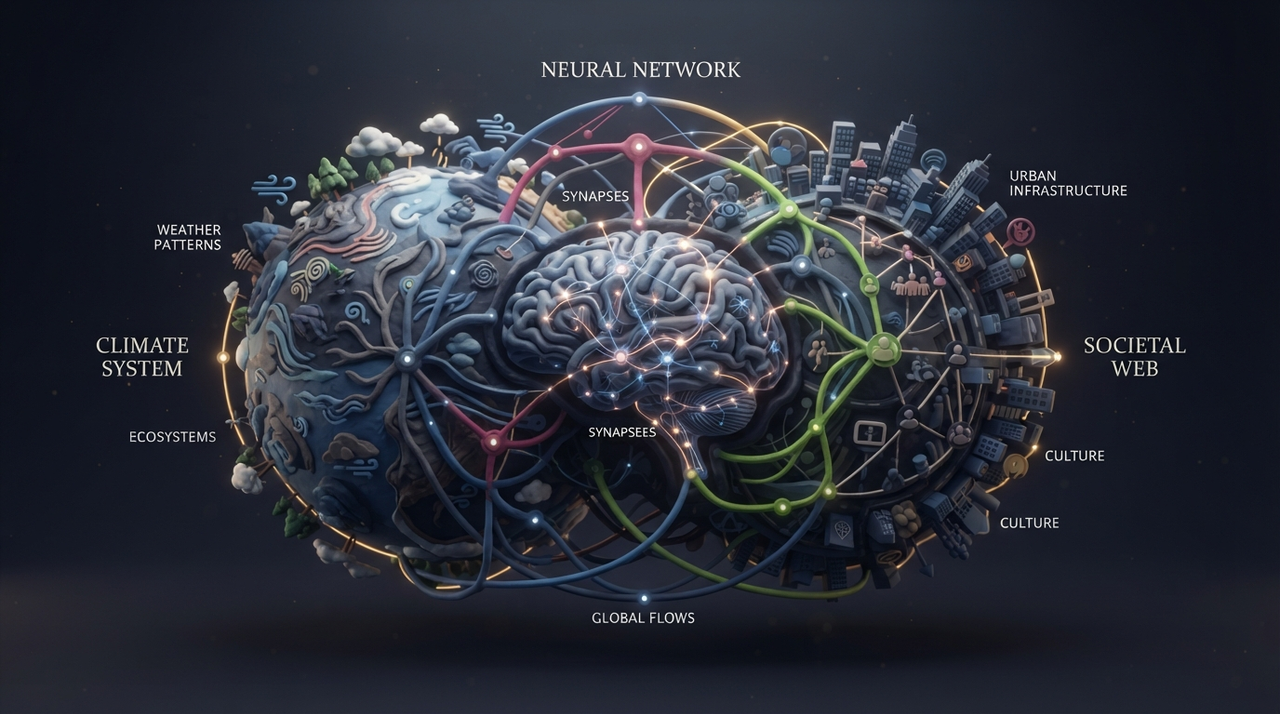
Unlocking Complex Systems: Climate Models, Simulations, and the Reality Gap
Imagine standing on a windswept cliff, gazing at a storm-tossed ocean. Waves crash in unpredictable rhythms, fed by invisible currents, shifting winds, and distant solar whims. This is no mere spectacle—it's a complex system in action, where tiny perturbations cascade into tempests. Systems science teaches us that such interconnected webs defy simple equations, demanding sophisticated modeling to glimpse their secrets. Yet, between our climate models and raw reality yawns a gap, one that reveals the profound challenges of simulating the world's intricate dance.
The Essence of Complex Systems
Complex systems permeate our universe: ecosystems teeming with feedback loops, financial markets pulsing with collective behaviors, even the human brain's neural symphony. In systems science, these aren't isolated machines but dynamic networks where parts interact nonlinearly, birthing emergent properties—like flocking birds forming murmurations without a leader.
Enter modeling: our bridge to understanding. We craft mathematical abstractions, from differential equations tracing fluid dynamics to agent-based simulations mimicking individual decisions rippling through economies. But fidelity is fleeting. A model captures patterns, not the universe's full chaos.
Climate Models: Simulating Earth's Fury
From Grid to Globe
Climate models stand as pinnacles of systems science, dividing Earth into grids—sometimes kilometers wide—to solve physics equations for atmosphere, oceans, ice, and land. General Circulation Models (GCMs) churn petabytes of data, projecting temperature rises or hurricane tracks. Yet, sub-grid processes, like cloud formation, elude capture, injecting uncertainty.
Simulations run forward in time, ensembles of thousands blending scenarios to hedge against unknowns. No crystal ball here—these tools illuminate possibilities, not prophecies.
The Reality Gap: Fidelity, Calibration, and Overfitting
Here's the crux: models mirror reality imperfectly. High fidelity means alignment on tested scales, but scaling up invites divergence. Calibration tunes parameters to historical data, vital for relevance. Overfitting lurks as a siren—memorizing noise as signal, failing on new data like a student cramming trivia over concepts.
- Ensemble methods counter this, averaging diverse models for robust probabilistic forecasts.
- Still, chaos theory reminds: tiny errors amplify, sensitivity to initial conditions dooming perfect predictions.
Neural networks enter the fray, trained on vast datasets to emulate climate patterns. Powerful for pattern recognition, they falter extrapolating beyond training regimes—echoing economies where black swan events shatter linear assumptions.
Computational Limits and Broader Horizons
Even supercomputers strain under exascale demands; resolving every eddy or molecule remains fantasy. Quantum computing whispers promises, but today's limits force approximations.
This dovetails with mathematics, where topology unravels network resilience and fractals quantify irregularity. Peering toward humanity's future, these tools inform policy—carbon pricing, resilient cities—without overpromising control over complex systems.
Small Models for Big Insights
In our personal quests, grand simulations inspire simpler ones. Sketch a mental model of your habits as feedback loops: exercise boosts energy, snowballing wellness. Test, calibrate, iterate. Systems science isn't elite machinery—it's a mindset bridging model and reality, fostering humility amid complexity.
As we refine climate models and beyond, the true unlock lies not in flawless prediction, but in wiser navigation of uncertainty.
Through Aetheria AI, we democratize this exploration, inviting you to probe interconnected systems with curiosity unbound.