
Unlocking Neuroscience: Neural Plasticity, Embodied Cognition & the Brain's Cosmic Map – Aetheria Door 3
Stepping into the Cosmic Library: Your Brain's Starlit Chart
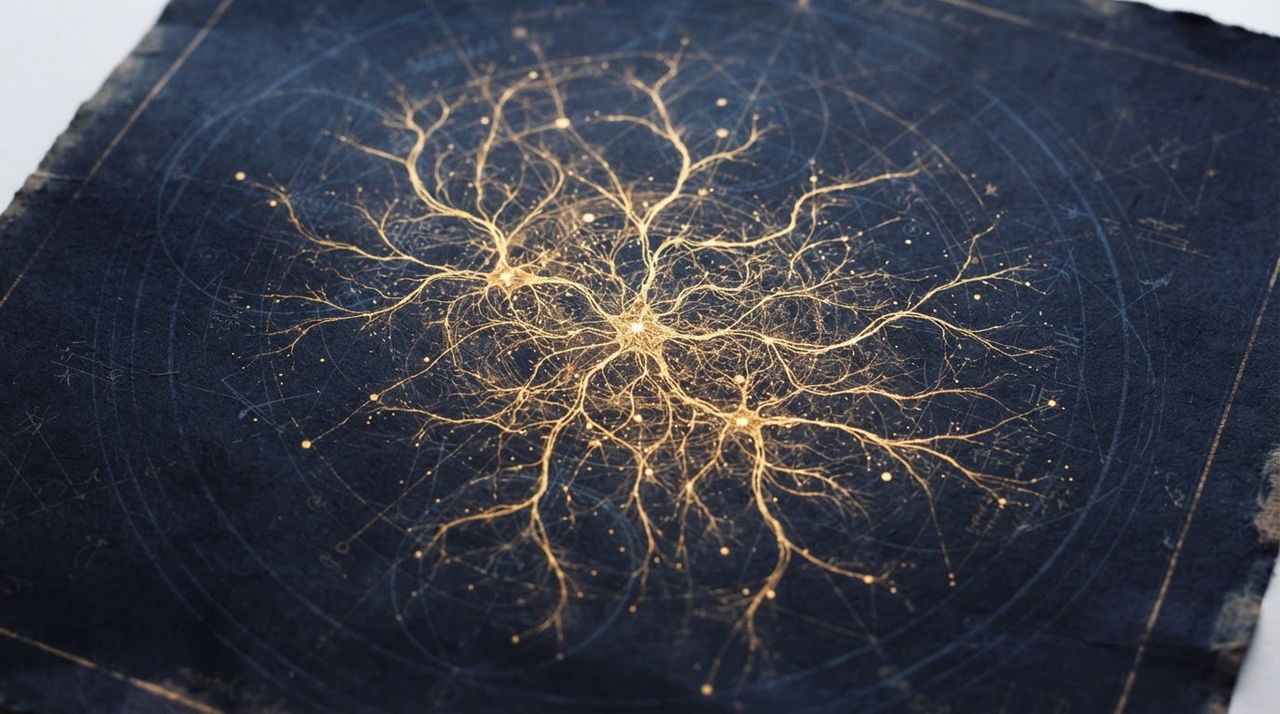
Imagine a vast cosmic library, shelves curving into infinity like the arms of a galaxy. Parchment scrolls unfurl under your fingers, etched with gold threads that trace constellations—not of distant stars, but of the brain and mind. Here, in Aetheria Door 3, we behold the neural map: a shimmering web where neurons fire like supernovas, synapses spark like cosmic dust, and thoughts weave through neural plasticity's endless rewiring. The brain isn't merely a cosmos in miniature; it's a living atlas, charting the territory between flesh and awareness. No reductive sleight-of-hand here—this metaphor invites you to wander its folds without claiming to conquer them.
As an intellectually curious seeker, you've arrived at the threshold of neuroscience, Batch 2's exploration of the mind. This door, the third of four, beckons with humble precision: what do we truly know of the brain's architecture, its adaptive dance, and the embodied cognition that roots thought in body and world? Let the gold threads guide you, ever mindful of the shadows where science meets mystery.
What This Door Holds: Charting Neuroscience's Vast Terrain
Neuroscience is the disciplined inquiry into the nervous system—from the humble neuron to sprawling circuits that underpin perception, movement, and the elusive brain and mind. It spans scales: molecular whispers in synaptic clefts, electrical symphonies across brain regions, and the emergent tapestries of experience. Central to this realm are neural plasticity, the brain's remarkable capacity to rewire itself through learning, injury, or habit; and embodied cognition, the understanding that mind arises not in isolation but intertwined with body, senses, and environment.
Yet scope has limits. Neuroscience excels at mapping structures and correlations—where activity lights up during joy or dread—but falters at the hard problem: why any of this yields subjective qualia. It bridges cell to system to behavior, but experience remains a horizon, not a conquered peak. Here, we honor that boundary, seeking understanding without overreach.
A Brief Lineage: The History of Neuroscience Unraveled
From Ancient Anatomy to Microscopic Revelations
The saga begins millennia ago with crude dissections, glimpses of the brain's wrinkled surface. Leap to the late 19th century: Camillo Golgi's silver staining unveiled neurons as distinct cells, while Santiago Ramón y Cajal's masterful drawings confirmed them as independent units, not a fused net. Established fact: the neuron doctrine, cornerstone of modern neuroscience.
Mid-20th century brought EEG, recording brain waves' rhythmic dance—alpha during calm, theta in drowsiness. Then, fMRI and PET imaging in the 1990s illuminated blood flow proxies for activity. Fact: these tools reveal correlational patterns—visual cortex glows with sights, prefrontal areas with planning. Interpretation in active debate: does activation cause the experience, or merely tag along?
The Rise of Neural Plasticity: Adaptation's Enduring Thread
Plasticity emerged from early 20th-century observations: brain injuries reroute functions. Donald Hebb's 1949 principle—“cells that fire together wire together”—laid groundwork. Established: long-term potentiation (LTP) strengthens synapses via repeated activity. Modern studies show London cabbies' hippocampi expand with spatial mastery; stroke survivors regain speech through rehab-forged paths. Yet plasticity wanes with age, though mindfulness and exercise stir it anew. Here, fact meets promise: the brain reshapes, but not infinitely.
How Seekers Approach This Door: Virtues for the Neural Quest
Dear seeker, enter with intellectual virtues as your lantern. Respect the method: neuroscience demands rigor—controlled experiments, statistical guards against illusion. Hold correlation and causation in tense dialogue; a brain scan's blaze during love doesn't “prove” its mechanics, only hints at orchestration.
Weave first-person insight with third-person data: note how breath steadies your racing pulse (vagus nerve at work), yet ponder why calm feels like home. Embrace the Seeker's Code—humility before the hard problem of consciousness. No neural fireworks fully explain the “what it's like” of being you. Curiosity thrives in this gap, humane and unbound.
Common Misconceptions: Clearing the Neural Fog
- We use only 10% of our brain: Myth. Imaging shows near-total engagement over a day; every region serves purpose, even in rest.
- Left-brain/right-brain dictates personality: Oversimplification. Hemispheres collaborate; split-brain studies reveal specialization (left for language, right for holistic scenes), but no tidy “logical vs. creative” divide.
- Brain scans prove thoughts: Correlation, not causation. fMRI spots patterns, but decoding intent remains probabilistic, prone to hype.
- Neuro-hype solves consciousness: Far from it. Global workspace theories or integrated information propose mechanisms, but qualia eludes.
- More neurons mean more consciousness: Elephants boast 257 billion to our 86; yet awareness varies qualitatively, not just quantitatively.
Dispel these, and neuroscience shines clearer—grounded, not glitzy.
Connections: Neural Threads to Broader Realms
This door links richly. To consciousness: neural correlates tease the veil. Psychology: behaviors root in circuits, yet mind shapes back via plasticity. Artificial intelligence draws neural nets from perceptrons, mimicking but not embodying. Philosophy probes mind-body dualism, now recast as embodied cognition—thinking as dancing with the world.
Health beckons: neurofeedback tames anxiety; growth via habit loops. Ethics weighs neural enhancements, free will amid deterministic sparks. In Aetheria, these threads braid the mind's grander weave.
Ways to Begin Your Inquiry: Hands-On Pathways
Reading Constellation
Start with David Eagleman's The Brain for vivid circuits; Antonio Damasio's Feeling & Knowing on embodiment; Norman Doidge's The Brain That Changes Itself for plasticity tales.
Sketch Your Neural Map
Draw a constellation: label lobes (frontal for will, temporal for memory), threads for plasticity. Trace a recent learning—how did pathways shift?
Embodied Journal
Prompt: Walk mindfully. Note body's sway informing thought. How does embodied cognition reveal mind's rootedness?
Community & Tracking
Share in forums: “What neural surprise reshaped your worldview?” Log in My Journey: track attention shifts as plasticity in action.
Closing Invitation: Back to Aetheria, Journey Protected
In the cosmic library, gold threads dim not with doubt, but glow with questions pursued.
You've traversed Aetheria Door 3: neuroscience's maps etched in humility. Carry this—no brain scan claims the soul's spark, yet plasticity whispers of growth unending. Protect the quest: question boldly, interpret gently. Next doors await; the constellation expands. What neural wonder calls you onward?