
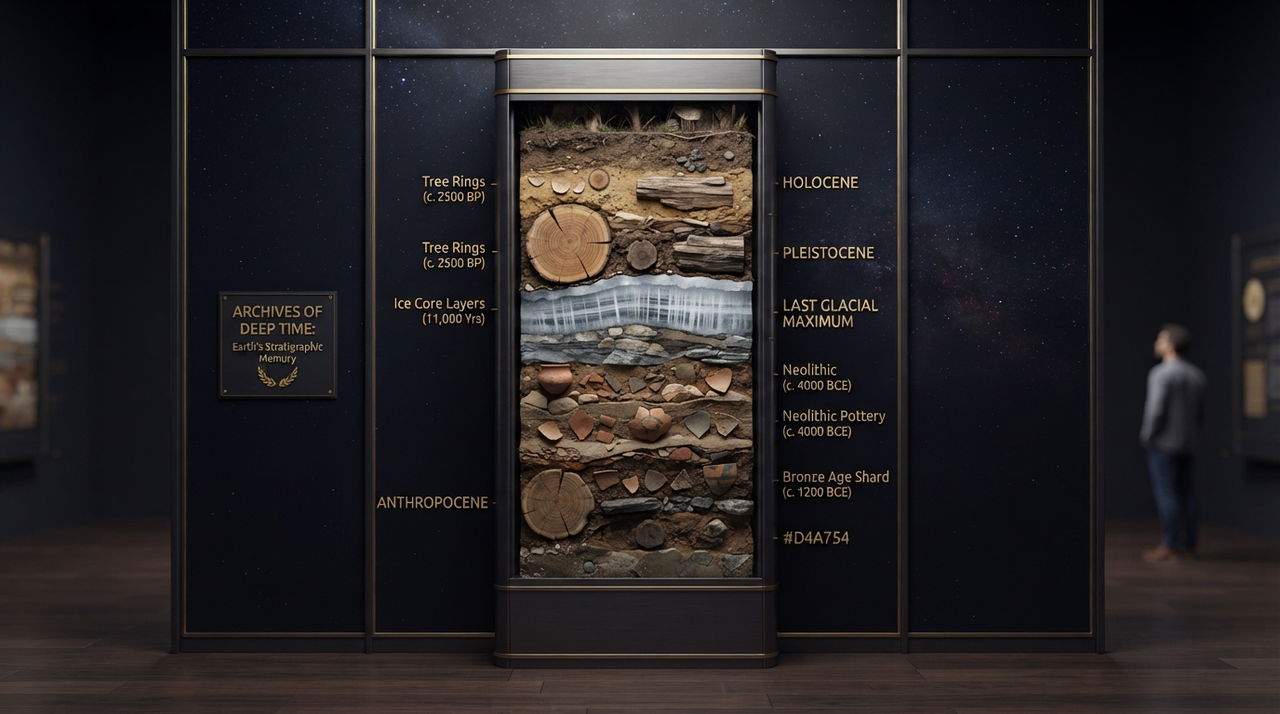
Unlocking Paleoclimate History: Ice Cores, Dendrochronology, and Oral Traditions in Climate Reconstruction
Imagine drilling through two miles of ice in Antarctica, pulling up a cylinder no thicker than your arm, each layer whispering secrets of atmospheres long vanished. This is the allure of paleoclimate history, where frozen archives, scarred tree trunks, and ancient stories converge to reconstruct Earth's climatic past. Far from a single ledger, climate emerges as a multi-layered archive, demanding diverse reading methods—from the pristine bubbles in ice cores to the rhythmic bands in dendrochronology, and the resilient narratives of oral traditions. In Aetheria's Knowledge Library, we explore this environment through such lenses, revealing not just temperatures and storms, but the intricate dance of evidence, uncertainty, and human insight.
Climate reconstruction isn't a quest for absolute truth but a mosaic pieced from ecological proxies: oxygen isotopes in ice, cellulose density in tree rings, pollen trapped in sediments. Each method carries its blind spots—regional biases, interpretive leaps—yet together, they illuminate patterns spanning millennia. Here, scientific precision meets the living authority of local knowledge, from Pacific Northwest Indigenous flood accounts to Sahel herders' drought lore, urging us to honor complexity over catastrophe.
Ice Cores: Frozen Time Capsules from Polar Voids
High on the Antarctic plateau, at sites like Vostok or Dome C, scientists extract ice cores that stretch back 800,000 years. These translucent rods trap ancient air in bubbles, snow turning to firn to solid ice under relentless pressure. By measuring ratios of oxygen-18 to oxygen-16 isotopes, researchers gauge past temperatures; dust layers signal arid spells; chemical traces map volcanic disruptions.
Consider the Younger Dryas, around 12,900 to 11,700 years ago—a sudden chill gripping the Northern Hemisphere. Ice cores from Greenland's GISP2 project capture this jolt: temperatures plummeting 10 degrees Celsius in decades, likely triggered by freshwater floods halting ocean currents. Yet uncertainties linger. Diffusion in warmer ice blurs fine details; core sites skew polar, missing tropical dynamics. Climate reconstruction via ice cores excels at global overviews but falters on hyper-local events, where resolution fades below decades.
Challenges in the Deep Freeze
Drilling logistics alone impose material constraints: remote camps, pristine protocols to avoid contamination. Interpreting beryllium-10 spikes for solar activity demands cross-checks with other proxies. Still, these cores anchor paleoclimate history, bridging ice ages to Holocene warmth, reminding us Earth's thermostat has swung wildly before human industry.
Dendrochronology: Tree Rings as Barometers of Seasonal Strife
In the bristlecone pines of California's White Mountains, some gnarled elders exceed 5,000 years, their rings a ledger of drought and deluge. Dendrochronology cross-dates these patterns across living trees, dead wood, and archaeological beams, forging timelines rivaling ice cores. Wide rings herald wet years; narrow ones, parched summers. Stable isotopes in cellulose refine this: hydrogen ratios track precipitation sources, carbon-13 fluctuations reveal photosynthetic stress.
Take the 536 CE event—a volcanic summer so cold European annals called it the sun's failing. Tree rings from Irish oaks and Siberian larches confirm stunted growth worldwide, linking to bilateral eruptions in Iceland and El Salvador. In the American Southwest, Anasazi sites yield beams showing megadroughts around 1100-1300 CE, coinciding with societal shifts amid aridity. But trees don't speak universally: tropical species ring faintly or not at all; fires scar records; elevation biases favor mountains over plains.
Scaling from Forest to Continent
- Networked chronologies, like the International Tree-Ring Data Bank, span hemispheres for robust climate reconstruction.
- Blue intensity measures ring density as a temperature proxy, sidestepping age-related trends.
- Yet, non-climatic noise—pests, logging—demands statistical sieves.
Dendrochronology thrives on accessibility: samples from ruins, bogs, even shipwrecks. It humanizes paleoclimate, tying environmental shifts to built landscapes and affected communities.
Oral Traditions and Climate: Voices from the Margins
Beyond labs and saws lie stories etched in memory, where oral traditions and climate intersect. In the Pacific Northwest, Salish and Kwakwaka'wakw elders recount cataclysmic floods carving fjords, tales aligning with post-glacial outbursts around 13,000 years ago—outburst floods from ice-dammed Glacial Lake Missoula, validated by geology. These narratives, passed matrilineally for generations, encode hydraulic details: wave heights, refuge peaks, unmatched by sparse sediments.
Across the Atlantic, Sahel pastoralists in Mali and Niger preserve drought sagas from the 1730s and 1790s, mega-events corroborated by lake cores and historical ledgers. Dogon skywatchers describe sandstorms veiling stars, timed to Nile flood failures felt 2,000 miles away. These accounts thrive on social institutions—council fires, songlines—yet face erosion from urbanization, mission schools, and power imbalances silencing Indigenous voices.
Bridging Worlds: Where Stories Meet Science
Oral traditions excel in scale and affect: hyper-local, immediate, embedding human cost. A Hawaiian chant laments 15th-century droughts starving taro fields; Australian Aboriginal star maps track monsoon failures. Counterevidence arises—embellishment over centuries, translation gaps—but convergences with proxies affirm their archive value. Present-day authority rests with living custodians, often stewards of resilient practices amid colonial legacies.
Comparing Knowledge Traditions: Science Versus Oral Memory
Juxtapose scientific paleoclimate—ice cores and dendrochronology—with oral memory, two pathways to the past. Scientific chronology builds cumulatively: 19th-century pioneers like Agassiz spotting ice ages, 20th-century coring revolutions, digital modeling today. Pathways rely on material constraints—drills piercing ice, microscopes probing rings—functioning for predictive forecasts, policy briefs. Authority derives from peer review, replicability, institutions like NOAA or IPCC.
Oral traditions unfold non-linearly: episodic, place-bound, from Paleolithic hearths to now. Pathways weave community validation—no paper, just recitation chains—constrained by memory decay, catastrophe's silence. They function for survival: taboos averting overharvest, migrations timed to lore. Differences sharpen: science quantifies globally, orally embeds ethics locally; counterevidence tests both, like mismatched ring widths challenging eruption dates.
In this tension lies strength—each tradition's gaps filled by the other's light, fostering holistic paleoclimate history.
Power dynamics persist: scientific access via grants, labs; oral via land rights, cultural sovereignty. Affected communities—Arctic Inuit validating cores with sea-ice songs—demand inclusion, lest reconstruction serve distant capitals over local futures.
Navigating Uncertainty in Climate's Complex Archive
No method reigns supreme; climate reconstruction brims with ambiguity. Proxy resolutions clash—annual tree rings versus centennial ice layers; regional signals amplify or mute. Historical interpretation layers further: Medieval Warm Period's warmth varied by latitude, not a uniform bliss; Little Ice Age squeezed institutions differently, from Viking Greenland's fade amid Inuit adaptation to Ming China's granary strains.
Complexity reigns—no lone drought topples empires. Chaco Canyon's abandonment intertwined aridity with soil depletion, trade ruptures; Maya lowlands' "collapse" spanned centuries, pests, and warfare atop rains' retreat. Ethical framing insists: amplify affected voices, question whose archives dominate. Cross into Aetheria's Books Door for Charles Mann's 1491, probing pre-Columbian climates; or Meaning Door for philosophical takes on environmental memory.
Toward Action Amid the Unknown
Paleoclimate's vault—ice cores, dendrochronology, oral traditions—urges humility. We hold uncertainty like a half-read map: probabilities, not prophecies. Act we must, stewarding institutions for equitable access, centering communities from Sahel nomads to Antarctic researchers. In this multi-voiced archive, understanding deepens resolve—not paralysis, but textured stewardship.
What layer will you probe next? Aetheria's Environment library awaits, inviting your curiosity into climate's enduring story.