
Unlocking the Arrow of Time: Entropy, Thermodynamics, and Why Time Flows Forward
Imagine watching a shattered glass reassemble itself mid-air, shards leaping back into a perfect chalice as cream swirls backward into coffee. Absurd, right? Yet the laws of physics, at their most fundamental, treat time as reversible. Electrons whirl, quarks dance—everything symmetric under time's reversal. So why does time march relentlessly forward? The answer hides in entropy, the second law of thermodynamics, and the enigmatic arrow of time. This isn't just time physics; it's the universe whispering its deepest secret.
What Is Entropy? The Measure of Disorder
Entropy, born from the Greek for 'transformation,' quantifies disorder or the number of ways a system can arrange itself. Picture a deck of cards: neatly stacked, low entropy. Shuffle wildly, and entropy soars—52 factorial possibilities explode into chaos.
The second law of thermodynamics declares: in an isolated system, entropy always increases. Ice melts in a warm room; heat flows from hot to cold, never reverse. This isn't a mere trend; it's ironclad, observed in every lab from steam engines to black holes. Ludwig Boltzmann formalized it in the 1870s, linking entropy to microscopic states: S = k ln W, where W tallies micro-configurations yielding the same macro-look.
The Thermodynamic Arrow of Time
Why Does Time Have a Direction?
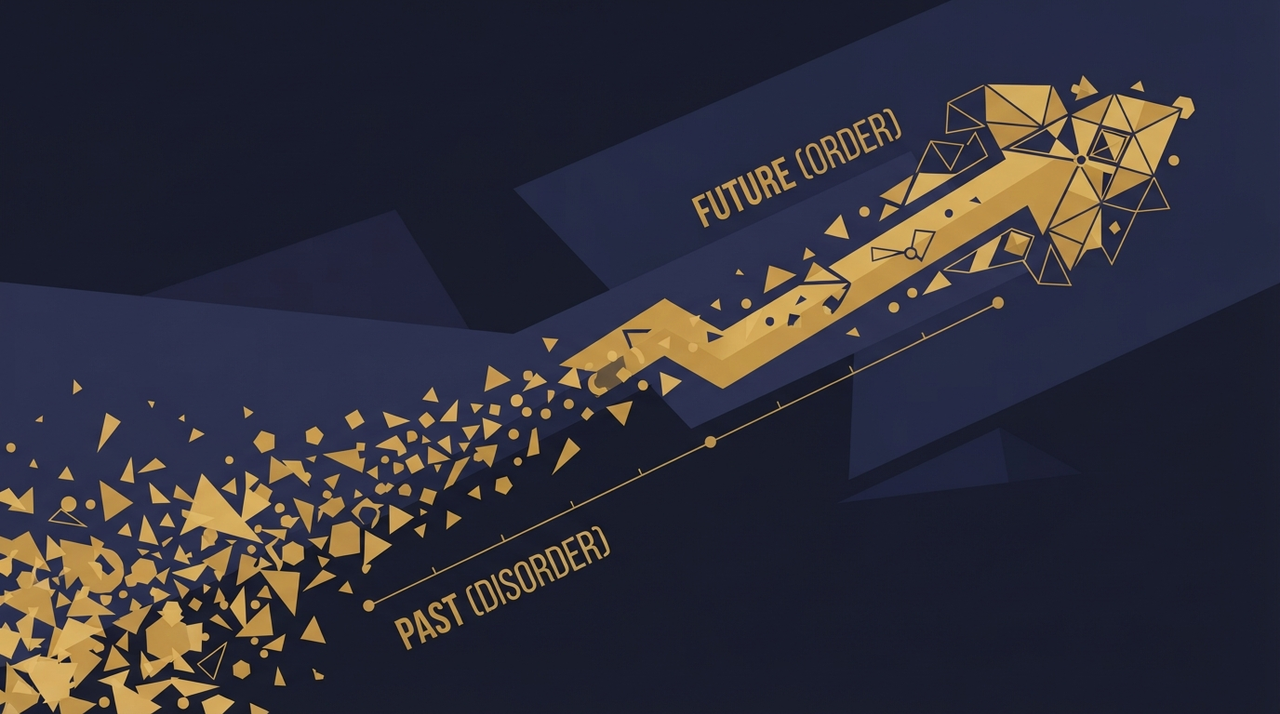
Here's the crux: the arrow of time emerges from entropy's rise. We remember the past, not the future, because low-entropy states (ordered, like the Big Bang's smooth plasma) evolve toward high-entropy futures (disorderly sprawl). Time's flow feels one-way because reversing it demands entropy decrease—an improbable fluke.
Distinguish the fact from the why. Measurement confirms entropy climbs in isolated systems; that's empirical bedrock. But interpretation? Why did the universe boot up low-entropy? That's the riddle. The thermodynamic arrow points forward via statistical inevitability: eggs break, never unbreak, because broken states vastly outnumber whole ones.
Challenges and Paradoxes: Boltzmann's Brain and Loschmidt's Echo
Not so fast, skeptics say. Josef Loschmidt's paradox stings: if molecules are time-symmetric, why can't we reverse velocities for entropy drop? Boltzmann countered with probability—reversals happen, but on cosmic timescales, in vast ensembles.
Enter Boltzmann brains: fleeting, self-aware fluctuations in equilibrium chaos, hallucinating order. If our low-entropy cosmos is rare, why aren't we brains in thermal soup? Debates rage—multiverse patches? Quantum fluctuations? No consensus; the origin of time's arrow remains veiled, no false certainty here.
Thermodynamic vs. Cosmological Arrows
Time physics splits arrows. Thermodynamic: entropy's climb in closed boxes. Cosmological: universe expansion from Big Bang, galaxies fleeing. They align now, but in a contracting cosmos? Entropy might dip. Relativity adds psychological and causal arrows—memory's past-bias, causes preceding effects. Entwined yet distinct, they propel our forward march.
Bridges to Philosophy and Mathematics
Entropy transcends labs, threading to philosophy's free will versus determinism, time's illusion per McTaggart. Mathematically, it dances in chaos theory's fractals, information theory's bits—Shannon entropy mirroring Boltzmann's. Explore Aetheria's Philosophy Door for time's subjective flow; the Mathematics Door unpacks infinities and probabilities fueling these arrows.
Tracking Your Arrow: A Journal Prompt
Over the next week, journal daily: Note three moments where time's arrow struck—spilled coffee, fading memories, irreversible choices. What entropy surges do you witness? How might glimpsing reversals reshape your now?
The universe hurtles forward, entropy's tide unyielding. Yet in pondering the arrow of time, we touch eternity's edge—seekers, forever chasing why.