
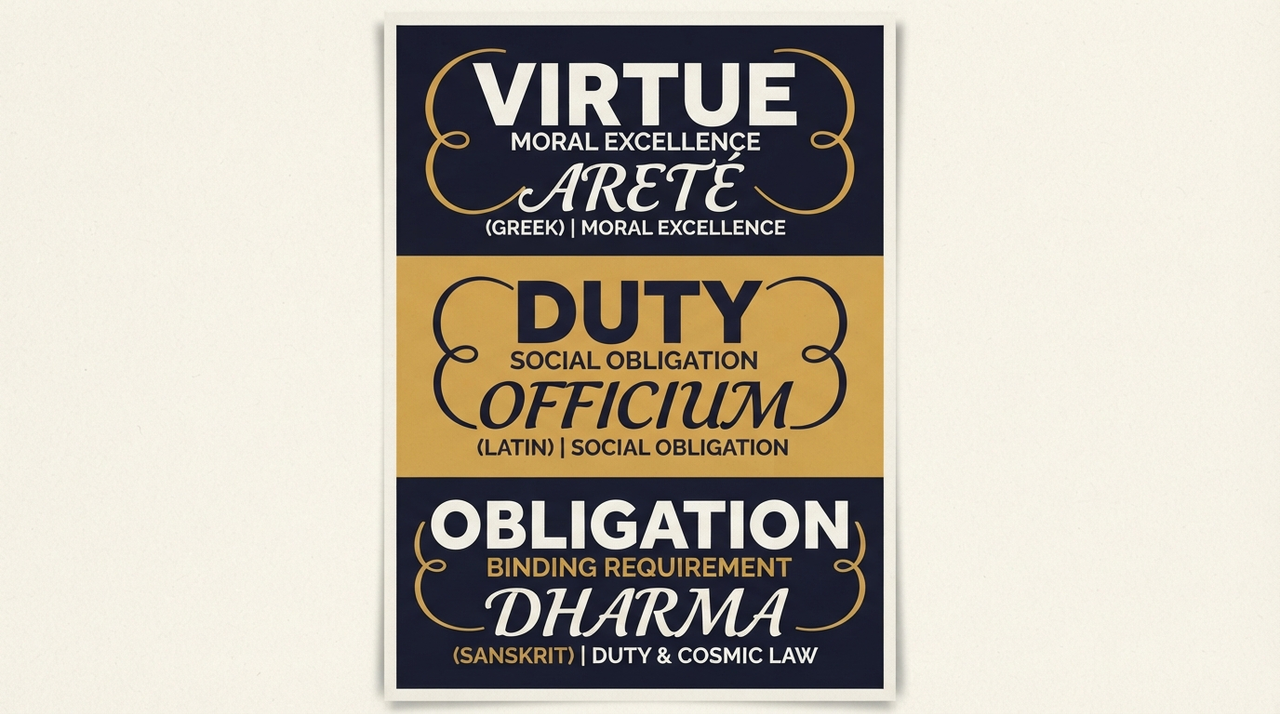
Virtue Ethics vs. Duty: Bounded Comparisons of Ancient Moral Traditions & Community Obligations
Imagine a scribe in ancient Egypt, quill poised over papyrus, weighing not just rules but the character that bends toward harmony. Or a Stoic philosopher in a bustling Roman forum, pondering duties amid chaos. These scenes from antiquity invite us into a virtue ethics comparison with deontological imperatives—character versus command. Yet, in a bounded comparison of moral traditions, we avoid grand syntheses, focusing instead on how duty ancient frameworks intertwined with community obligation. Through case studies from Egypt, Sumer, Stoicism, Confucianism, and Rabbinic Judaism, we explore tensions, debates, and echoes—distinguishing textual evidence from modern echoes.
Unpacking Virtue and Duty in Ancient Contexts
Virtue ethics centers the cultivator: become wise, just, temperate. Duty, by contrast, spotlights the deed: fulfill the mandate, regardless of inner disposition. But ancient sources blur these lines, embedding both in communal webs. A virtue ethics comparison reveals no pure dichotomy; instead, moral traditions debated internally how personal excellence served collective bonds.
Evidence draws from wisdom literatures and philosophical treatises, not blueprints for today. Modern applications—say, in AI ethics or corporate codes—must grapple with cultural transplants, lest we impose anachronistic universals.
Egyptian Instructions: Ptahhotep's Path to Ma'at
Old Kingdom Wisdom Literature (c. 2450 BCE), Scribal Elite Community
In the Maxims of Ptahhotep, from Egypt's Fifth Dynasty, the vizier advises his son on rekh (knowledgeable conduct) toward ma'at (cosmic order). Virtue shines: "Be a craftsman in speech that thou mayest be strong." Here, character forges community harmony—control anger, honor elders. Yet duty lurks in imperatives: obey superiors, sustain the pharaoh's order.
Internal debate? Later texts like Instructions of Amenemope (New Kingdom) soften hierarchy, emphasizing humility. Community obligation binds: ma'at demands reciprocity, not blind rule-following. Evidence: pyramid temple archives. Today? Echoes in restorative justice, but sans Nile theology.
Sumerian Proverbs: Shuruppak's Practical Wisdom
Early Dynastic III (c. 2600 BCE), Urban Cuneiform Proverbs, Temple-City Communities
From Shuruppak, Instructions of Shuruppak (nam-qul, human norms) mix proverb and precept: "Do not curse the king," duty plain. Virtues cluster—reverence gods, aid kin—framing community obligation as survival in ziggurat shadows.
- "The thief is a lion in the night"—character vigilance.
- "Do not buy an ass that brays too much"—prudential duty.
Debate emerges in bilingual collections: Akkadian glosses prioritize equity over rigid station. Bounded view: pragmatic virtues serve Mesopotamian collectives, evidenced in Nippur tablets. Modern lens? Folk wisdom in proverbs apps, stripped of divine kingship.
Stoic Kathēkon: Duties of the Sage
Hellenistic-Roman Period (3rd c. BCE–2nd c. CE), Stoic Philosophical School, Cosmopolitan Elite
Epictetus defines kathēkon (appropriate acts) as duties aligned with nature—rational, social. Virtue (arete) perfects them: courage in facing exile. Duty ancient here is role-bound: parent, citizen. Community? Oikeiōsis extends care universally.
The foot's job: walk; the hand's: grasp—yours: live according to nature.
Debate: Panaetius adapts for Rome, softening sage-perfection. Evidence: Discourses, Nag Hammadi echoes. Today, resilience training nods to Stoic virtue-duty blend, sans logos theology.
Confucian Li and Ren: Ritual Heart
Warring States (5th–3rd c. BCE), Ru School Texts, Scholar-Gentry Networks
Li (ritual propriety), ren (humane benevolence) fuse duty and virtue. Analects urge: perform rites sincerely. Community obligation radiates from filial piety to state harmony.
Debate: Mencius stresses innate ren; Xunzi, cultivated li. Evidence: bamboo slips from Mawangdui. Modern? Corporate rituals in East Asia, but commodified.
Rabbinic Mitzvah: Covenantal Commands
Tannaitic Period (1st–2nd c. CE), Mishnah Oral Torah, Rabbinic Study Houses
Mitzvot (commandments)—613 duties—anchor ethics. Yet virtue infuses: middot (character traits) like humility. Community? Synagogue mutual aid.
Debate: Hillel vs. Shammai on stringency. Evidence: Cairo Geniza fragments. Today, ethical observance in pluralist societies tests bounds.
Bounded Horizons: Lessons Without Universals
This virtue ethics comparison and duty ancient survey reveals hybrids: virtues enabling duties, communities as crucibles. No single code emerges; internal debates enrich. For Aetheria AI seekers, these open Religion Doors and Philosophy Doors—prompt ancient texts, debate applications. In our fragmented age, such bounded comparison of moral traditions fosters humble inquiry, not dogmatic decree.