
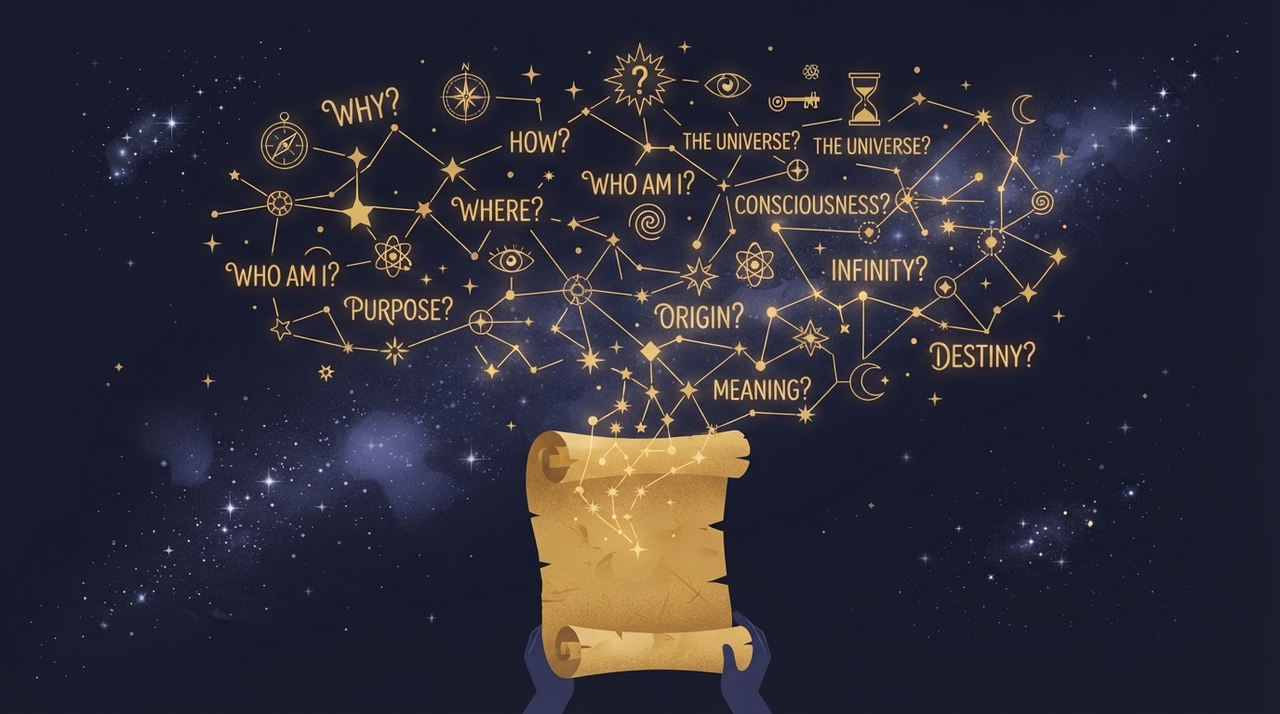
What Is Philosophy? Philosophical Questions, Methods of Inquiry, and the Students of Existence
Picture a lone figure on a windswept cliff at dusk, gazing into the vastness of the sea. Waves crash below, relentless and indifferent, while stars prick the fading sky. A single question escapes their lips: "Why is there something rather than nothing?" In that moment, suspended between earth and eternity, philosophy is born—not as a dusty tome or an ancient lecture hall, but as the raw pulse of human wonder. This is the Philosophy Door in Aetheria's Knowledge Library, a portal for Students of Existence who dare to probe the unseen foundations of reality.
Here, amid the echoing corridors of inquiry, we do not merely recount tales of what was said or done. Those belong to the Historical and Scriptural Doors, preserving the footprints of the past. No, what is philosophy reveals itself in the art of questioning itself—the relentless pursuit of clarity amid ambiguity. For the intellectually curious, the budding philosophy student, or the seeker stepping through this Door for the first time, this journey promises not answers etched in stone, but a Foundation Stone upon which to build your own understanding. Welcome. Let us step inside.
The Essence of What Is Philosophy: Beyond Definitions, Into the Activity
Philosophy, from the Greek philosophia, means "love of wisdom." Yet this label, while evocative, skims the surface. Established scholarship, drawing from Plato's dialogues like the Theaetetus, distinguishes philosophy as an activity rather than a fixed doctrine. It's the disciplined wrestle with life's deepest riddles, not a creed to recite. Aristotle echoed this in his Metaphysics, portraying the philosopher as one driven by thaumazein—that primal sense of wonder at the world's sheer existence.
Interpretations of thaumazein vary: some scholars see it as childlike awe, others as the vertigo of confronting the cosmos's contingency. Speculation takes us further—what did early humans whisper around flickering campfires? Perhaps, "What holds the stars in place?" or "Why do we suffer, only to find joy again?" These are not idle musings but the seeds of philosophical questions that propel us forward.
In Aetheria's embrace, philosophy stands as open inquiry, inviting all Students of Existence to participate. It's the thread that binds the Library's Doors, turning raw data into wisdom. Unlike science's empirical chase or religion's revelatory claims, philosophy lingers in the conceptual shadows, asking not just "how," but "what does it mean?"
What Makes a Question Philosophical? Three Pillars of Inquiry
Philosophical questions shimmer with a unique light. They evade simple yes-or-no answers, demanding we peel back layers of assumption. Consider three hallmarks: conceptual analysis, normative inquiry, and second-order reflection. Each forges the blade of philosophical thought.
Conceptual Analysis: Dissecting the Invisible
At its core, philosophy clarifies concepts. What is "knowledge"? Plato's Meno probes this, revealing it's not mere true opinion but justified true belief—a definition later challenged by Edmund Gettier's counterexamples. Imagine a jury deliberating: Is intent what defines murder, or the outcome? These questions unravel language's knots, exposing hidden meanings. In everyday life, they surface when a friend asks, "Are we truly free, or puppets of circumstance?"
Normative Inquiry: Charting the "Ought"
Philosophy doesn't stop at description; it prescribes. What ought we value? Kant's categorical imperative in Groundwork of the Metaphysics of Morals insists on universalizable maxims: Act only if you'd will it for all. Utilitarians like Mill counter with happiness maximization. Picture a healer facing scarcity—administer to the many or the deserving few? Normative inquiry fuels ethics, politics, and aesthetics, guiding the Seeker's Code through moral mazes.
Second-Order Reflection: Questioning the Questioners
Philosophy turns inward, examining its own tools. Descartes' "I think, therefore I am" births epistemology. How do we know what we know? Skepticism, from Pyrrho to modern brain-in-a-vat scenarios, tests certainty. This reflexivity distinguishes it: science measures phenomena; philosophy asks, "What counts as measurement?"
In the quiet forge of the mind, philosophical questions hammer out not truths, but better questions—sharper, deeper, enduring.
Methods of Inquiry: The Artisan's Toolkit
Methods of inquiry are philosophy's craft. Dialectic, Socratic style, proceeds through dialogue: question, counter, refine. Imagine Socrates in the Athenian agora, cornering a sophist—not to win, but to birth insight. Thought experiments sharpen this: Mary's room (Frank Jackson) challenges physicalism; the trolley problem (Philippa Foot) dissects moral intuition.
Logic provides rigor—Aristotle's syllogisms, Frege's predicate calculus. Phenomenology (Husserl) brackets assumptions to reveal experience's essence. Analytic philosophy parses language; continental weaves narrative. Each method of inquiry suits the terrain: metaphysics ponders being; epistemology, justification.
- Dialectic: Conversation as crucible.
- Thought Experiments: Hypotheticals that illuminate impossibilities.
- Logical Analysis: Precision against fallacy.
- Phenomenological Reduction: Returning to the things themselves.
For Students of Existence, mastering these is Protect the journey incarnate—safeguarding inquiry from haste or dogma.
The Students of Existence: Bearers of the Seeker's Code
Who walks these paths? Students of Existence—not cloistered academics alone, but anyone gripped by wonder. From cave-dwellers etching questions on walls to modern thinkers like Simone de Beauvoir probing freedom's contours, they share the Seeker's Code: humility before mystery, courage in doubt, commitment to dialogue.
Envision a marketplace of minds: Epictetus, stoic slave, affirms agency amid chains; Nietzsche heralds eternal recurrence, urging life-affirmation. Women like Hypatia, martyred for her Neoplatonism, embody resilience. Today, they are you—the curious soul pausing mid-scroll to ponder purpose.
The Seeker's Code whispers: Question relentlessly, yet listen deeply. Honor diverse voices, from Eastern non-dualism (Advaita Vedanta) to African ubuntu's relational self. This code is the Foundation Stone of philosophical life.
Philosophy Amid the Doors: A Study in Contrast
Aetheria's Knowledge Library unfolds through Doors, each a lens on reality. Philosophy contrasts sharply. The Historical Door chronicles what happened: battles fought, empires risen. Philosophy asks, "What makes an event meaningful?"
Scriptural Doors preserve what was commanded: divine edicts, sacred rites. Philosophy probes, "What binds a law—divine will or reason?" Ancestors Door honors whom we revere; philosophy queries, "Why does ancestry confer value?"
Cross-Door Weavings: Philosophy as Illuminator
Consider Creation stories in the Mythic Door: They narrate what happened at the beginning. Philosophy interjects: What must "beginning" conceptually entail? Was it temporal, logical, or divine fiat?
First Laws Door details what was commanded. Philosophy counters: What renders a command binding—authority, utility, or intrinsic good? Ancestors Door evokes lineage; philosophy reflects: Does blood tie morality, or is virtue earned?
These intersections enrich: History provides data; philosophy, interpretation. Together, they form a tapestry where open inquiry thrives.
Echoes Through Time: Philosophy's Enduring Dance
Philosophy evolves, yet its questions endure. Medieval scholastics like Aquinas synthesized faith and reason; Enlightenment thinkers like Locke forged social contract theory amid tyranny's shadow. Existentialists—Sartre declaring existence precedes essence—grappled with absurdity post-World War.
Today, analytic philosophers dissect AI consciousness; feminists like bell hooks reframe love as action. Global traditions converge: Confucian harmony meets Levinasian ethics of the Other. Each era, a new dialogue, proving philosophy's vitality.
Metaphors abound: Philosophy as Sisyphus, eternally rolling the boulder of truth; as Odysseus, navigating Scylla and Charybdis of extremes. Through it all, Students of Existence persist.
The Foundation Stone: Your Path Forward
We stand at philosophy's threshold, tools in hand, questions aflame. This Door does not close; it beckons deeper. Protect the journey by embracing uncertainty—it's the soil of wisdom. Live the Seeker's Code: Inquire openly, reflect humbly, connect boldly.
As you depart, pause. What philosophical question stirs your soul? Does freedom demand solitude, or community? What methods of inquiry will you wield next?
The unexamined life is not worth living—Socrates. But the examined one? It unfolds eternally.
Private Note Prompt: In your journal, scribe one philosophical question born here today. Return to it weekly. Watch it evolve. This is the Students of Existence way—perpetual becoming.
Step back into Aetheria's Library. Another Door awaits, but philosophy lingers, a quiet companion.