
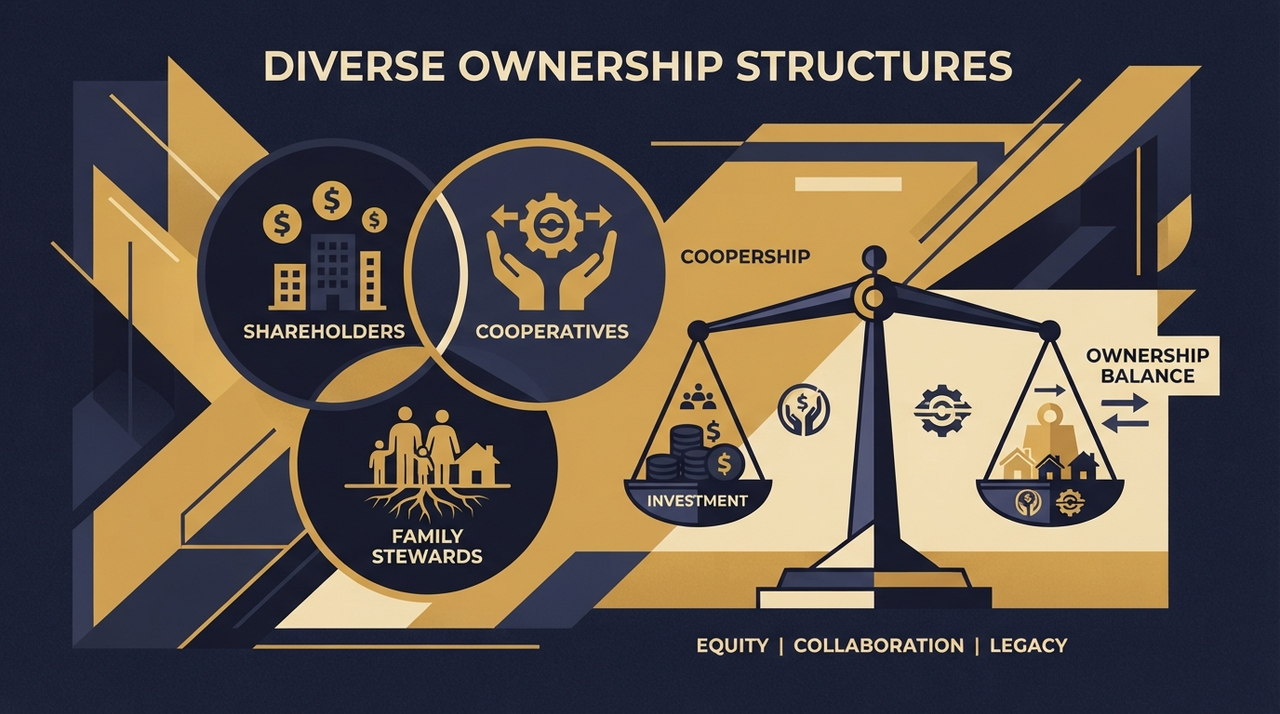
Who Decides? Business Ownership and Governance Models Beyond Legal Forms
The Illusion of Legal Finality
Imagine a merchant in 12th-century Venice, ink drying on a commenda contract as ships laden with spices bob in the lagoon. Who truly decides the venture's fate—the silent investor funding the voyage or the seafaring agent risking life on choppy seas? Fast-forward to the Basque hills of 1956, where workers in Mondragon pool their wages to birth a cooperative empire. Or picture a Tokyo shinise, a family firm tracing roots to the Edo period, where decisions ripple through generations under lantern-lit workshops. In each case, business ownership transcends paper forms. Legal structures—sole proprietorships, partnerships, corporations, LLCs, cooperatives, even state-owned enterprises—merely frame the stage. The real drama unfolds in governance models: who holds the vote, stewards the risk, and shapes the horizon.
Why does this matter? Because settling on a legal form like an LLC or corporation often masquerades as resolving the deeper question: who decides? Yet governance practice diverges sharply. A boardroom in a public corporation might chase quarterly yields, while a family council in a shinise plots centuries ahead. Economic models layer in further: profit-sharing cooperatives redistribute gains democratically, unlike hierarchical corporations funneling dividends upward. And the lived consequences? Workers in Mondragon own their jobs; communities near Venetian ports thrived on trade networks. These aren't abstract; they etch patterns into labor relations, community ties, and resilience against shocks.
This piece, drawn from Aetheria's Knowledge Library, unpacks business ownership and corporate governance beyond legalese. We'll trace historical threads, dissect concrete cases, and weigh shifts in profit, risk, and time. No single model reigns supreme—each demands vigilance over its assumptions.
Legal Structures: The Skeleton, Not the Soul
Legal forms provide liability shields and tax paths, but they bow to governance models. A sole proprietorship vests all in one owner, yet kin might advise informally. Partnerships split equity, but decision vetoes vary by pact. Corporations, with shares traded or held tight, delegate to boards—yet bylaws can embed worker reps or family vetoes. LLCs flex operating agreements, cooperatives mandate one-member-one-vote, and state firms answer to ministries.
Governance practice breathes life into these bones. Boards convene in glass towers for corporate governance, councils deliberate in village halls for cooperatives, kinship stewards pass lore in family firms. Economic models dictate flow: capitalist ventures prioritize returns to capital, cooperatives to labor. Time horizons stretch or shrink accordingly—a corporation's shareholders eye exits, a shinise safeguards legacy.
Consider the distinctions in action. Legal form sets entry barriers; governance practice allocates power. One without the other falters: a cooperative's legal status crumbles without democratic habits, a corporation's board dissolves into factionalism absent clear mandates.
Venetian Commenda: Risk-Pooling in Maritime Shadows
12th-Century Trade Networks
In Venice's Rialto, circa 1150, the commenda emerged—not a rigid corporation, but a contract pairing sedentary investors (sedentes) with traveling agents (tractatores). Legally a partnership variant, its governance hinged on trust and profit splits: the investor fronted capital, risking loss but claiming 75% of gains; the agent bore operational peril, pocketing 25%. No perpetual entity; each voyage reset the clock.
Profit flowed asymmetrically, risk skewed to the sea, time horizon voyage-bound—months, not decades. Labor relations? Agents commanded crews, but Venice's guild ethos curbed exploitation. Communities flourished: Arsenal shipyards employed thousands, trade fueled palazzos. Yet counterevidence lurks—shipwrecks wiped investors clean, sparking lawsuits over agency.
Pathway from antiquity's chattel sea loans, function as scalable venture capital sans usury bans. Differences from modern LLCs: transient, faith-based enforcement. Basque cooperatives later echoed its pooling, but with labor primacy.
Mondragon: Cooperative Ownership in the Industrial Age
From 1956 Basque Forges to Global Reach
Cooperative ownership crystallized in Mondragon, Spain, when priest José María Arizmendiarrieta rallied five workers to launch Talleres Ulgor with 25,000 pesetas in 1956. Legally a worker cooperative under Spanish law, governance pivoted on solidarity: one worker, one share, one vote via elected councils. Today, a federation of 80+ cooperatives employs 80,000, spanning appliances to banking.
Profit distribution? Reinvested or shared equitably—wage caps limit executive pay to six times entry-level. Risk collectivized: layoffs minimized via inter-coop mobility. Time horizon long: education funds and R&D labs bet on endurance. Labor relations thrive on participation—workers elect managers, deliberate strategy. Community context? Basque identity forged resilience post-Franco; local universities anchor innovation.
Chronology from 19th-century Rochdale pioneers, pathway via Catholic social teaching. Function: democratic scale. Counterevidence: globalization strains—some satellites falter, prompting buyouts. Unlike Venetian transience, Mondragon institutionalizes kinship through labor bonds.
Shinise: Family Business as Living Legacy
Japan's Enduring Manufacturing Dynasties
Shinise—firms over 100 years old, many predating Meiji—embody family business governance. Take Hosoya Urushi, lacquerware makers since 1590 near Tokyo. Legally a kabushiki kaisha (stock company), control nests in family stewardship: decisions via ie (household) councils, succession rituals binding heirs.
Profit reinvests for perpetuity—dividends secondary. Risk internalized: families absorb downturns, shielding employees as quasi-kin. Time horizon? Centuries; techniques preserved amid tech shifts. Labor relations foster loyalty—lifetime employment norms, apprenticeships as rites. Community weaves in: festivals honor shinise, suppliers entwine locally.
Pathway from samurai retainers, function as cultural custodians. Differences from cooperatives: blood trumps ballots. Counterevidence: succession crises fracture some, yet 5,400+ endure per 2020 tallies.
Comparing Models: Chronology, Tradeoffs, and Contexts
Align these chronologically: commenda (1150s, medieval trade), Mondragon (1956, postwar industry), shinise (pre-1600s, ongoing craft). Pathways diverge—contractual venture to federated democracy to hereditary stewardship. Functions pivot: risk finance, worker control, legacy preservation.
Profit shifts: commenda upward to capital (75%), Mondragon lateral to members, shinise inward to continuity. Risk: agent-borne, shared, familial. Horizons: voyage, generational, eternal. Labor elevates from hired hands to owners to kin-like. Communities? Ports pulsed, regions rooted, locales revered.
Counterevidence tempers: commendas bred disputes, Mondragon faces scale dilution, shinise succession woes. No model immune—each embeds assumptions, from Venice's piety to Basque solidarity to Japanese harmony.
- Commenda: Scalable but fragile.
- Mondragon: Inclusive yet bureaucratic.
- Shinise: Resilient but insular.
Shifts and Consequences: Workers, Communities, Futures
In business ownership, form sculpts fate. Venetian agents innovated boldly, Mondragon workers innovated collectively, shinise artisans innovated patiently. Lived consequences ripple: cooperatives buffer recessions via job rotation, family firms weather via restraint, contracts spark but scatter.
Cross to Politics Door: Legitimacy—governance claims authority. Echoes in Sacred Kingship, where stewardship mirrors divine trust. Ties to Ethics Door: does power serve or extract?
Protecting the Sacred Core
Who decides? Not law alone, but the vigilant. Venetian pacts guarded trust, Mondragon solidarity, shinise harmony. Each governance model whispers: what does this form ask its members to protect?
In the end, ownership is stewardship—what endures beyond the ledger?