
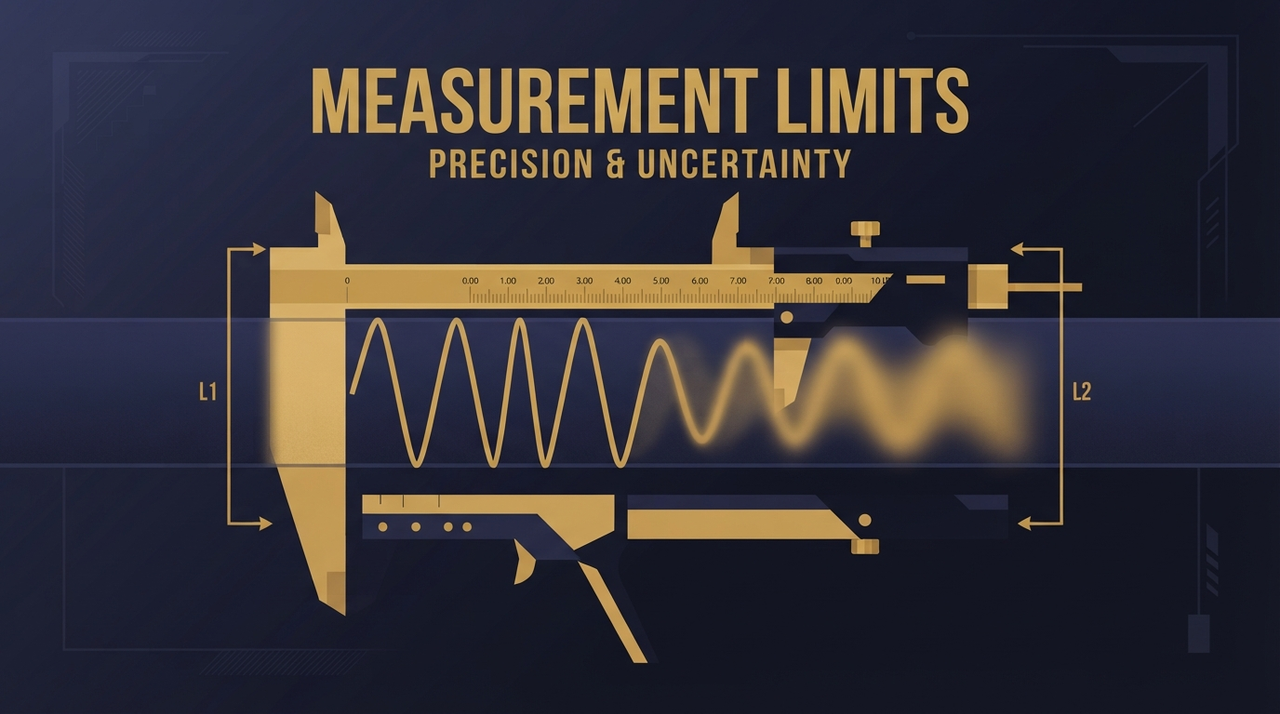
Theory-Laden Tools: The Limits of Scientific Instruments, Metrology, and Observation
Picture this: a lone astronomer in 1919, squinting at photographic plates during a solar eclipse. Arthur Eddington's team measures starlight bending around the sun, confirming Einstein's general relativity. But those measurements? They hinged on brass instruments calibrated with rulers etched by hand, telescopes ground to precise curves under gaslight. What if the tools themselves whispered theories into the data, shaping reality before our eyes ever glimpse it?
This is the essence of theory-laden tools—the idea that scientific instruments, our windows to the universe, are not neutral observers. They're forged in the crucible of prior theories, from the physics of light to the metrology of measurement. In this exploration, we'll map how these tools connect knowledge across domains, revealing the limits of observation that both constrain and propel discovery. For seekers charting visual webs between instruments and insights, this is your compass.
The Theory-Laden Nature of Scientific Instruments
Every scientific instrument embodies assumptions. A telescope doesn't just collect light; its mirrors and lenses are designed around wave optics, preconceived notions of how photons behave. Build it wrong, and galaxies blur into myth. Microscopes amplify this: electron microscopes hurl beams at samples, interpreting scatters through quantum mechanics. Without the theory, the image is gibberish.
Particle detectors like those at CERN's Large Hadron Collider (LHC) sift collisions for Higgs bosons, but their silicon sensors are tuned to Standard Model predictions. Sensors in smartphones—accelerometers, gyroscopes—trace back to the same lineage, embedding Newtonian mechanics into your pocket. These tools don't passively record; they actively filter reality through theoretical lenses, linking Technology Doors to raw physics.
From Mercury Thermometers to LIGO: A History of Metrology
Early Milestones in Precision Measurement
Metrology, the science of measurement, began humbly. In the 17th century, mercury thermometers replaced inconsistent body-heat guesses, enabling Galileo's rough temperature scales. Yet calibration was king: expand mercury against iron gauges, all predicated on uniform thermal expansion—a theory ripe for refinement.
Fast-forward to the 19th century: Michelson interferometers measured light's speed with mind-bending precision, paving Einstein's path. Each leap refined metrology, from steam-era workshops to laser-aligned labs.
Modern Marvels and Their Theoretical Roots
Enter LIGO, the Laser Interferometer Gravitational-Wave Observatory. Since 2015, its kilometer-long arms detect spacetime ripples from black hole mergers. But LIGO's mirrors hang on exquisitely isolated suspensions, calibrated against general relativity's predictions. Noise from cosmic rays, earthquakes, even passing trucks is subtracted—not magically, but via models baked into the software. This evolution ties historical measurement to today's Physics Doors, visualizing how tools evolve with theory.
Unveiling the Limits of Observation
Resolution: The Pixel Ceiling of Reality
No scientific instrument sees infinitely. Telescopes hit the diffraction limit—light waves smearing point sources into Airy disks. Hubble resolves quasars billions of light-years away, yet ground-based scopes tremble under atmosphere, demanding adaptive optics rooted in turbulent flow theory. Microscopes fare similarly: visible light caps at 200 nanometers; electrons push to atoms, but sample damage looms.
Noise, Calibration, and the Ghosts in the Machine
- Noise: Thermal jitter, quantum fluctuations—LIGO squeezes vacuum states to hear whispers quieter than atoms.
- Calibration: Rulers warp; clocks drift. Metrology standards, like cesium atomic clocks, anchor time to hyperfine transitions, a theoretical choice.
- Observer Effects: Not quantum mysticism, but tangible—like electron microscopes boiling samples or LHC beams perturbing particles. Distinguish this from woo: it's engineered physics, not consciousness collapsing waves.
These limits of observation form boundaries in your mental maps, where tools converge with knowledge gaps.
Mapping Connections: Instruments as Gateways
Visualize it: a concept graph with scientific instruments at nodes, edges to theories (optics, relativity), domains (Technology, Physics), and limits (resolution, noise). Telescopes link to cosmology; sensors to AI-driven analysis. Aetheria AI invites you to diagram these webs, spotting how metrology bottlenecks innovation—from climate sensors parsing noisy data to quantum computers probing subatomic realms.
Tools don't just measure the world; they sculpt our questions about it.
Invitation to Observe the Observers
Next time you trust a weather app's barometer or marvel at JWST images, pause. What theories lurk in those pixels? How do limits of observation redraw your map of reality? Dive into Aetheria AI's visual canvases—plot instruments against insights, trace metrology's threads through Physics and Technology Doors. Notice how tools shape what we notice, and watch the universe unfold anew.