
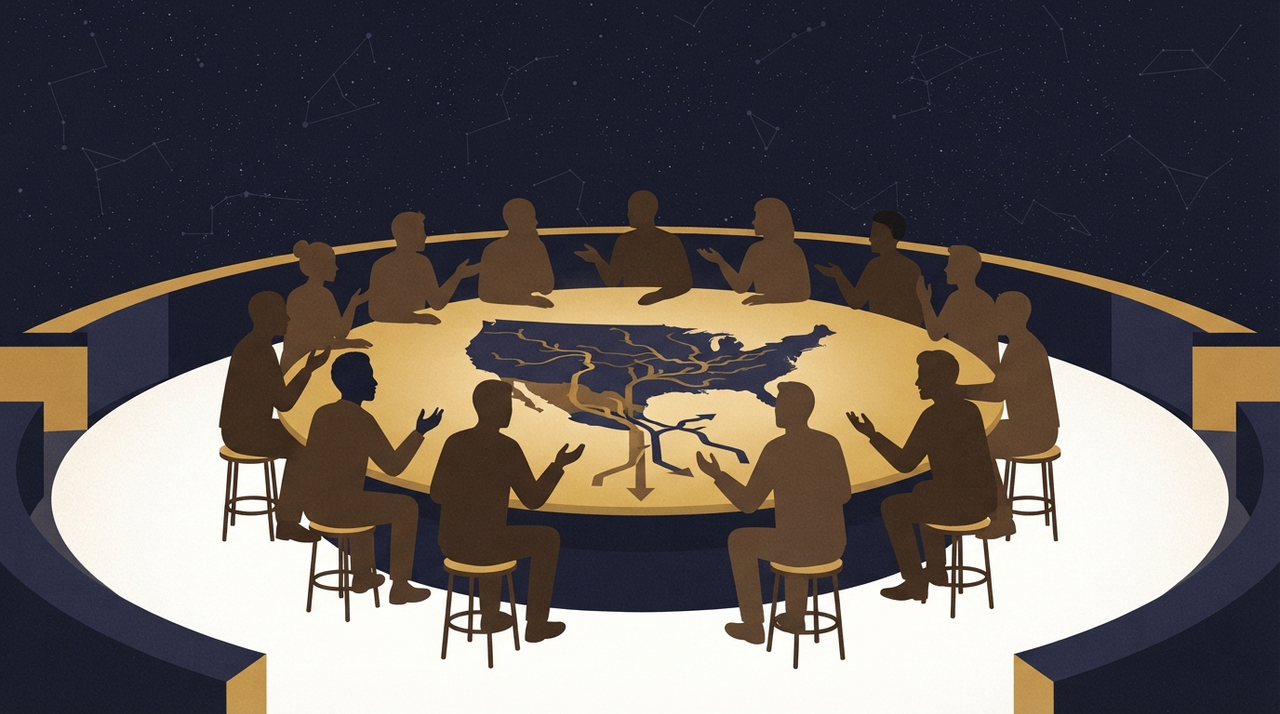
Who Decides the Future? Democratic Futures, Governance by Consent, and the Future of Work
Futures are not discovered like distant stars; they are decided, brick by deliberative brick, in the councils of the willing and the watchful. Picture this: a gathering under olive trees in ancient Athens, where citizens hashed out not just today's taxes but tomorrow's alliances. Or fast-forward to boardrooms in 1970s France, where futurists sketched paths through oil crises and technological upheavals. Who decides the future? It's the question echoing through history, one that demands we interrogate future governance consent today—especially as AI reshapes the future of work and meaning.
In an era where algorithms predict our next click and automation whispers obsolescence to entire professions, democratic futures aren't a luxury. They're the scaffolding for hope amid risk. This isn't about utopia sales or doom-scrolling prophecies. It's an open inquiry into possible futures plural: how communities consent to trajectories, balancing innovation's promise with the quiet dignity of meaningful labor. At Aetheria AI, we explore these through a Future of Humanity lens, inviting thoughtful readers to weigh governance, work, and communal future-making.
Echoes from History: Institutions That Shaped Future Governance
History brims with experiments in who decides the future. Take the Athenian boule of the 5th century BCE—a council of 500 citizens, drawn by lot, tasked not only with daily decrees but with long-view strategies. They debated naval expansions and grain imports years ahead, embedding foresight into democracy's DNA. This wasn't elite prophecy; it was collective deliberation, where ordinary voices vetoed reckless paths.
Across the Atlantic, the Iroquois Grand Council refined this art over centuries. Their Great Law of Peace outlined decision-making for seven generations ahead—a veto power for the unborn, woven into confederacy protocols. Chiefs from allied nations convened in longhouses, weighing environmental stewardship against wartime gains, ensuring futures weren't mortgaged for present comforts.
Leap to the 20th century: France's Commissariat général du Plan (1946) institutionalized futures thinking post-WWII. Jean Monnet's team orchestrated economic foresight, projecting infrastructure and industrial shifts. Japan followed suit with its Futures Commission in the 1970s, navigating the oil shocks by modeling energy transitions and tech investments. These weren't oracles but institutional choices, grounding speculation in data and debate.
What unites them? Future governance consent through structured inclusion. They remind us: foresight thrives when diverse hands steer the wheel.
Navigating the Landscape: Scenarios, Ethics, Institutions, and Lived Realities
Scenario Planning vs. Ethical Argument
Scenario planning, pioneered by Shell in the 1970s, paints vivid possible futures plural—branching narratives like 'high-regulation AI utopia' or 'decentralized gig collapse.' It's probabilistic mapping, not prediction. Ethical argument layers in: Should AI displace truckers without retraining consent? Institutions then operationalize—think global AI safety summits or national workfare reforms.
The Primacy of Lived Experience
Amid abstractions, affected communities anchor truth. Fisherfolk facing ocean automation or artists amid generative AI floods bring visceral stakes. Their testimonies—lost crafts, eroded identities—cut through models, demanding veto rights in democratic futures. True governance listens here, blending data with the texture of human striving.
Frameworks for Consent: Vetoes, Representation, and the Future of Work
At the heart of future governance consent lie frameworks that honor agency. Consent isn't passive nod; it's active co-creation. Veto power, as in Iroquois tradition, halts trajectories harming downstream generations. Representation of the unborn? Imagine proxy advocates in AI ethics boards, auditing job displacement models for intergenerational equity.
Then, the future of work and meaning. As AI automates routine labor, what sustains purpose? Frameworks pivot from wage slavery to creative commons: universal basic services funding apprenticeships in regenerative design, or community data trusts democratizing AI benefits. Risk and hope eschew spectacle—no viral TED panaceas—but steady cultivation: risk as shared ledger, hope as consented experiments.
Governance without consent is just coercion dressed in forecasts.
Pathways Compared: Market-Led, State-Led, Commons-Led Futures
Chronology and Functions
Market-led futures surged post-1980s deregulation: venture capital scouts disruptions, from Silicon Valley's app economy to crypto DAOs. Function? Rapid iteration, profit signals innovation. State-led, rooted in mid-20th century planning, endures in China's AI infrastructure or EU's GDPR—central coordination for scale.
Commons-Led: The Emerging Third Way
Commons-led traces to open-source movements (Linux, 1990s) and platform co-ops today. Function: peer governance, shared ownership. Differences? Markets chase returns (counter: inequality spikes); states enforce equity (counter: innovation lags); commons balance via consent protocols (counter: scaling hurdles).
- Market: Fast, unequal—e.g., Uber's gig precarity.
- State: Stable, bureaucratic—e.g., Soviet overplanning.
- Commons: Inclusive, experimental—e.g., Wikipedia's enduring knowledge.
No pathway monopolizes truth; hybrids beckon, consented by communities.
The Geometry of Futures: Place, Scale, Power, Resources
Futures unfold in contours of place (rural vs. urban divides), scale (local food sovereignty vs. global supply chains), power (who codes the AI?), and resources (data as the new oil). Visibility matters: opaque algorithms breed distrust; transparent ledgers invite consent. In democratic futures, map these explicitly—audit power asymmetries, localize where scale permits, ensuring no corner of humanity is siloed from decision.
Embracing Possible Futures Plural
We reject singular sales pitches—no techno-utopia, no collapse porn. Possible futures plural demand pluralism: a market-state-commons braid, tailored by consent. The who decides the future puzzle yields no oracle, only invitation to participate. Precision eludes; wisdom compounds through iterated choice.
Cross-Doors: Expanding the Inquiry
This exploration portals to kindred realms. In Business & Leadership, probe AI stewardship in boardrooms. Politics & Economics unpacks policy levers for work's reinvention. Relationships considers communal bonds in flux, while Personal Growth equips you for consent-driven lives.
Your Reflective Next Step: Journaling the Future You Consent To
Pause. What community claims you—profession, neighborhood, online kin? What future would you consent to build? Grab a journal. Sketch three possible futures plural: one market-tinged, one collective, one wild card. Note risks, hopes, vetoes. Who must join the council? This isn't armchair futurism; it's the seed of democratic futures.
In consenting, we decide. The future awaits your mark.