
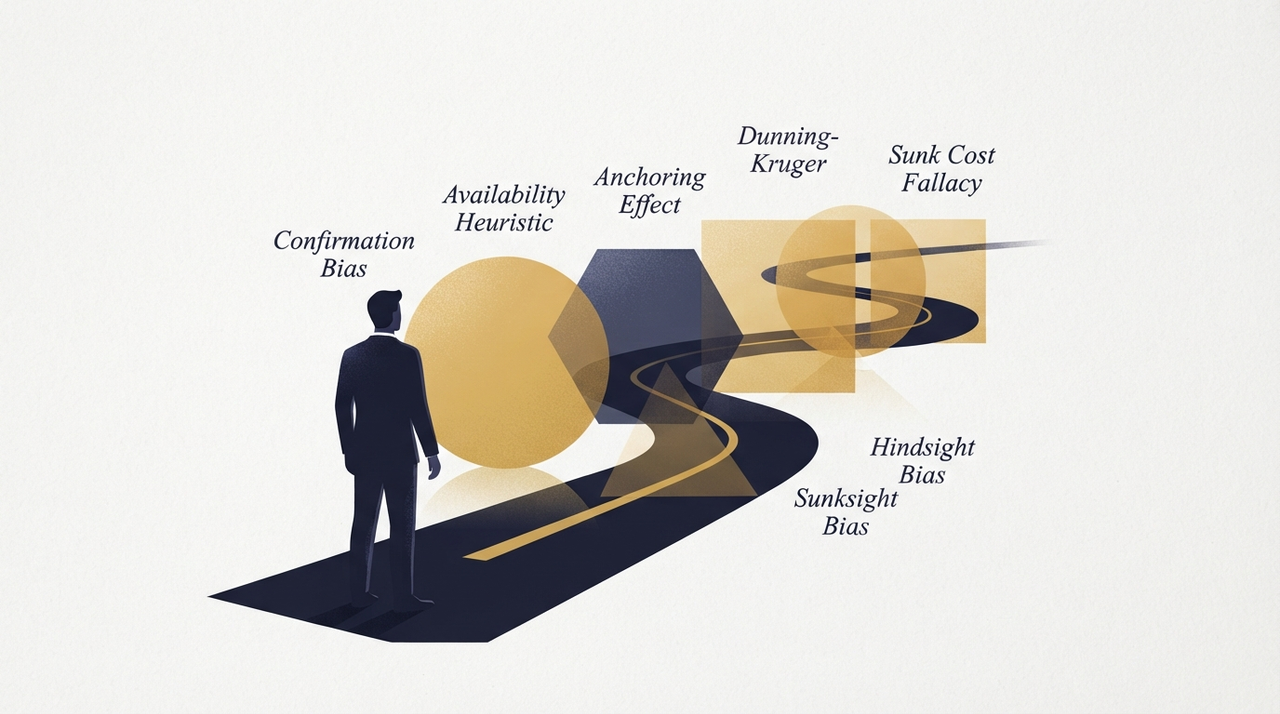
Cognitive Biases Unveiled: Kahneman & Tversky's Heuristics, Availability, Anchoring, and Loss Aversion in Decision Making
Picture this: You're at the airport, scrolling through news of a recent plane crash. Your heart races, palms sweat, and suddenly, booking that cross-country flight feels like tempting fate. Yet statistically, driving remains far deadlier. Why does the vivid headline eclipse the dry data? This is the subtle sorcery of cognitive biases—mental shortcuts that shape our decision making in ways we rarely notice.
At the heart of this psychological drama lie Daniel Kahneman and Amos Tversky, whose groundbreaking work in the 1970s revolutionized our understanding of the human mind. Their insights into heuristics—those intuitive rules of thumb—and specific biases like availability, anchoring, and loss aversion, peeled back the curtain on why we so often stumble in judgment. For intellectually curious explorers navigating Aetheria AI's Psychology Door, this isn't just history; it's a mirror to our own flawed brilliance. Let's journey through their legacy, unpacking these forces with real-world grit, while acknowledging the shadows of uncertainty that linger.
The Architects of Psychology History: Kahneman and Tversky's Revolution
In the staid labs of the 1970s, amid the rise of behavioral economics, two Israeli psychologists dared to challenge the rational actor model dominating economics and decision theory. Kahneman, a psychologist steeped in perception, and Tversky, a mathematician with a probabilistic bent, met at Hebrew University. Their collaboration birthed a paradigm shift, detailed in seminal papers like "Judgment Under Uncertainty: Heuristics and Biases" (1974).
They posited that under uncertainty, our brains don't crunch numbers like computers. Instead, we rely on heuristics—fast, frugal strategies that often lead us astray. Kahneman later won the Nobel Prize in Economics in 2002 (Tversky had passed away), cementing their place in psychology history. But theirs was no tidy theory; it was forged in experiments revealing how cognitive biases warp probability judgments, from gamblers' fallacies to investors' hunches.
Fast-forward: Their ideas underpin nudge theory, AI ethics, and even policy design. Yet, as we'll explore, replication debates and cultural variances remind us this is evolving science, not gospel.
The Availability Heuristic: When Memory Trumps Math
Ever wonder why shark attacks dominate beach conversations more than heart disease, despite the odds? Enter the availability heuristic, one of Kahneman and Tversky's cornerstone heuristics. We judge an event's likelihood by how easily examples spring to mind, not objective frequency.
Concrete Example: Media and Mortality
Consider post-9/11 fears. Vivid replays of collapsing towers made terrorism loom larger than car wrecks or flu outbreaks, skewing public risk perception. Kahneman and Tversky demonstrated this in studies where participants overestimated causes of death spotlighted in news—homicides over asthma, plane crashes over diabetes.
In decision making, this heuristic falters when media amplifies rarity. Investors dump stocks after a market dip headline, ignoring long-term trends. Or parents vaccinate less amid anecdotal autism stories, blind to epidemiological data.
Ties to Consciousness and Attention
Here, availability whispers to Aetheria's Consciousness Door: What grabs attention shapes what's "available." Salient stimuli hijack our spotlight, echoing selective perception studies. It's a bridge to epistemology in the Philosophy Door—how do biased recall and attention undermine justified belief?
Anchoring: The Invisible Tether in Negotiation and Beyond
Imagine haggling for a used car. The seller quotes $20,000. You counter $15,000, but settle at $18,000. That initial number? It's an anchor, pulling your final judgment toward it, regardless of merit.
Kahneman-Tversky Experiments: Roulette Wheel Revelations
Their classic demo: Spin a wheel rigged to land on 10 or 65, then ask UN estimates of African countries. Those seeing 10 guessed 25%; 65, 45%. Absurd, yet the arbitrary anchor biased experts.
Real stakes abound. In court, prosecutors' high sentencing demands anchor juries higher, even if adjusted down. Shoppers fixate on "original" prices slashed 50%, deeming deals better. Anchoring thrives because we insufficiently adjust from the starting point—a cognitive bias hardwired for efficiency.
Modern Echoes in Tech and Markets
AI pricing algorithms exploit this; first offers set the frame. Yet cultural limits emerge: Collectivist societies may anchor less to individuals, prioritizing group norms.
Loss Aversion: Why Losses Sting Twice as Hard
Prospect theory, Kahneman and Tversky's 1979 masterpiece, unveiled loss aversion: Losses hurt roughly twice as much as equivalent gains feel good. A $100 gain sparks mild joy; a $100 loss, sharp pain.
Everyday Gambles: Mug Experiments and Beyond
- Endowment Effect: Own a mug? Demand $7 to sell; buy one? Pay $3. Ownership amplifies perceived value.
- Status Quo Bias: Utility companies default to green energy; opt-outs dwindle because change feels like loss.
- Investment Traps: Holding crashing stocks longer than buying equivalents—sunk costs as losses loom.
In politics, framing taxes as "cuts" (gains) versus "hikes" (losses) sways votes. This asymmetry explains inertia: We'd rather avoid pain than chase pleasure.
Shadows of Doubt: Replication, Culture, and Open Questions
Kahneman himself flagged uncertainties. The replication crisis rocked psychology; some heuristics hold firm, others wane under scrutiny. Availability shines in meta-analyses, but effect sizes vary. Anchoring persists across domains, yet lab-to-life translations falter.
Cultural limits abound: Western individualism amplifies loss aversion; East Asian contexts temper it with harmony. Gender, expertise, mood modulate too. Scholarly interpretations evolve—neuroscience pins these to System 1 (fast, intuitive) versus System 2 (slow, deliberate), per Kahneman's Thinking, Fast and Slow.
As Kahneman reflected, these biases are "features, not bugs" of our adaptive minds—trade-offs for survival in ancestral wilds.
Modern speculation swirls: AI could mimic or mitigate them, training models on debiased data. Ties to epistemology question: Can we ever escape biased knowing?
Weaving Threads: From Psychology to Broader Inquiry
These Kahneman Tversky insights ripple. Availability links to attention's fickle gaze in the Consciousness Door—why mindfulness practices recalibrate mental availability. Anchoring probes epistemological anchors: What first principles truly ground knowledge?
No panaceas here; awareness sparks deliberation, not erasure. In an AI era, understanding cognitive biases equips us to design humane systems, questioning machine "rationality" against human depth.
Invitation to the Abyss of Mind
Kahneman and Tversky didn't hand us a flawless map of decision making; they lit a lantern in the fog of heuristics. As you mull your next choice—be it a bet, a buy, or a belief—pause. What availability floods your mind? What anchor tugs unseen? What loss haunts?
Dive deeper through Aetheria AI's doors: Explore attention's role in the Consciousness Door, or epistemological pitfalls in the Philosophy Door. What biases beckon you next? The inquiry awaits.