
Mapping the Mind: Neuroscience History from Phrenology to Brodmann Areas and Modern Brain Atlases
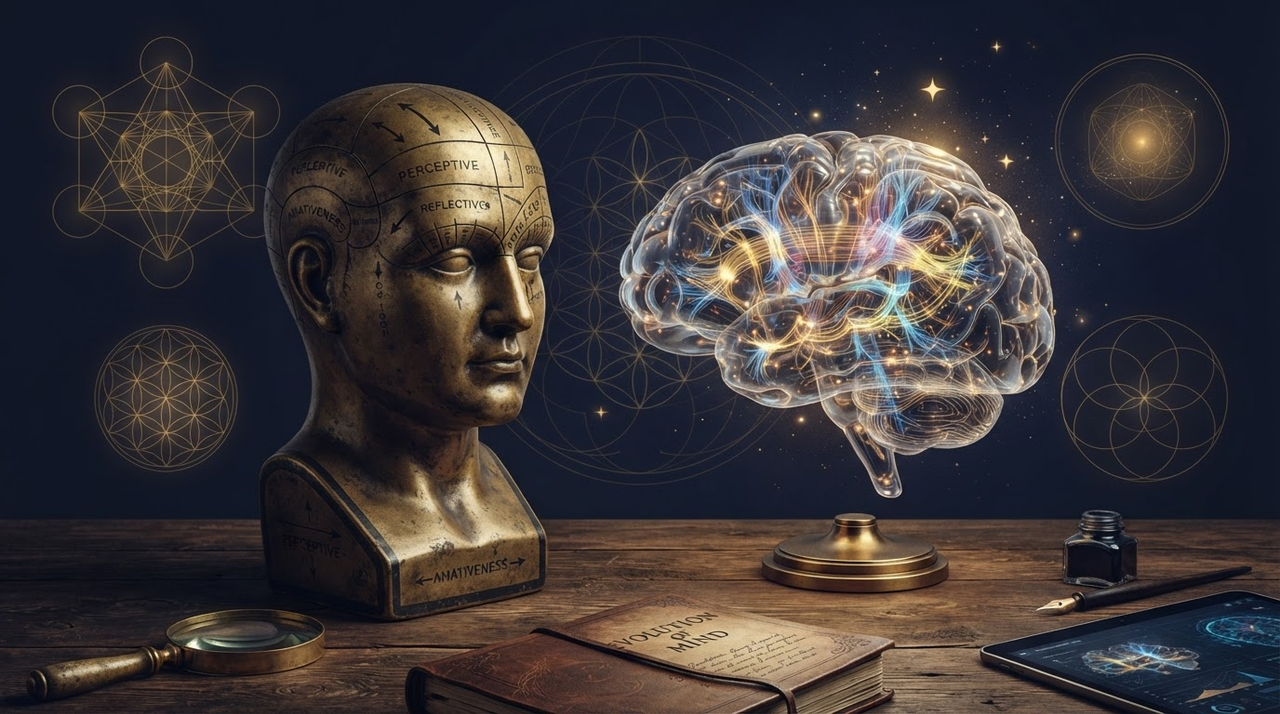
Picture a dimly lit parlor in 19th-century Europe. A practitioner runs fingers over the contours of your skull, declaring your propensities for combativeness or benevolence. This was phrenology, the audacious first stab at mapping the mind—a pseudoscience that, for all its flaws, ignited humanity's quest to chart the brain's hidden territories. In the sweeping history of neuroscience, this journey from skull-bump fortune-telling to sophisticated brain atlases reveals not just scientific triumphs, but profound lessons in humility and the slippery nature of localization of function.
Today, as explorers in Aetheria's Knowledge Library, we trace this path. From early speculations to probabilistic maps of neural circuitry, understanding the brain's architecture demands we distinguish ironclad findings from tantalizing correlations—and always question our interpretations.
Phrenology: The Spark of Brain Mapping
In the late 1700s, Franz Joseph Gall proposed that mental faculties resided in distinct brain regions, their sizes reflected in skull bumps. Phrenology swept Europe and America, appealing to its era's craving for empirical self-knowledge. Practitioners divided the skull into 27+ "organs," each tied to traits like amativeness or ideality.
Its allure? Democratized psychology—no Latin required, just touch. Yet rigorous tests exposed its folly: no consistent links between bumps and behaviors. By mid-century, phrenology crumbled under scientific scrutiny, but it planted a seed: the brain might hold functions in specific locales. This notion of localization of function endured, tempered by critics like Pierre Flourens, who showed lesion studies yielded diffuse deficits, not pinpoint losses.
The 19th-Century Localization Revolution
Broca and Wernicke: Speech's Neural Homes
Paul Broca's 1861 autopsy of a speech-impaired patient pinpointed a left-frontal lesion—now Broca's area—for production. Carl Wernicke's 1874 work identified a temporal counterpart for comprehension. These clinical-pathological correlations, blending autopsies with symptom observation, marked neuroscience's maturation. Methods evolved: precise lesion mapping via emerging microscopy.
Yet context matters. These were single cases amid Victorian asylums; individual variability loomed large. Still, they propelled the neuroscience history toward structured atlases.
Brodmann Areas: Cytoarchitecture's Precision
Enter Korbinian Brodmann in 1909. Dissecting thousands of brains, he stained slices to reveal cellular layers—cytoarchitecture—and delineated 52 areas by microscopic patterns. Brodmann's map, a cornerstone of brain atlases, linked structure to presumptive function: area 17 for vision, 4 for motor control.
- Area 44/45 (Broca's): Expressive language.
- Area 22 (Wernicke's): Auditory processing.
- These endure as references, though refined by function.
Brodmann's genius lay in standardization, yet he noted individual deviations—foreshadowing today's probabilistic views.
Modern Brain Atlases: From Static Maps to Dynamic Networks
Probabilistic Atlases and Connectomes
fMRI and diffusion imaging shattered rigid boundaries. Brains vary wildly; functions overlap. Enter brain atlases like the Allen Brain Atlas (2000s), gene-expression maps across species, and the Human Connectome Project (2010+), charting 1,000+ subjects' wiring via tractography.
These are probabilistic: area X activates 80% in task Y. Uncertainty reigns—plasticity reshapes maps, correlations ≠ causation. Historical methods (lesions, stains) yielded snapshots; modern ones capture flux, but interpretation demands caution. No neuroessentialism here: traits aren't skull-locked or area-bound.
Humility in the History of Neuroscience
The brain defies tidy cartography; its essence eludes full capture.
Phrenology's bust reminds us: enthusiasm outpaces evidence at peril. Cross to Philosophy's Door: does localization solve mind-brain riddles? Psychology's: functions localize yet distribute. Established: Brodmann's structures. Tentative: precise roles. Embrace uncertainty—protect the journey.
Next Steps for Seekers
As a Foundation Stone in Aetheria's Neuroscience Door, this history of neuroscience invites open inquiry. Dive deeper: Allen Atlas online, HCP datasets. Ponder: What unmapped realms await? Your mind's map unfolds uniquely—chart it with curiosity.