
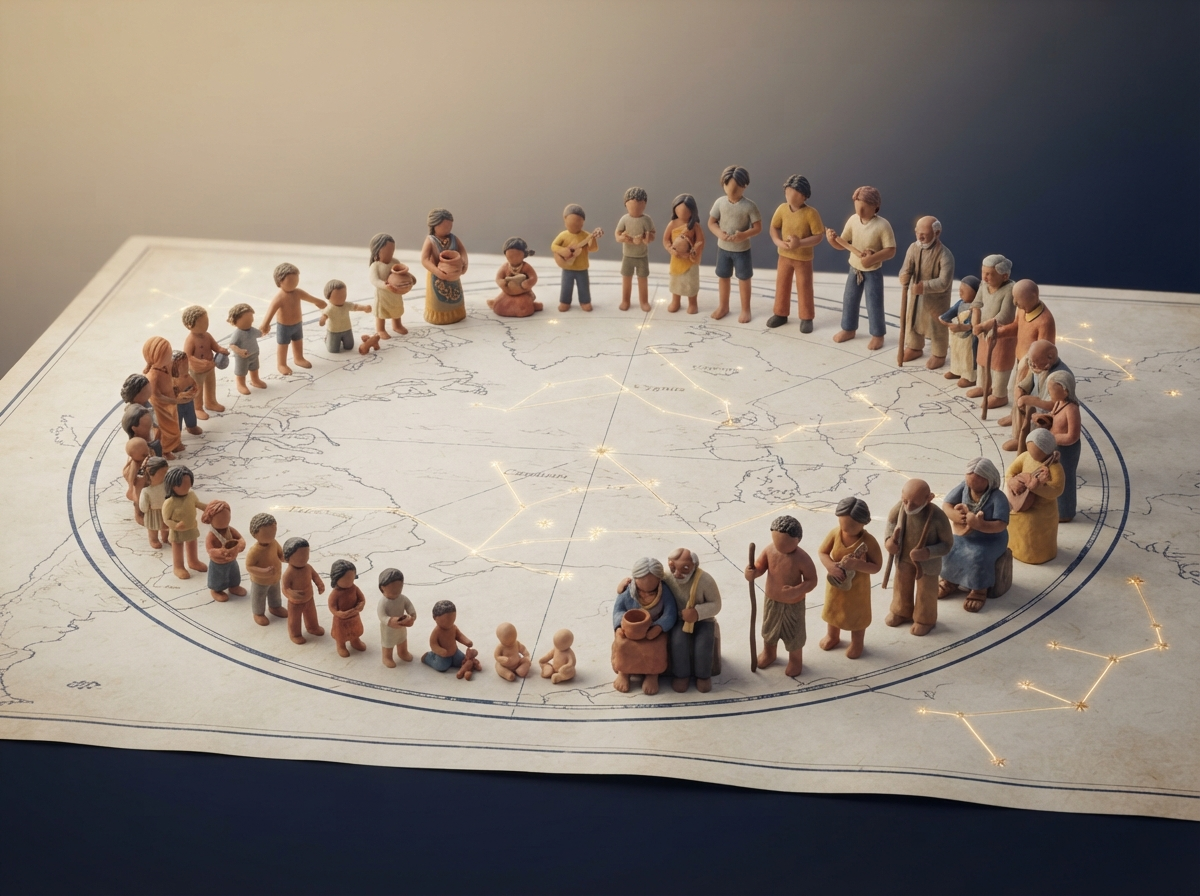
Shaping Identity in Place and Time: Cultural Psychology, Lifespan Development, and Clinical History
Imagine a child in a bustling Tokyo market, weaving through vendors' calls, absorbing the rhythm of collectivity before uttering her first words. Contrast that with a toddler on a vast American ranch, exploring boundless space, her sense of self budding in isolation's quiet expanse. Identity does not emerge in a vacuum—it crystallizes in place and time, sculpted by the invisible hands of culture, the relentless march of lifespan development, and the shadowed corridors of clinical history. These three strands of psychology interlace to reveal how we become who we are, not as isolated atoms, but as beings profoundly shaped by context.
Cultural psychology illuminates how societal tapestries color our inner worlds. Developmental psychology charts the trajectory from infancy's raw potential to elderhood's reflective wisdom. And the history of clinical psychology, with its triumphs and tribulations, reminds us of the delicate balance between healing and harm in addressing mental health and culture. Together, they offer a humane lens on human becoming, inviting thoughtful readers to ponder their own stories amid these forces.
The Lifespan Arc: Foundations of Developmental Psychology
Lifespan development frames human growth not as a linear sprint but as a winding river, carving deeper channels with each decade. From the neonate's reflexive grasp to the octogenarian's contemplative gaze, developmental psychology posits that identity evolves continuously, influenced by biology, experience, and environment. This perspective underscores that who we are at 30 is not fixed but a provisional sketch, subject to revision across the lifespan.
Central to early cognition are the contrasting models of Jean Piaget and Lev Vygotsky. Piaget envisioned development as a series of universal stages—sensorimotor, preoperational, concrete operational, formal operational—where children actively construct knowledge through interaction with the physical world. Picture a four-year-old stacking blocks, intuiting conservation as towers topple and reform. Yet Piaget's stage theory, elegant in its universality, overlooks the social scaffolding that Vygotsky championed.
Piaget vs. Vygotsky: Solo Exploration or Social Symphony?
Vygotsky's zone of proximal development flips the script: what a child can do alone pales beside what she achieves with guidance from more knowledgeable others. Language, tools, and culture mediate this growth, turning solitary play into collaborative mastery. In a Russian classroom of Vygotsky's era, peers debating a folktale might propel one child's understanding forward, a dynamic Piaget's lab-based observations missed. These models, complementary rather than competitive, highlight tension between innate maturation and cultural nurture in shaping developmental psychology.
Attachment research, pioneered by John Bowlby and Mary Ainsworth, adds emotional depth. Secure base theory posits that early bonds with caregivers forge internal working models of self and others, rippling across the lifespan. The Strange Situation paradigm reveals attachment styles—secure, anxious, avoidant, disorganized—but cultural caveats abound. Western emphasis on independence yields more avoidant patterns, while collectivist societies prioritize interdependence, fostering attachments attuned to harmony over autonomy. Thus, lifespan development is not a one-size-fits-all blueprint but a culturally inflected odyssey.
Aging: Wisdom's Quiet Revolution
The far shore of lifespan development, aging, challenges stereotypes of decline. Erik Erikson's stages culminate in integrity vs. despair, where elders review lives for meaning. Research shows selective optimization with compensation: older adults hone emotional wisdom, prioritizing positive memories (positivity effect) and complex social understanding. In Japan, ikigai—purposeful aging—embodies this, contrasting Western fears of obsolescence. Developmental psychology thus reframes later life as culmination, not coda, enriching identity's tapestry.
Cultural Psychology: The Invisible Architect of Self
Cultural psychology asserts that the mind is not a universal machine but a product of its milieu. Identity, far from innate, emerges from self-construals molded by place: independent in the West, interdependent in the East. Hazel Markus and Shinobu Kitayama's seminal work contrasts these: Americans view the self as a bounded entity, spotlighting personal traits; Japanese see it as relational, contextual flux. A New Yorker might boast, "I'm creative," while a Kyotan's narrative embeds "I" in family legacies.
Emotions in Cultural Codes
Display rules govern emotions too. Westerners prize authenticity, tears flowing freely in therapy; many Asian cultures favor restraint, saving face amid grief. Dialectical thinking in East Asia embraces contradiction—joy laced with sorrow—while linear Western logic seeks resolution. These variances shape mental health and culture, as suppressed emotions in one context signal resilience, pathology in another.
Memory Narratives: Stories We Tell Ourselves
Autobiographical memory bends to cultural winds. Americans craft redemption arcs—triumph over adversity—fostering agency; East Asians emphasize continuity, lessons from kin shaping collective identity. The WEIRD bias (Western, Educated, Industrialized, Rich, Democratic) pervades psychology: most studies draw from 80% of citations but 12% of humanity, skewing universals. Indigenous psychologies counter this—Navajo harmony with nature, Ubuntu's African "I am because we are"—as vital knowledges reclaiming cultural psychology's breadth.
These insights demystify why identity feels fluid across borders, urging humility in psychological claims.
Clinical Psychology History: From Shadows to Support
Clinical psychology history traces a path from institutional chains to empathetic dialogue, distinct from developmental or cultural inquiries. It focuses on alleviating distress through evidence-based support, not general human exploration. Early asylums, like Bedlam in 18th-century London, warehoused difference as madness, moral treatments emerging with Philippe Pinel unchaining patients in revolutionary France—a humane pivot, yet paternalistic.
From Freud to Manuals: Evolution and Pitfalls
Psychoanalysis shifted to talk therapy, Sigmund Freud probing unconscious conflicts, but scalability demanded structure. Behaviorism (Watson, Skinner) and humanism (Rogers, Maslow) diversified, culminating in diagnostic manuals like DSM-I (1952), evolving to DSM-5's dimensional nuance. These tools standardize clinical psychology history, aiding reliability yet risking reification of norms.
Historical harms loom large: pathologizing homosexuality (depathologized 1973), drapetomania labeling enslaved people's flight as illness, institutional abuses like Willowbrook's neglect. Lobotomies and electroconvulsive therapies, once routine, highlight power imbalances. Colonial psychiatry imposed Western frames on indigenous distress, mistaking cultural idioms for disorder. These underscore distinguishing findings (observable patterns) from interpretations (causal narratives), vital for ethical mental health and culture intersections.
Today, clinical support emphasizes cultural competence, trauma-informed care, distinguishing professional intervention from self-inquiry—no symptom checklists or treatments here, only history's cautionary wisdom.
Weaving the Strands: Identity's Broader Echoes
These threads—lifespan development, cultural psychology, clinical history—intertwine with philosophy's meditations on self, writing and memory's life narratives, even death and afterlife's meaning in suffering. Together, they affirm identity as dynamic, contextual, resilient.
Reflective Horizons: Journaling Your Path
Pause amid these insights. Consider these open inquiries:
- How has your cultural place shaped a key developmental milestone, from childhood attachment to midlife shift?
- In what ways do your self-construal and emotion stories reflect or resist your heritage's display rules?
- What lessons from clinical psychology history guide your approach to personal growth and mental health and culture?
Let these questions stir your narrative, fostering understanding in place and time.