
Sleep Stages Explained: Neuroscience of Dreams, Consciousness, and Sleep Architecture
Picture this: you drift off under a canopy of stars, only to awaken in a bustling marketplace from centuries past, bartering with shadowy figures. Was that a dream, a glitch in consciousness, or your brain's nightly masterpiece? Sleep neuroscience reveals the hidden architecture beneath these nocturnal adventures, mapping stages that cycle through the night like waves on an unseen ocean. Far from mere rest, sleep unfolds in precise layers—each with its own neural symphony—shaping dreams, memory, and even our sense of self.
In this exploration of sleep stages explained, we'll dissect the neuroscience of dreams and consciousness, from slow-wave depths to vivid REM theaters. No productivity sermons here—just the raw mechanics of how your brain builds its nightly world.
Sleep Architecture: The Nightly Cycle Revealed
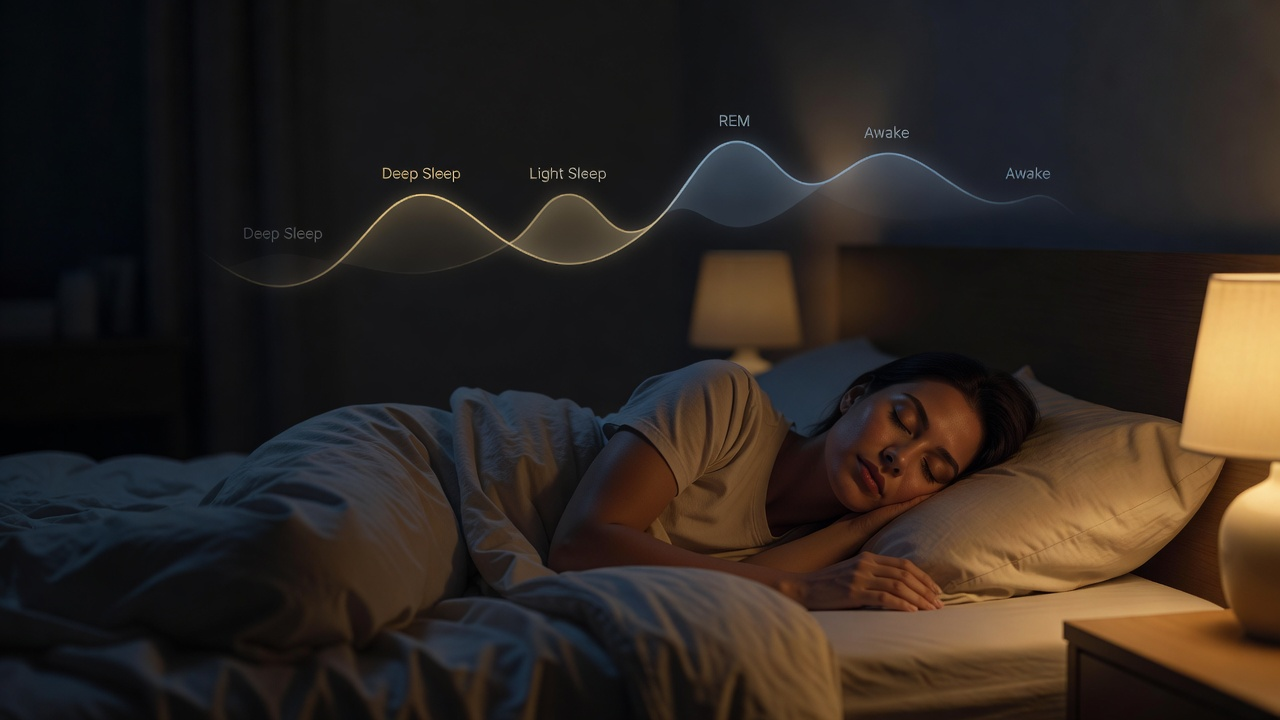
Your sleep isn't a flat line of oblivion. It's a dynamic structure, cycling every 90 minutes or so through non-REM and REM phases, tracked via polysomnography—a gold-standard toolkit blending EEG for brain waves, EOG for eye movements, and EMG for muscle tone.
Non-REM Stages: The Foundations of Restoration
Stage N1 kicks off lightly: theta waves emerge as you teeter on wakefulness, lasting mere minutes. Then N2 dominates half the night, marked by sleep spindles—bursts of 12-14 Hz activity shielding the brain from noise—and K-complexes, sharp waves that consolidate memories. Dive deeper into N3, slow-wave sleep (SWS), where delta waves (0.5-4 Hz) thunder like distant drums, fueling physical repair and immune boosts.
Here, consciousness dims; reports of mentation are sparse, fragmented—like half-remembered whispers—challenging old notions of sleep as total blackout.
REM Sleep: Epicenter of Dream Research
Enter REM, the rapid eye movement stage where dreams ignite. Brain activity mirrors wakefulness—beta waves buzzing, eyes darting behind lids, muscles paralyzed to prevent acting out plots. This is dream research territory: vivid narratives unfold, blending recent events with ancient fears.
Yet, sleep neuroscience draws a crucial line: polysomnography measures the state, not the story. EEG patterns predict REM likelihood, but awakening yields the dream report. Consciousness neuroscience debates rage—does NREM harbor covert awareness? Pattern-matching experiments hint yes, but evidence stays bounded, no grand revelations.
The Drives: Circadian Rhythm and Homeostatic Pressure
What Orchestrates the Dance?
Two forces conduct this ballet. Circadian drive, your suprachiasmatic nucleus's 24-hour clock, peaks sleepiness at night via melatonin surges. Homeostatic pressure builds like a debt—the longer awake, the more adenosine accumulates, craving SWS repayment.
Together, they sculpt architecture: early nights heavy on SWS, later ones tipping to REM. Disrupt one, and dreams warp, consciousness frays.
Consciousness Neuroscience: Dreams Under the Scanner
fMRI lights up dreamscapes—REM activates visual cortices, amygdala for emotions—but decoding specifics falters. Brain scans spot when dreaming brews, not what. Limits abound: vast interpersonal variance, no universal dream lexicon. Interpretation stays interpretive, not prophetic.
This consciousness neuroscience frontier echoes broader mysteries: sleep as a bounded realm where self dissolves, yet insights emerge. Explore further via our Sacred Time Door for timeless rhythms, or the Consciousness Doors for awakening layers.
Your Invitation: Track the Threshold
Next time you surface from slumber, note the clock. Align sleep onset with circadian dusk? Journal the dream's essence—not for proof, but pattern. In this quiet experiment, sleep stages explained become personal, bridging neuroscience to your inner cosmos. What worlds await?