
Unpacking Asch, Milgram, and Sherif: Conformity, Obedience, and Group Dynamics in Social Psychology
Imagine a dimly lit room in 1950s Princeton. You're handed a simple task: match the length of one line to another among three choices. Easy, right? But as confederates around the table chime in with the blatantly wrong answer, doubt creeps in. Do you trust your eyes or the group's consensus? This scene from Solomon Asch's experiments captures the essence of conformity in social psychology—a force that bends individual judgment under social pressure.
In the shadow of World War II, researchers like Asch, Stanley Milgram, and Muzafer Sherif probed the uncomfortable truths of human behavior: how ordinary people conform, obey authority, and form divisive group dynamics. These landmark studies illuminate the interplay of norms, power, and prejudice, offering timeless insights into why we follow the crowd, heed commands, or clash in tribes. Yet, popular retellings often amplify their drama—portraying blind obedience or universal submission—while the evidence reveals nuance, resistance, and ethical thorns.
Asch's Line Experiments: The Power of Conformity
Postwar America grappled with how Nazi sympathizers emerged from everyday citizens. Solomon Asch, in 1951, designed deceptively simple perceptual tasks to test conformity. Participants sat with seven confederates who deliberately picked the incorrect matching line. Unaware of the setup, the real subject answered last.
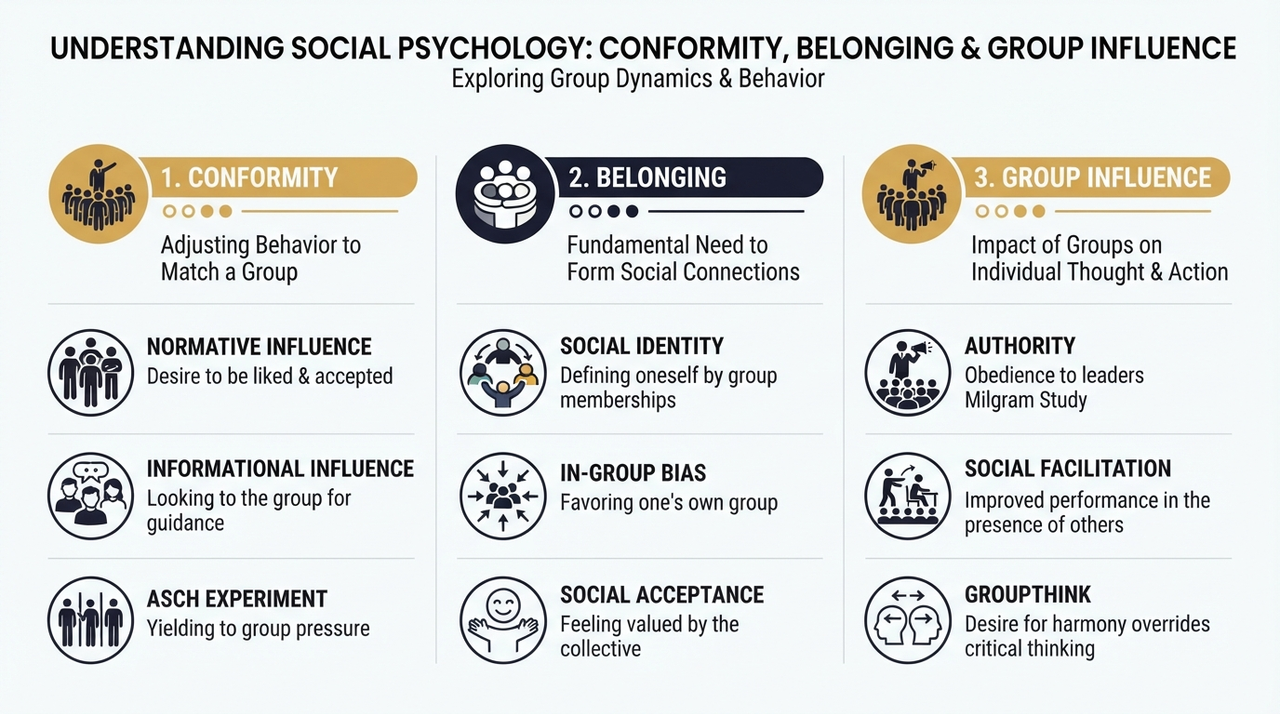
Results? About 75% conformed at least once across 12 critical trials, yielding a 37% conformity rate per trial. But here's the key distinction from myth: 25% never conformed, and even conformers often agonized, whispering doubts. Asch showed informational influence (seeking group wisdom in ambiguity) and normative pressure (fitting in to avoid ridicule). Replications worldwide confirm robustness, though rates dip in collectivist cultures emphasizing harmony less dramatically than popularly claimed.
From Lab to Life: Norms Shaping Behavior
These findings underscore how social norms silently steer us, from fashion trends to misinformation echo chambers. Yet, Asch's deception raised early ethical flags—did stress harm participants?—paving the way for modern informed consent standards. Dive deeper into these dilemmas via our Ethics Door.
Sherif's Robbers Cave: Group Dynamics and Prejudice
Muzafer Sherif took social psychology outdoors in 1954, staging a boys' summer camp at Oklahoma's Robbers Cave State Park. Two groups of 12-year-olds formed naturally, then competed in tug-of-war, baseball, and raids. Hostility erupted: name-calling, flag burnings, cafeteria brawls. Prejudice wasn't innate but forged in conflict over resources.
Sherif's realistic conflict theory posits group dynamics breed in-group favoritism and out-group bias under scarcity. Resolution came via superordinate goals—like fixing a water truck—fostering cooperation. Critiques note small samples and observer effects, but replications, including adult simulations, affirm the pattern. Popular lore exaggerates instant hatred; evidence shows it builds gradually, tied to competition.
Prejudice as a Social Construct
Sherif's work demystifies prejudice, linking it to institutional rivalries rather than inherent flaws. Ethical concerns? Real aggression scarred boys emotionally. For historical context on such field experiments, visit our History Door.
Milgram's Shock Studies: Obedience to Authority
Inspired by Eichmann's trial, Stanley Milgram asked in 1961: How far would people go under orders? "Teachers" administered escalating shocks (15-450V, labeled "XXX") to a stoic "learner" (actor) for wrong answers. An experimenter in a lab coat urged continuance: "The experiment requires that you continue."
65% obeyed to the maximum—far higher than predicted—but subjects sweated, stammered protests, rarely laughing maniacally as myths suggest. Gradual escalation, authority proximity, and institutional veneer fueled compliance. Replications yield 50-90% obedience, varying by culture (lower in Australia) and reminders of responsibility.
Ethical Storms and Enduring Lessons
Milgram's deception induced severe stress—screams taped, participants deceived—sparking APA reforms. Critiques highlight Yale prestige's role, yet power's pull persists in modern simulations.
Bridging Studies: Power, Institutions, and Modern Echoes
Asch, Sherif, and Milgram converge on social psychology's core: authority symbols, group norms, and institutional cues override personal ethics. Conformity yields to peers, obedience to experts, prejudice to rivals. Culturally, WEIRD (Western, Educated, Industrialized, Rich, Democratic) biases limit universality, but principles hold.
Today, they explain viral challenges, polarized politics, corporate scandals. Not deterministic—resistance abounds—but a call to question influences. These aren't tales of monsters, but mirrors to our shared vulnerability.
In understanding these dynamics, we reclaim agency from the crowd.