
Ethiopian Orthodox Bible Canon Explained: The Broader Ge'ez Tradition with 1 Enoch & Jubilees
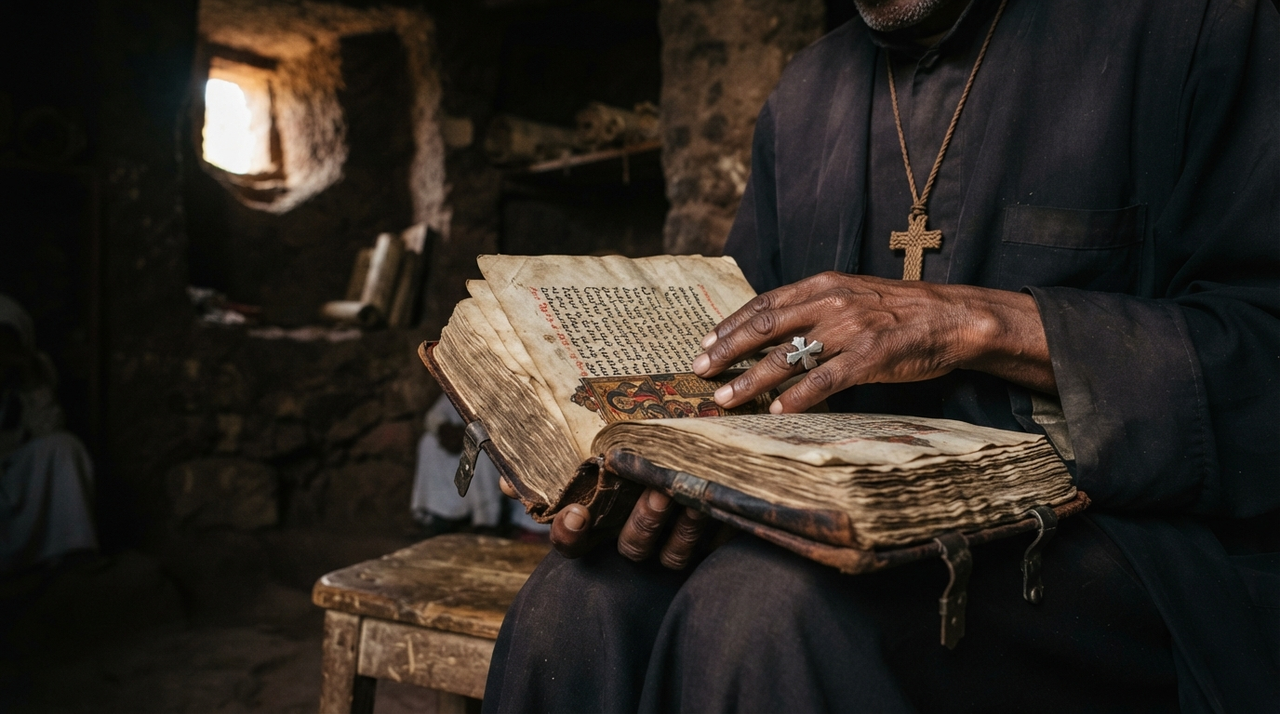
Picture this: high in the rugged highlands of Ethiopia, monks in ancient monasteries hunch over vellum manuscripts, their quills etching words from a sacred library that includes the Book of 1 Enoch—quoted directly in the New Testament's Epistle of Jude—and the Book of Jubilees, a retelling of Genesis with cosmic calendars. This isn't a hidden vault of "lost" scriptures. It's the living Ethiopian Bible canon of the Ethiopian Orthodox Tewahedo Church (EOTC), part of Oriental Orthodoxy.
Direct answer: The EOTC preserves a broader canon in the ancient Ge'ez language, encompassing 1 Enoch, Jubilees, and other texts integral to its tradition. These aren't late additions to a universal list but books embraced through distinct historical processes, shaped by translation, liturgy, and geography.
Not Removed But Different Histories
Biblical canons didn't emerge from a single council stamping an official roster. They crystallized organically within diverse Christian communities, reflecting what texts shaped worship, teaching, and identity. In the West, Protestant reformers streamlined to 66 books, Catholics affirmed 73 at Trent, while Eastern Orthodox traditions vary slightly.
The EOTC's path diverged early. Christianity arrived in Aksum by the 4th century via Frumentius, translating scriptures into Ge'ez—the Semitic tongue of the highlands—before many European vernaculars. Isolation from Byzantine and Roman controversies allowed independent canon formation, prioritizing texts like 1 Enoch that resonated in Jewish-Christian circles.
The Ethiopic Bible and Ge'ez Tradition
Ge'ez isn't just a language; it's the liturgical heartbeat of the EOTC. The Ethiopian Bible canon exists primarily in Ethiopic manuscripts, a vast collection copied by hand for centuries. These aren't uniform printed editions but fluid traditions where texts interweave Old and New Testaments with wisdom literature.
From the 14th-15th century Garima Gospels—one of the world's oldest illuminated Bibles—to later octateuchs, Ge'ez scribes preserved a canon echoing Second Temple Judaism more closely than later Western lists. This broader canon underscores the EOTC's Oriental Orthodox roots, distinct from Chalcedonian churches.
What Is in the Broader Canon?
Manuscripts vary—no single "81-book" list is fixed—but core expansions beyond Protestant canons include:
- 1 Enoch (Ethiopic Enoch): Visions of angels, watchers, and judgment; read in liturgy. Explore the Book of Enoch Explained.
- Jubilees: Mosaic-era rewrite framing history in 49-year cycles.
- Paralipomena of Jeremiah (4 Baruch), Ascension of Isaiah, and expansions like Meqabyan (Maccabees analogs).
- Old Testament pseudepigrapha and apocrypha: Wisdom of Solomon, Sirach, Tobit, Judith.
- New Testament additions: Sinodos (church orders), Clement, Didascalia.
Numbers fluctuate (46-51 OT, 35 NT in some tallies), highlighting canon as communal use, not rigid count. For deeper dives, see our Book of Jubilees companion.
How Manuscript Culture, Isolation, and Liturgy Shaped Preservation
Ethiopia's mountainous terrain and Red Sea barriers fostered self-reliance. Post-7th century Islamic expansions severed Mediterranean ties, turning inward to manuscript monasteries like Debre Libanos.
Liturgy cemented texts: 1 Enoch's feasts echo in EOTC calendars; Jubilees informs sabbath observance. Scribes recopied favorites, winnowing others naturally—no dramatic purges, just faithful transmission.
Comparison With Other Christian Canons
Respectfully, the EOTC's broader canon outstrips Protestant (66 books), Catholic (73), and even most Eastern Orthodox lists. Yet all share protocanonical cores. Differences spotlight diversity: Apocrypha vs. Pseudepigrapha distinctions blur in Ge'ez, where Enoch thrives. Read how in How Biblical Canon Was Formed.
What Preservation Does and Does Not Mean
Inclusion signals reverence in EOTC life—Enoch for eschatology, Jubilees for law—but not equal doctrinal weight. Texts inspire devotion without uniform dogma. Preservation guards heritage, inviting curiosity over controversy. It's a window into ancient Christianity's richness, not a rebuke to others.
Frequently Asked Questions
Is the Ethiopian Bible the oldest?
Not entirely—Garima Gospels date to ~500 AD, rivaling but not surpassing Codex Sinaiticus. Ge'ez translations preserve early readings.
Why more books?
Unique history: early access to Jewish texts, isolation, liturgical embedding.
Are they the same as Catholic apocrypha?
Overlap (Tobit), but extras like Enoch are pseudepigrapha, absent elsewhere.
Curious for more? Our Guide to Ethiopian Bible unlocks manuscripts and meanings. Dive into the Ethiopian Bible cornerstone, blog insights, or companion pieces. Journey with respect—discover the universe of faith.