
History of Geometry: From Egyptian Surveying to Sulba Sutras and Euclidean Proofs
Imagine the Nile's annual flood receding, leaving behind a patchwork of silt-rich fields, boundaries erased like whispers in the wind. No maps, no deeds—just the sun-baked earth demanding order. Here, amid the urgency of survival, geometry was born. Not as the crystalline abstractions of later philosophers, but as geo-metron: the measurement of the earth. This practical art, forged in the fires of necessity, would ripple through civilizations, evolving from ropes and stakes to the iron-clad proofs of Euclid. In Aetheria's cosmic library, where mathematics whispers ancient wisdom, the history of geometry invites us to trace these roots—not as dusty relics, but as living threads connecting human ingenuity to the universe's hidden patterns.
What began as Egyptian surveying for fertile plots blossomed into the intricate altar designs of India's Sulba Sutras, then crystallized in Greek geometry's pursuit of eternal truth. Along the way, whispers of sacred geometry emerge, tempting us with cosmic symmetries. Yet this journey demands care: we honor empirical practices without romanticizing myths, distinguish proven theorems from debated histories, and marvel at proof's power without claiming it unveils all mysteries. Join us in this deep dive, where geometric measurement meets the quest for certainty.
The Nile's Reckoning: Egyptian Surveying and the Harpedonaptai
Picture them: the harpedonaptai, or 'rope-stretchers,' elite surveyors of ancient Egypt, their linen cords knotted at precise intervals, eyes sharp against the horizon. Each year, as the Nile swelled and subsided around 3000 BCE, these practitioners redrew field boundaries with geometric precision. Papyrus records like the Rhind Mathematical Papyrus (c. 1650 BCE) reveal their toolkit: calculations for areas, volumes, and slopes, all rooted in Egyptian surveying.
Herodotus, the Greek traveler writing in the 5th century BCE, spun a captivating tale: Egyptian surveyors formed right angles by crafting ropes into 3-4-5 triangles—3 units one way, 4 perpendicular, 5 hypotenuse. A nod to the Pythagorean theorem millennia early? Archaeology tempers this romance. While 3-4-5 proportions appear in tools and tomb inscriptions, no direct evidence confirms Herodotus's ritual. Instead, tools like the merkhet (a timekeeping plumb line) and bay (palm-rib sighting rods) enabled alignments for pyramids, such as Giza's Great Pyramid, squared to true north within a fraction of a degree.
This was geometry as craft: practical, iterative, tied to the land's rhythms. Egyptians computed circle areas with an approximation π ≈ 256/81 (3.16), close enough for granary silos. Yet no formal proofs shadowed their methods—knowledge passed orally, refined by trial. In Aetheria's lens, this hums with history of geometry's primal pulse: humans imposing order on chaos, one measured rod at a time.
Vedic Altars and the Sulba Sutras: Precision in Sacred Space
Building the Cosmos on Earth
Far east, around 800–200 BCE, Indian Vedic priests faced a divine geometry challenge: construct altars of exact shape and size for rituals invoking the gods. The Sulba Sutras—appendices to Vedic texts—emerge as terse manuals of geometric measurement, detailing rope-based constructions for squares, rectangles, and circles.
Take the Baudhayana Sulba Sutra (c. 800 BCE?): It states a theorem mirroring Pythagoras: 'The diagonal of a rectangle produces by its addition to the sides the area of an isosceles triangle with base equal to the sum of the sides and vertex angle twice that at the base.' In modern terms: a² + b² = c², with constructions for squares on sides. Falcons altars morphed from square to rhombus via geometric transformations, ensuring area preservation—early glimpses of equivalence proofs.
Dating Debates and Cultural Depth
Dating sparks scholarly fire: linguistic analysis pegs Baudhayana earliest, Apastamba next, but cross-references blur lines. Were these empirical discoveries or axiomatic? Like Egyptians, Indians favored construction over deduction, yet their approximations (√2 ≈ 1.4142135) rival modern values, hinting at iterative algorithms.
The Sulba Sutras shine in the history of geometry for wedding utility to ritual. Altars weren't mere platforms; they mirrored cosmic order, falcons symbolizing Agni's flight. Here, geometry place-makes the sacred—echoing Aetheria's Sacred Places Door, where form births meaning.
The Greek Revolution: From Thales to the Euclidean Proof
Thales and the Dawn of Deduction
Enter Greece, c. 600 BCE, where Ionian thinker Thales shifted geometry seaward. Legend credits him measuring a pyramid's height by its shadow at solstice, or proving a triangle's base angles equal via parallels. Sparse evidence survives, but Thales symbolizes the pivot: from ad-hoc measurement to general principles.
Euclid's Elements: Architecture of Proof
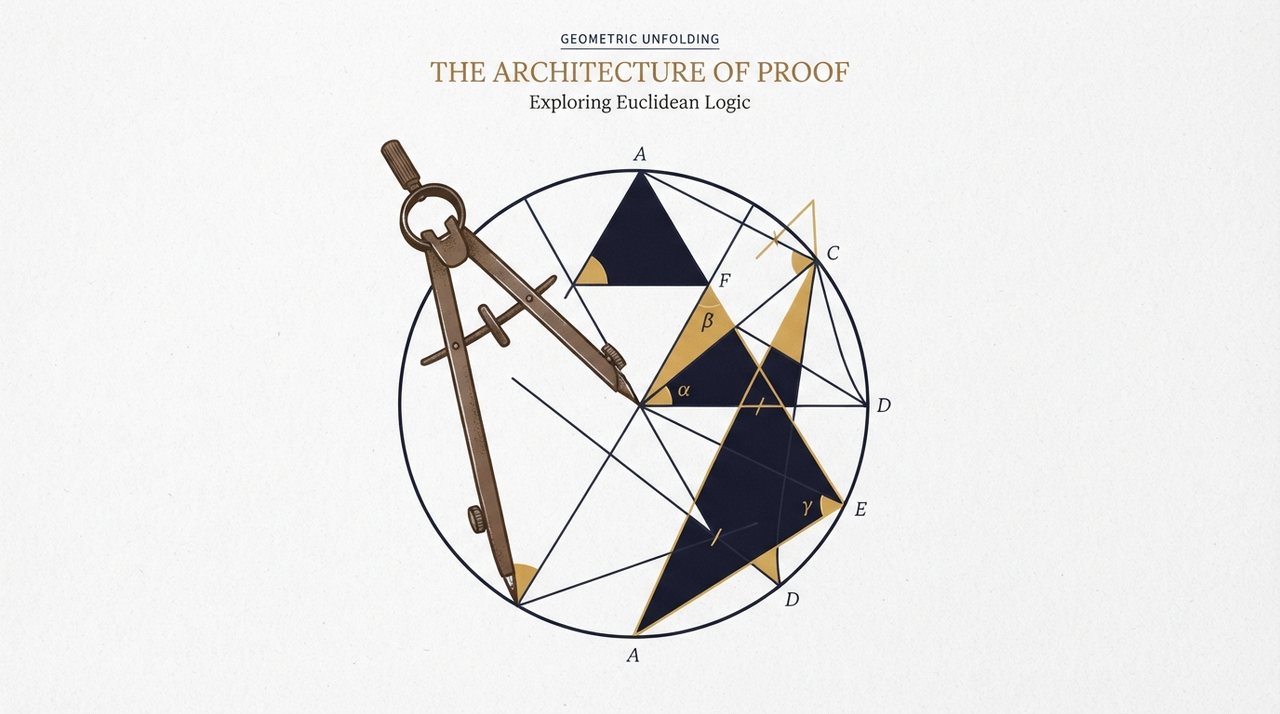
By 300 BCE, Euclid's Elements crowns this era. Thirteen books build from five postulates and common notions to theorems like Pythagoras (Proposition 47). A Euclidean proof unfolds rigorously: state claim, invoke axioms, deduce via prior propositions. Book I's SAS congruence shows triangles equal by two sides and included angle—foundational for Greek geometry.
Yet myth bust: Euclid didn't invent logic—that traces to Aristotle. Nor do proofs claim absolute reality; they're conditional on axioms. Non-Euclidean geometries later (Lobachevsky, Riemann) bend parallels, revolutionizing physics. Euclid systematized, didn't originate.
In the Elements, geometry transcends earth-measuring, aspiring to universal truths—yet rooted in the same rope-tautened right angles of old.
Sacred Geometry: Patterns, Not Panaceas
Fibonacci spirals in sunflowers, golden ratios in nautilus shells—sacred geometry tantalizes with nature's signatures. From Chartres Cathedral's rose windows to Islamic tessellations, humans discern divine proportion. Egyptians aligned pyramids to stars; Sulba priests squared the circle symbolically; Greeks Platonic-ized solids as elemental.
Caution tempers awe: our brains excel at pattern recognition, sometimes imposing order where chance reigns. Flower of Life motifs inspire, but asserting they 'control reality' veers mystical. Instead, celebrate sacred geometry as bridge: empirical craft revealing perceptual symmetries. In Aetheria's cosmic library, it links to the Philosophy Door—what counts as knowledge when intuition meets proof?
- Egypt: Pyramids as resurrection machines, geometry eternalizing pharaohs.
- India: Altars invoking yajna, space as sacrifice.
- Greece: Solids embodying forms beyond senses.
Traditions diverge yet converse—Egyptian empiricism, Indian ritual precision, Greek abstraction—each illuminating history of geometry without collapse.
Echoes Across Doors: Geometry's Cosmic Conversation
This arc resonates beyond mathematics. In philosophy, Euclidean proofs probe epistemology: deduction certifies, yet axioms invite faith. Sacred places worldwide—Stonehenge's heel stone, Teotihuacan's solar alignments—deploy geometry for place-making, anchoring communities to cosmos.
Aetheria's seekers, ponder: how does geometric measurement shape your world? From GPS grids to architectural blueprints, it persists.
Tracing the Thread: Your Invitation
Next time a shadow slants or a circle gleams, pause. Sketch a 3-4-5 triangle; feel the rope's tension. Wonder at Sulba altar's curve-to-square alchemy; chase Euclid's propositions step-by-step. Geometry's history isn't linear triumph—it's humanity's curious dance with form, from Nile mud to stellar vaults.
In Aetheria's embrace, may this wisdom awaken your inner measurer. What shape will you prove next?