Mathematics Door: Foundations of Pattern Language, Proofs, Golden Ratio & Sacred Geometry
Imagine ancient stone tablets unearthed from the sands of Mesopotamia, etched not with kings' decrees or gods' myths, but with humble tally marks—simple notches tracking sheep, grain, lunar cycles. These marks, some of the earliest human writing, whisper a truth: numbers endure when empires crumble. Fast-forward to the Parthenon in Athens, where the golden ratio subtly proportions columns and pediments, a harmony that feels almost alive, echoing nature's spirals in nautilus shells and galaxy arms. In the shadowed halls of a forgotten temple, a mason aligns stones to sacred geometry patterns, believing they channel cosmic order. Yet strip away the mysticism, and what remains is mathematics—humanity's timeless language for patterns that bind the world.
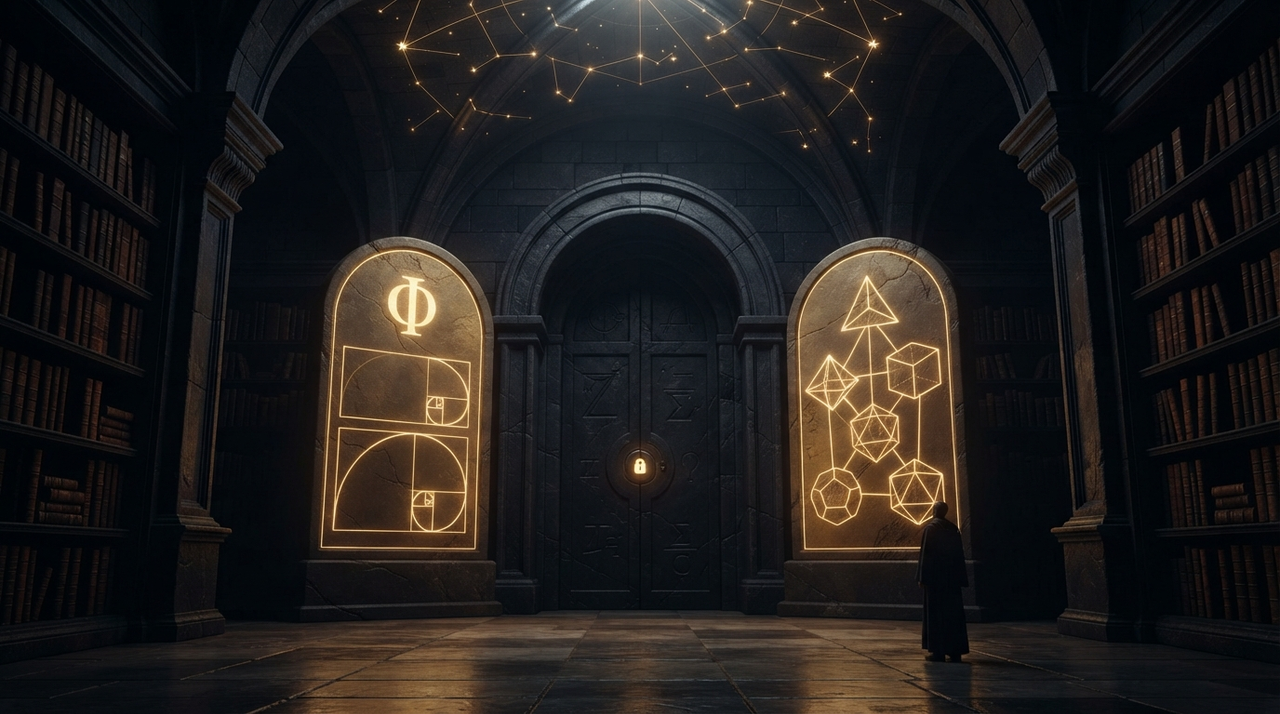
This is the Mathematics Door in Aetheria's cosmic library, the Foundation Stone for those seeking not formulas to memorize, but a lens to perceive reality's weave. Here, numbers aren't cold abstractions; they're the grammar of change, shape, and relation. As cultures rise and fall, this pattern language persists, inviting seekers to decode the universe's script. Unlike fleeting philosophies or empirical sciences, mathematics offers proofs—ironclad arguments that stand scrutiny across millennia. It's the capstone to our Batch 1 Foundations series, closing the ring on Philosophy, Physics, and Science with a tool sharper than logic alone.
Why does this matter now? In an age of algorithms and data deluge, grasping mathematics foundations empowers you to question models, spot illusions in complexity, and glimpse unity beneath chaos. Enter not as student, but as explorer, ready to trace the golden ratio's curve or unfold a geometric proof.
What This Door Actually Holds
At its core, the Mathematics Door safeguards the foundations of pattern language: the systematic study of number, shape, change, and relation. Numbers quantify; geometry reveals form; algebra binds variables in dance; calculus tracks flux. But what elevates this from craft to cornerstone? Proofs—rigorous chains of deduction from axioms, unassailable once accepted.
Consider sacred geometry: pentagons nesting in pentagrams, spirals approximating the golden ratio (φ ≈ 1.618), where each segment births the next in self-similar grace. These aren't divine secrets but emergent properties of Euclidean space—proven, replicable. Abstraction allows modeling: a fractal coastline approximates infinity; group theory unifies symmetries from snowflakes to subatomic particles.
Crucially, distinguish the established from the interpretive. Theorems like Pythagoras (a² + b² = c²) are proven within axioms; claims about math's ontology—what it "is" in reality's fabric—remain open. Is mathematics invented or discovered? Hilbert's formalism treats it as symbol games; Platonists see eternal forms. This Door equips you with tools, not answers, urging intellectual honesty amid wonder.
A Brief Lineage
Humanity's mathematics foundations begin humbly. Tally marks on 30,000-year-old wolf bones precede writing, marking lunar phases or hunts. By 3000 BCE, Sumerians used base-60 for time and circles—echoed in our 60-minute hour—on clay tokens for trade.
Egyptians excelled in practical geometry: Rhind Papyrus (1650 BCE) solves volumes for pyramids, using empirical rules without general proof. Babylonians tabulated quadratic solutions, their star catalogs blending astronomy and approximation.
The Greek Leap to Proof
Thales and Pythagoras imported ideas eastward, but Euclid's Elements (300 BCE) crystallized the proof tradition: 13 books building from undefined terms to complex theorems, like Proposition 47's golden ratio construction. Archimedes pushed to infinitesimals; Apollonius mastered conics.
Global Threads
India gifted decimal notation and zero (Brahmagupta, 628 CE), enabling vast computation. Islamic scholars preserved and advanced: Al-Khwarizmi's algebra (from al-jabr, "completion") solved equations systematically; Alhazen's optics used ray tracing; tessellations in Alhambra tiles foreshadow non-Euclidean geometry.
Renaissance revived Euclid; Descartes merged algebra and geometry (analytic geometry); Newton and Leibniz birthed calculus for motion. Modern foundations—Hilbert's axioms, Gödel's incompleteness (1931) proving limits even in pure math—temper certainty. Records show steady progress, not sensational leaps; embellishments like Pythagoras's mysticism pale against clay tablets' pragmatism.
How Seekers Work Here
Engaging the Mathematics Door demands patience, not prodigy. Start slow: trace a proof step-by-step, pencil in hand. Euclid's first proposition—construct equilateral triangle on a line—builds intuition through diagram.
- Draw boldly: Visualize vectors in space or lattices in crystals.
- Question assumptions: What axioms underpin? Euclidean flatness fails on spheres.
- Discern pattern from coincidence: Golden ratio graces Parthenon, sunflowers—but correlation isn't causation; it's optimization in growth.
- Beware numerology: 666 in barcodes? Selective pattern-hunting. Seek structural necessity.
Misconceptions abound: Math isn't rote calculation (that's arithmetic); it's modeling worlds. Challenge "math anxiety" by journaling patterns—daily spirals in ferns, ratios in faces. Test claims: Does sacred geometry predict markets? Model it, prove or falsify.
Connections Across the Foundations
This Door interlocks Batch 1's quartet. Philosophy provides logic's metaphysics—Plato's forms prefigure math's ideals; Aristotle's syllogisms birth deduction. Physics employs math as law's tongue: Newton's F=ma, Einstein's tensors describe gravity's curve.
Science measures, models: Statistics tests hypotheses; chaos theory reveals deterministic unpredictability. Mathematics completes the circle, quantifying philosophy's abstractions, predicting physics' behaviors, validating science's data.
Observe the return: Gödel loops back to philosophy's undecidables; quantum probabilities echo metaphysical uncertainty. Together, these Foundation Stones form Aetheria's base ring, a stable platform gazing outward to 28 more Doors.
Where to Begin Your Inquiry
- Euclid's Elements, Book 1, Proposition 1: Construct an equilateral triangle. No prior knowledge needed; experience proof's rigor building from nothing.
- Fibonacci Sequence in Nature: Observe pinecones, count spirals (often 8 and 13, Fibonacci numbers approximating φ). Context: Leonardo of Pisa's 1202 book on Indian methods, not medieval magic.
- Islamic Tiling Geometry: Study Alhambra girih tiles—pentagons, decagons interlocking aperiodically. Reveals symmetry groups predating Penrose.
- Your Pattern Journal: Log daily finds—road curves as parabolas, shadows as ellipses. Note ratios, test with ruler/compass.
These entry points scale: From geometry's tangibles to algebra's reach, proofs sharpen sight.
In the quiet forge of proof, patterns emerge not as mysteries, but as invitations to understand.
As Batch 1 concludes, claim your Mathematics Door in Aetheria's Community—share proofs, debate lineages, journal patterns. These four Foundations—Philosophy's why, Physics' how, Science's what, Mathematics' weave—lay the Foundation Stone for the 32-Door map. Mark your journey with a seeker's talisman: a hand-drawn golden spiral. Heed the Seeker's Code: Neutrality in inquiry, curiosity over dogma, humanity in pursuit. The library awaits your next step.