
The 7 Hermetic Principles Explained in Plain English
Picture a quiet library in early 20th-century Chicago, where ancient wisdom meets modern curiosity. A mysterious book appears: The Kybalion, penned by "Three Initiates." Inside, seven timeless principles promise to unlock the universe's hidden patterns. But are they spells for manifestation or simple tools for clearer thinking?
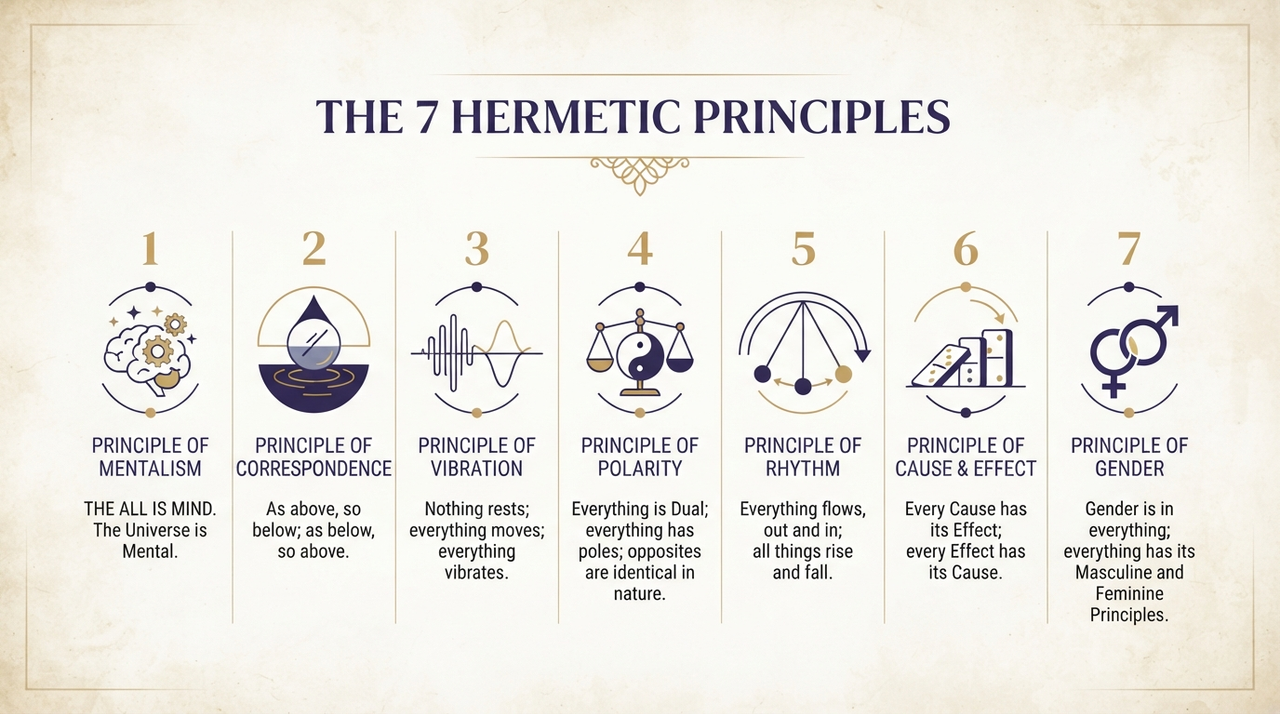
Here's the direct scoop for beginners: The 7 Hermetic Principles come from The Kybalion (1908), not straight from ancient Egypt. They distill later Hermetic thought into practical ideas:
- Mentalism: The universe is mental.
- Correspondence: As above, so below.
- Vibration: Everything vibrates.
- Polarity: Everything has opposites.
- Rhythm: Everything has rhythms and cycles.
- Cause and Effect: Every cause has an effect.
- Gender: Everything has masculine and feminine principles.
These aren't hype for quick riches—they're lenses for understanding reality, rooted in Hermeticism, a philosophy blending Greek, Egyptian, and mystical influences.
Where Do the 7 Hermetic Principles Come From?
Hermeticism draws from texts like the Corpus Hermeticum (2nd–3rd century AD), a collection attributed to Hermes Trismegistus—a legendary figure merging Greek god Hermes and Egyptian Thoth. These writings, rediscovered in the Renaissance, explore divinity, cosmos, and the soul. The Emerald Tablet, a cryptic alchemical text, famously states "as above, so below," hinting at the law of correspondence. Asclepius, another key dialogue, discusses creation and divine mind.
Enter The Kybalion: Published in 1908 by the Yogi Publication Society in Chicago, it's credited to "Three Initiates." Scholars widely attribute it to William Walker Atkinson, a prolific New Thought author. Far from ancient Egypt, it's a modern synthesis of Hermetic ideas with 19th-century occultism. While inspired by the tradition, its exact seven principles aren't verbatim from the Corpus Hermeticum—origins remain contested, blending myth and philosophy.
The Seven Hermetic Principles
1. The Principle of Mentalism
"The All is Mind; the Universe is Mental." Reality springs from a universal mind. It suggests your thoughts shape experience—not magic, but focus influences outcomes. Common misinterpretation: Wishful thinking alone creates wealth. Reflective question: What mental patterns hold you back today?
2. The Principle of Correspondence (The Law of Correspondence)
"As above, so below; as below, so above." Patterns repeat across scales—from atoms to galaxies. It suggests studying small things reveals big truths. Misinterpretation: Literal astrology dictates fate. Question: How does a pattern in your life mirror a larger cosmic rhythm? Explore patterns in time.
3. The Principle of Vibration
Nothing is still; everything vibrates at different frequencies. It suggests raising your "vibration" through positive habits shifts reality. Misinterpretation: Pseudoscience ignoring physics. Question: What low-vibration habits can you elevate?
4. The Principle of Polarity
Opposites are two extremes of the same thing, like hot and cold. It suggests transmuting negatives into positives by shifting degree. Misinterpretation: Good and evil are illusions. Question: Where can you polarize a challenge into opportunity?
5. The Principle of Rhythm
Everything ebbs and flows, like tides or pendulums. It suggests neutralizing extremes by rising above swings. Misinterpretation: Passively accept all ups and downs. Question: How can you balance your current rhythm? See creation cycles.
6. The Principle of Cause and Effect
No chance; every effect traces to a cause. It suggests mindful actions create desired results. Misinterpretation: Fatalism erases free will. Question: What cause are you planting for tomorrow's effects?
7. The Principle of Gender
Masculine (active, projective) and feminine (receptive, creative) energies exist in all things for generation. Not modern gender identity—think electricity's positive/negative poles. It suggests balancing both sparks creation. Misinterpretation: Reinforces stereotypes. Question: Where do you need more receptive energy? Dive deeper via the Guide.
Frequently Asked Questions About Hermetic Principles
Are Hermetic Principles Ancient Egyptian?
No—these specific seven are from 1908's Kybalion. Hermeticism claims Egyptian roots via Hermes Trismegistus, but texts like Corpus Hermeticum are Greco-Roman era.
How to Use Them Without Magical Thinking?
Apply as psychological tools: Observe patterns, shift mindset, act intentionally. Pair with science for grounded insights. Read more.
What's the Difference Between Hermeticism and the Kybalion?
Hermeticism is the broad tradition (Corpus Hermeticum, alchemy). Kybalion is a concise, modern take—practical but not canonical. Learn about origins.
What Is Hermeticism?
A philosophical-mystical tradition emphasizing unity of mind, cosmos, and divine. Explore layered meanings like in Enochian texts.
These principles invite you to see the universe not as chaos, but orchestrated harmony. Start observing.
Continue learning inside the Aetheria Hermetic Room—a space exploring Hermetic texts through The Guide and Creation Room. Home.