The Emerald Tablets of Thoth: History, Myths, and What They Actually Teach
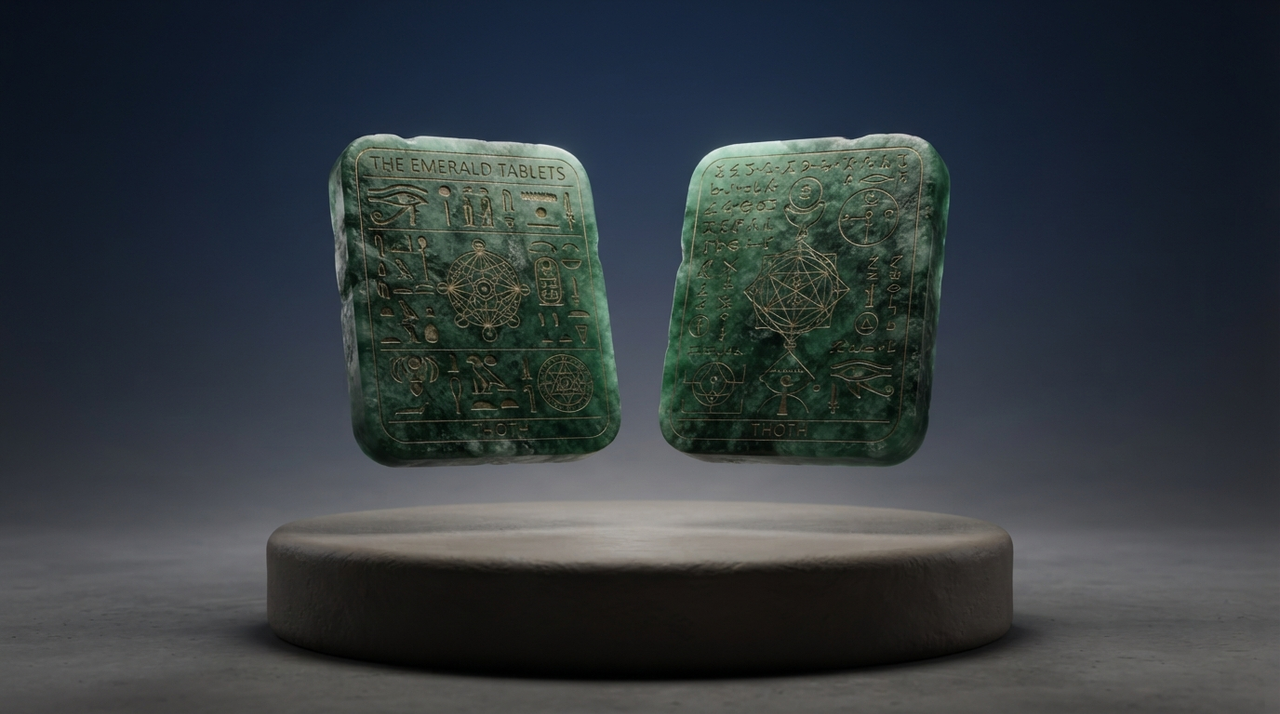
Picture this: a shimmering green slab of emerald, etched with cryptic wisdom from an ancient god, promising the keys to immortality, alchemy, and the universe's hidden order. Legends whisper of Thoth, the ibis-headed scribe of Egypt, inscribing these truths before Atlantis sank. But hold that thought. The Emerald Tablets of Thoth aren't one artifact—they're two distinct traditions wrapped in myth. The historical Tabula Smaragdina (Emerald Tablet, singular) is a short medieval Hermetic text attributed to Hermes Trismegistus, teaching principles like "as above, so below." The other is Maurice Doreal's 20th-century New Age creation, claiming to translate 13 Atlantean tablets penned by Thoth himself. Their histories are contested, origins late, and neither hails from pharaonic Egypt.
This distinction matters for seekers of Hermetic wisdom and ancient Egyptian knowledge. Let's unravel the tangle.
What People Mean by the Emerald Tablets
Search "Emerald Tablets" online, and you'll drown in New Age forums blending Egyptian gods, Atlantis, and crystal healing. Most refer to Doreal's poetic opus, evoking Thoth as an Atlantean survivor who hid his wisdom in the Great Pyramid. Yet scholars point to the singular Tabula Smaragdina, a cornerstone of Western esotericism. The confusion stems from syncretism: Thoth morphs into Hermes Trismegistus, blending Egyptian lore with Greek philosophy. Both promise profound Hermetic wisdom, but one is a 12th-century Latin gem, the other a 1930s invention.
The Historical Tabula Smaragdina
Our story begins not in pyramids, but Arabic alchemy. The text likely originated as Kitab Sirr al-Khaliqa (Book of the Secret of Creation) or Kitab Balaniyus al-Hakim fi'l-`Ilal, attributed to "the sage Balinas" (pseudo-Apollonius of Tyana), from the 6th to 8th century CE. A Latin version surfaced in the 12th century, dubbed Tabula Smaragdina, sparking Renaissance fascination.
It influenced the Corpus Hermeticum, Picatrix grimoires, and even Isaac Newton's private translation: "Tis true without lying, certain and most true. That which is below is like that which is above & that which is above is like that which is below to do the miracle of one only thing." No physical emerald slab exists; it's a symbolic manifesto of Hermetic principles.
Thoth vs. Hermes Trismegistus: Syncretic Roots
Thoth, Egypt's moon god of writing and magic, inspired Hellenistic thinkers. Ptolemaic syncretism fused him with Hermes, birthing Hermes Trismegistus—the "thrice-great." This figure authored the Corpus Hermeticum, 2nd-3rd century CE dialogues blending Platonism, Stoicism, and Egyptian echoes. The Emerald Tablet fits this milieu, not Tutankhamun's era. French Egyptologists like M. Pierre Lacau, excavating Giza, found no such tablets—only modern forgeries debunked.
Explore Hermetic context in sacred time for deeper layers.What the Emerald Tablet Actually Teaches
At 12-14 cryptic lines, it distills Hermetic wisdom: unity of macrocosm and microcosm. "That which is above is like to that which is below, and that which is below is like to that which is above," teaches correspondence—the philosopher's stone as inner transmutation. Alchemists read it as lab instructions; mystics as spiritual ascent. No spells, no Atlantis—just profound unity.
The 20th-Century Atlantean Emerald Tablets
Enter Maurice Doreal (Claude Doggins), who between 1925 and 1939 claimed psychic translation of 13 emerald tablets from Thoth's Atlantean exile. Published as The Emerald Tablets of Thoth the Atlantean, it's verse-filled with reincarnation, serpent power, and pyramid secrets. Doreal's Brotherhood of the White Temple promoted it. Gripping myth, but no archaeological trace.
See our blog for New Age evolutions.What Reliable Scholarship Says
Experts peg the Tabula Smaragdina's roots post-Islamic Golden Age, not pharaonic Egypt. Uncertainties linger on exact Arabic provenance, but it's pseudepigraphal—falsely ancient. Doreal's version? Pure 20th-century esoterica, echoing Theosophy. For ancient Egyptian knowledge, stick to papyri like the Book of the Dead. Layered transmissions like Enoch mirror this mythic buildup.
Frequently Asked Questions
Is Thoth the author?
Mythically, yes; historically, no. Hermes Trismegistus is a composite, not the god Thoth.
Are the Emerald Tablets ancient Egyptian?
No evidence supports this. No artifacts found.
Where can I read the original?
Latin Tabula Smaragdina in grimoires; Arabic fragments survive. Doreal's full text online.
What's the difference between versions?
- Historical: Short, alchemical axiom.
- Doreal: Epic, Atlantean narrative.
"The real emerald is within—polish it with discernment."
Peel back the myths, and Emerald Tablets reveal timeless Hermetic echoes. Dive deeper with us.
Read the texts, commentary, and AI explanations on Aetheria. Start at /guide or /creation for Hermetic texts.