
What Is Sacred Geometry? A Beginner's Guide to the Hidden Language of the Universe
Imagine standing in an ancient temple, where interlocking circles etched into stone whisper secrets of creation itself. Or gaze at a nautilus shell spiraling toward infinity, mirroring the proportions of the Parthenon. These aren't coincidences—they're echoes of sacred geometry, patterns that bridge the visible world and something deeper.
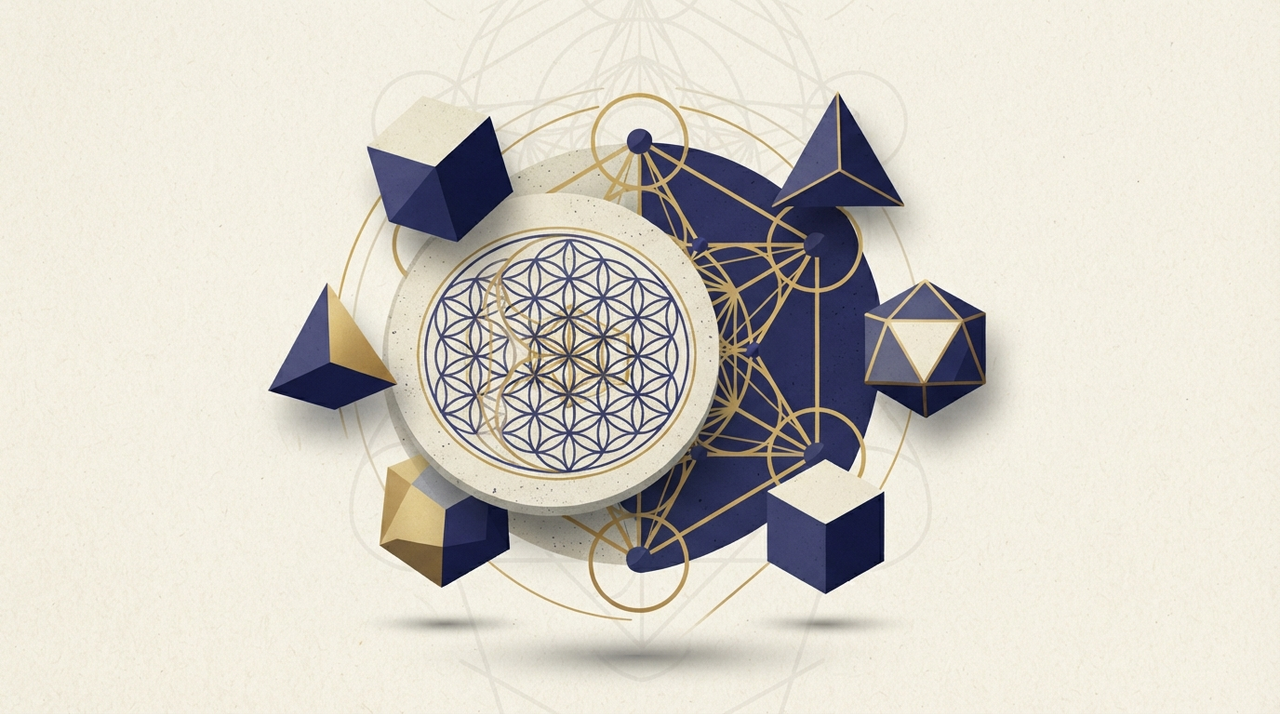
Sacred geometry is the study of geometric forms and proportions—like the Flower of Life, Metatron's Cube, and Platonic solids—that appear repeatedly in nature, art, and architecture. Many ancient traditions viewed them as divine blueprints, rooted in Greek philosophy from Plato's Timaeus, Islamic geometric designs, and Gothic cathedrals. Today, they inspire both mathematical rigor and personal wonder, blending verifiable patterns with interpretive meaning.
What Is Sacred Geometry?
At its core, sacred geometry explores universal patterns built on proportion, symmetry, and repetition. Think of honeycombs' hexagonal grids or the branching of trees following fractal logic. These aren't random; they emerge from simple mathematical rules.
From snowflakes' six-fold symmetry to the orbits of planets, geometry underpins reality. Ancient builders like Vitruvius in Roman architecture codified these ratios for harmony. Modern eyes see them in DNA helices or galaxy spirals—facts of math, layered with cultural reverence.
Why Do People Find Sacred Geometry Sacred?
In a chaotic universe, these patterns offer order—a comforting recurrence suggesting underlying intelligence. Plato saw Platonic solids as elemental building blocks; Islamic artists veiled the infinite through tiles that repeat without end. It's this sense of connection: microcosm reflecting macrocosm, personal scale echoing cosmic.
For beginners, the draw is intuitive. A single circle becomes many, forming life-like blooms. It's meditative, prompting questions: Why does this spiral please the eye? Does it hint at universal laws, or is it our minds seeking meaning?
Core Patterns of Sacred Geometry
The Flower of Life
This iconic pattern—19 overlapping circles forming flowers within flowers—captures imagination. Traced to carvings at Abydos temple in Egypt (though modern scholarship debates their dating as late graffiti, per Keith Critchlow's analyses), it gained modern fame through Drunvalo Melchizedek's teachings. Notice it as Aetheria's logo family; from here sprout all sacred forms. Link to patterns in creation myths.
The Seed of Life
The Flower's origin: seven circles in a flower shape, symbolizing seven days of creation or chakras. Simple, yet it seeds complexity.
Metatron's Cube
Derived from 13 circles of the Fruit of Life (an extension of the Flower), it connects with lines to form the five Platonic solids. Linked to Kabbalistic angel Metatron in modern lore, its name is recent, but the geometry echoes ancient grids.
Platonic Solids
Plato's Timaeus assigned these five perfect polyhedra—tetrahedron (fire), cube (earth), octahedron (air), icosahedron (water), dodecahedron (ether)—to elements. Euclid formalized them in Elements Book XIII. Measurable, buildable, they represent purity.
Golden Ratio and Fibonacci Sequence
Phi (1.618...) spirals in sunflowers, human bodies, the Pyramids. Fibonacci numbers (1,1,2,3,5...) approximate it. Evidence abounds in nature, though claims of deliberate ancient encoding vary.
How to Approach Sacred Geometry Thoughtfully
Distinguish geometry's math (provable via compass and straightedge) from interpretations. Historical uses—like Islamic non-figural art or Gothic rose windows—are factual. Personal resonance? That's yours. Avoid pseudoscience by grounding in sources: Plato, Euclid, Critchlow. Explore via our founder's insights at /founder.
Frequently Asked Questions
Is sacred geometry proven science?
The geometry is mathematical fact; its "sacred" meaning is cultural and philosophical.
Where does the Flower of Life come from?
Ancient carvings like Abydos; popularized recently.
What is Metatron's Cube?
A star-like figure from the Flower, outlining Platonic solids.
How are Platonic solids sacred?
Plato tied them to elements; their perfection inspires awe.
These patterns invite quiet exploration—math meeting mystery. Explore interactive lessons and AI-guided learning in Aetheria through current paths like /guide and /sacred-time for guided discovery now.