
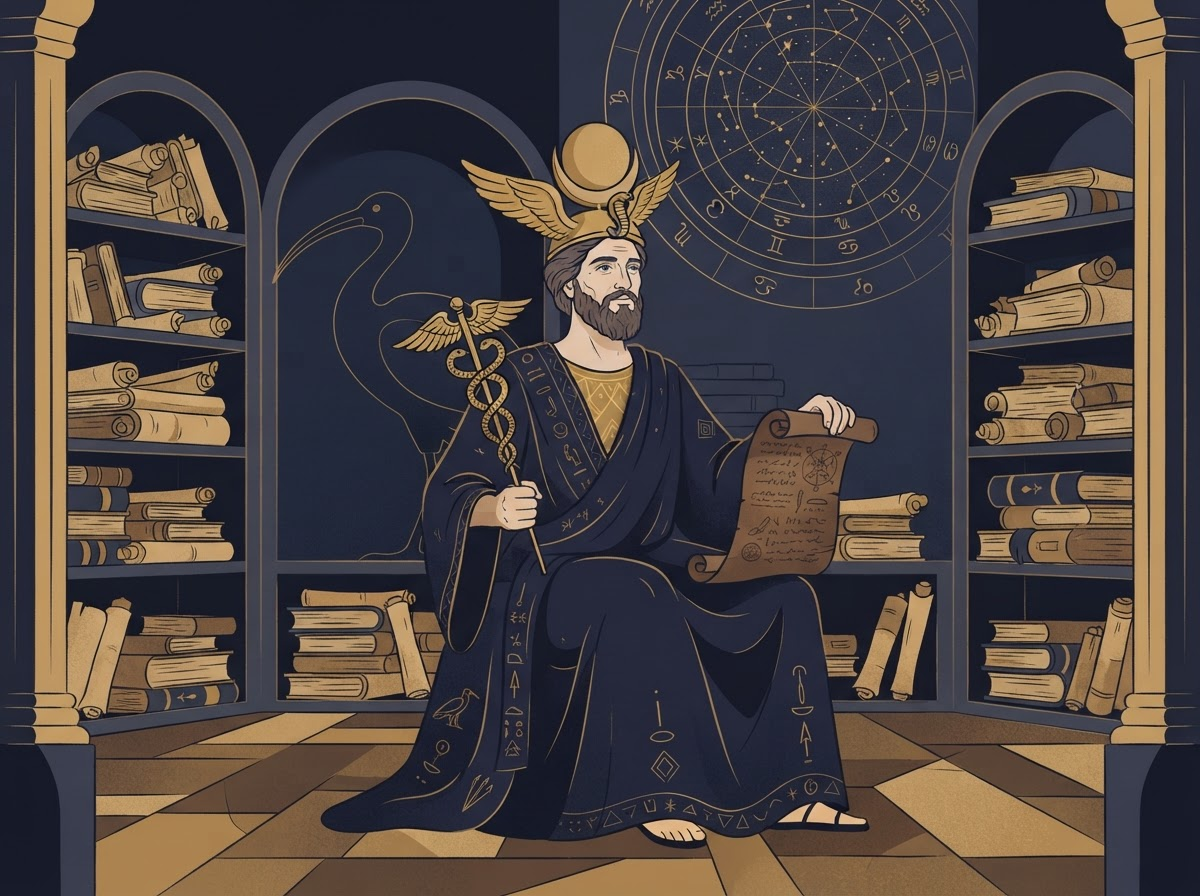
Who Was Hermes Trismegistus? Unraveling the Syncretic Sage of Hermeticism and Thoth
In the bustling crossroads of ancient Alexandria, where the Nile's mysteries met the Acropolis's logic, a legendary sage emerged—not as flesh and blood, but as a divine fusion. Hermes Trismegistus, the "thrice-great" master of wisdom, alchemy, and the cosmos, has captivated seekers for centuries. But who was Hermes Trismegistus? Far from a single historical person, he embodies a syncretic Hellenistic figure, blending the Greek god Hermes with the Egyptian Thoth. This enigmatic archetype arose in Greco-Roman Egypt around the 2nd century BCE, whispering secrets of the universe through texts that ignited Hermeticism history.
Picture scholars in torchlit libraries, poring over scrolls where Egyptian priests and Greek philosophers debated the soul's ascent. Here, Thoth—the ibis-headed scribe of gods, inventor of writing and magic—merged with Hermes, the swift-footed messenger bearing the caduceus. The result? Hermes Trismegistus, or "Thoth Hermes," a transcendent teacher credited with divine revelations on creation, divinity, and human potential.
The Syncretic Birth of Thoth Hermes in Ptolemaic Egypt
Hermeticism flourished in Ptolemaic Egypt (305–30 BCE), a cultural melting pot under Greek rulers. Egyptians revered Thoth as the moon god, measurer of time, and author of sacred books numbering 42. Greeks saw Hermes as guide of souls and patron of eloquence. By the Hellenistic era, these attributes intertwined, birthing Hermes Trismegistus as a primordial sage predating Moses and Plato—antediluvian wisdom incarnate.
Ancient writers like Cicero and Tertullian nodded to this fusion, but the figure crystallized in pseudepigraphal texts attributed to him. Not a biography, but a mythic persona channeling eternal truths. This Thoth Hermes syncretism reflects Alexandria's syncretic spirit, where mystery cults and philosophy brewed ideas still echoing today.
The Heart of Hermeticism: Corpus Hermeticum and Key Texts
Corpus Hermeticum: Dialogues of Divine Wisdom
The cornerstone of Hermeticism history is the Corpus Hermeticum, a collection of 17 Greek treatises from the 2nd–3rd centuries CE. These dialogues, often between Hermes Trismegistus and disciples like Asclepius or Tat, explore gnosis—the direct knowledge of the divine. Topics span cosmology, theurgy, and the unity of all things: "God is the Good, Mind is God." Authorship? Anonymous philosophers in Roman Egypt, cloaking insights in the sage's name for authority.
Asclepius and the Emerald Tablet Legacy
Complementing the Corpus is the Latin Asclepius, a prophetic lament for Egypt's spiritual decline. Both texts distinguish early Hermetica—profound philosophical musings—from later alchemical forgeries. The fabled Emerald Tablet, purportedly inscribed by Hermes and unearthed by Alexander, distills principles like "As above, so below." Explore its ties to the 7 Hermetic Principles in our Journal for deeper layers.
Renaissance Revival and Lasting Echoes
Forgotten in the Middle Ages, Hermetic texts resurfaced in 1460 when Cosimo de' Medici acquired a Greek Corpus Hermeticum manuscript. Marsilio Ficino's 1471 translation electrified Florence, positioning Hermes Trismegistus as a primal theologian bridging paganism and Christianity. Figures like Pico della Mirandola hailed him as Moses' contemporary, fueling alchemy, Rosicrucianism, and even modern esotericism.
Yet scholars like Isaac Casaubon (1614) dated the texts post-Christian, debunking antiquity claims. Today, we distinguish authentic Hermetica—philosophical gems—from medieval attributions, valuing their timeless call to inner divinity.
The Hermetic tradition invites us not to worship a man, but to awaken the sage within.
FAQs: Unpacking Hermes Trismegistus
Who was Hermes Trismegistus really?
A legendary syncretic figure merging Thoth and Hermes, not a historical individual. Texts attributed to him emerged in Hellenistic Egypt.
Corpus Hermeticum authorship: Who wrote it?
Likely 2nd–3rd century CE Alexandrian philosophers using pseudepigraphy for legitimacy.
Is Hermeticism history linked to alchemy?
Yes, but core texts emphasize spiritual transformation over literal gold-making.
Hermes Trismegistus endures as a beacon for the curious soul, reminding us wisdom transcends time. Ready to unravel more? Join the Aetheria Guide for personalized paths through Hermeticism, or dive into our Creation series and Blog. Your journey awaits—step into the light of gnosis today.