
Reproducibility Crisis Exposed: Why Peer Review Falls Short and Open Science Builds Trust
Picture this: a groundbreaking study grabs headlines, promising a cure for a dreaded disease or a revolution in human behavior. Researchers worldwide rush to build on it. But when they try to replicate the results? Crickets. Empty labs echo with silence. This isn't rare fiction—it's the reproducibility crisis shaking the foundations of scientific trust.
For students navigating a sea of studies, understanding this crisis means grasping why peer review, science's venerable gatekeeper, isn't infallible. It also spotlights open science as a beacon for rebuilding trust. Let's unpack the evidence, history, and solutions without descending into doubt—focusing instead on how these challenges drive progress.
The Reproducibility Crisis: Hard Evidence from the Lab
Reproducibility—the ability to repeat an experiment and get the same results—lies at science's heart. Yet, large-scale efforts reveal stark failures. In psychology, a landmark project attempted to replicate 100 high-profile studies; only about 36% succeeded. Fields like cancer biology fare worse, with reproducibility rates hovering below 50% in some surveys. Economics and social sciences echo these woes, with meta-analyses showing inconsistent findings across similar setups.
These aren't cherry-picked outliers. They stem from real-world complexities: subtle methodological tweaks, underpowered samples, or publication bias favoring flashy positives. Importantly, most cases arise from technical hurdles, not outright misconduct—a key distinction. Fraud grabs attention, like retracted papers, but honest errors and overlooked variables dominate the crisis.
Peer Review: A Historical Guardian with Limits
Roots in the Royal Society's Vetting Process
Peer review traces to 1665, when the Royal Society began scrutinizing submissions for Philosophical Transactions. Secret referees vetted claims for novelty and rigor, birthing modern oversight. Today, it checks logic, methods, and ethics—but not everything.
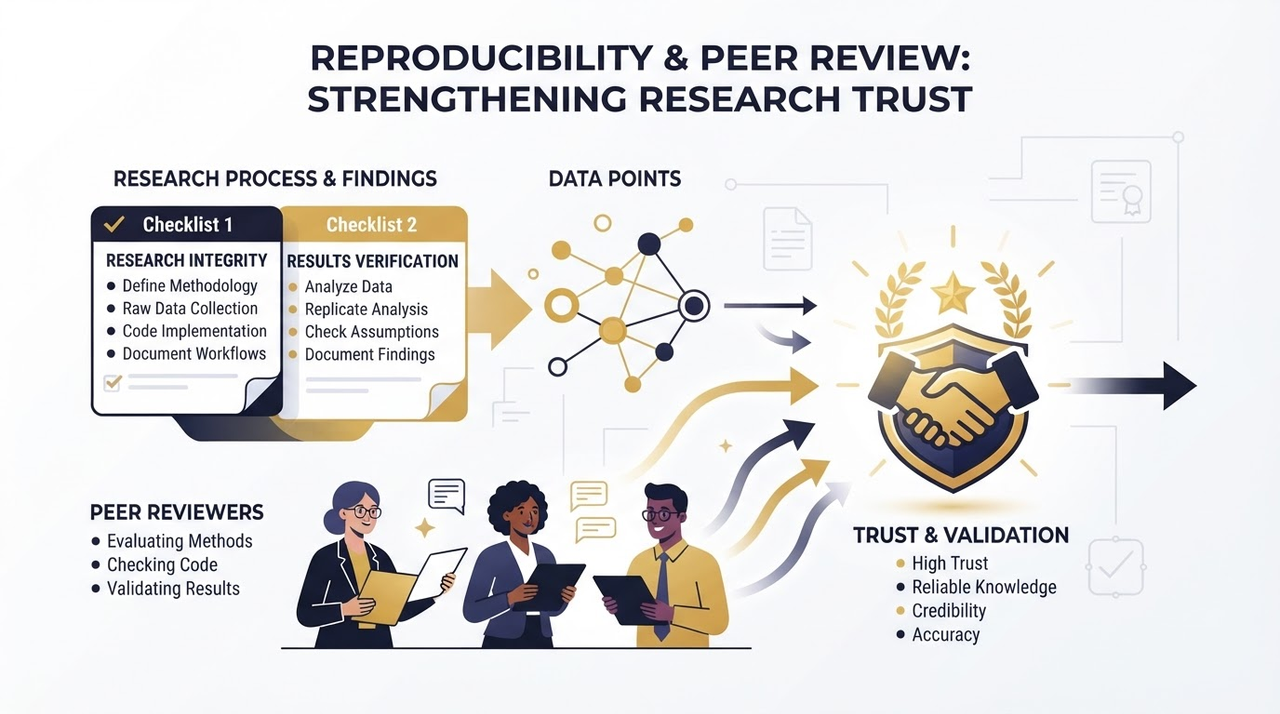
What peer review excels at: spotting glaring flaws, ensuring clarity, and flagging ethical lapses. What it misses: raw data verification, full code execution, or independent replication. Reviewers, often overworked volunteers, can't rerun every experiment. They assess the story, not recreate the lab.
Open Science: Pre-Registration and Data Sharing to the Rescue
Enter open science, fortifying peer review without replacing it. Pre-registration—publicly logging hypotheses and analyses before data collection—curbs selective reporting. Platforms like OSF (Open Science Framework) host these plans, making p-hacking (tweaking for significance) transparent.
Data sharing takes it further. Journals now mandate depositing datasets in repositories like Zenodo or Figshare. Anyone can probe the numbers, fostering reproducibility. Journals award badges for open practices, incentivizing transparency. These tools don't eliminate issues but build layered trust: peer review plus community scrutiny.
- Pre-registration locks in plans upfront.
- Data sharing invites verification.
- Open peer review exposes critiques.
Distinguishing Failures: Technical vs. Misconduct
Not all non-reproducible work signals deceit. Technical failures abound—fragile stats, unreported variables, or evolving lab conditions. Misconduct, like data fabrication, is rarer but devastating, caught via statistical audits or whistleblowers. Open science shines here: shared data unmasks fakes faster, while pre-registration prevents sneaky adjustments.
This nuance preserves scientific trust. Systems evolve—retraction watches, replication initiatives—turning crises into catalysts.
Linking to Technology, Education, and Broader Trust
At Aetheria AI, this ties to our Technology Door: AI tools now automate reproducibility checks, scanning code and stats. Imagine neural networks flagging anomalies pre-publication. Our Education Door equips students with open science skills—teaching pre-registration in classrooms to nurture discerning minds.
These bridges restore faith: peer review endures, augmented by open practices.
Rebuilding Scientific Trust for the Next Generation
The reproducibility crisis exposes peer review's gaps, but open science fills them with collaboration. Students, you're poised to demand more: check for pre-registered plans, shared data, replication attempts.
In a world of rapid claims, how do you evaluate scientific trust? What one practice will you adopt next time you read a study?