
Article
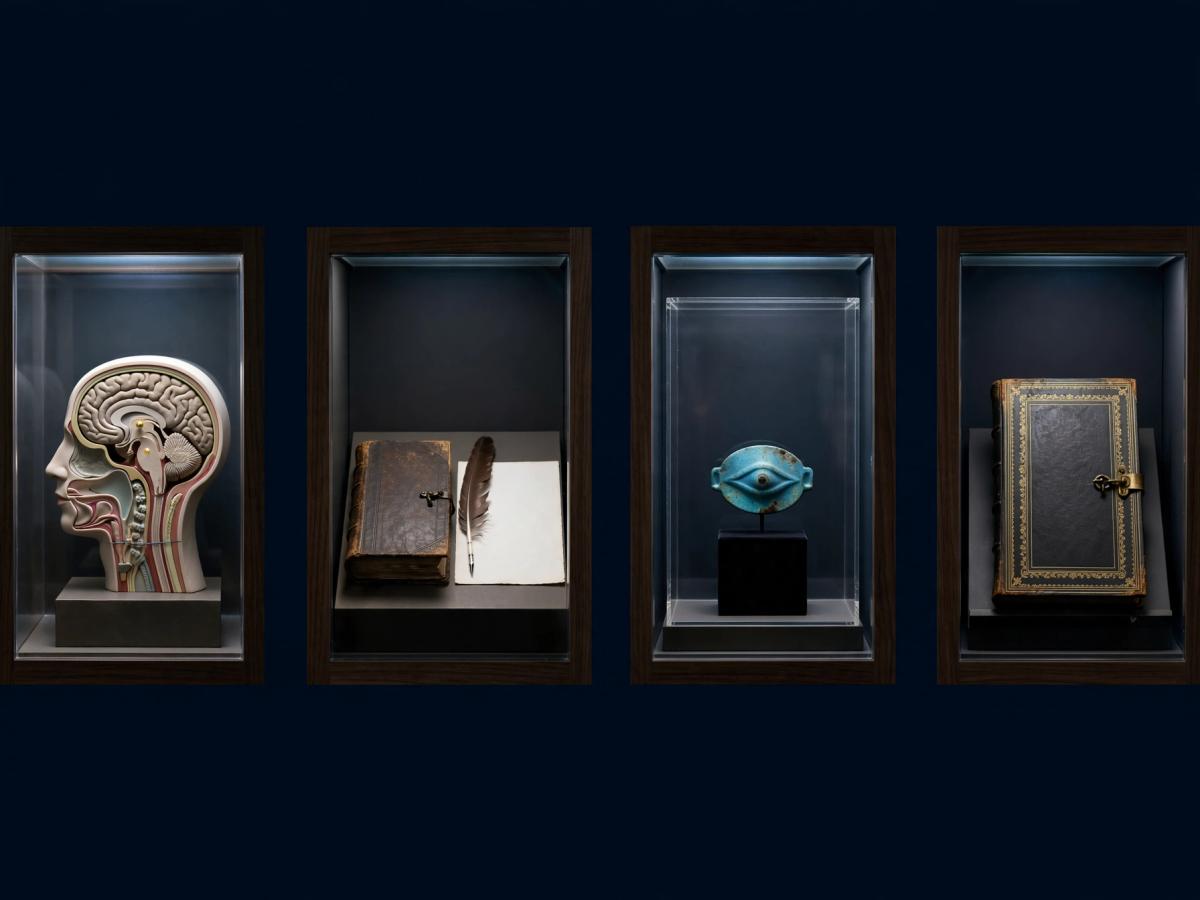
The pineal gland has a real place in endocrine physiology and a long afterlife in philosophical and spiritual writing. Those histories can be read together without making them the same claim. Current biology describes a pathway by which retinal light information helps time pineal melatonin output. Descartes gave the gland a philosophical role, an Egyptian eye amulet is a different kind of object, and a modern Theosophical association is not ancient anatomy.
A biological pathway, not direct light detection
Pineal melatonin timing is regulated through an indirect route. Light is detected by the retina; signals reach the suprachiasmatic nucleus (SCN), then travel through downstream hypothalamic and sympathetic pathways that influence pineal signaling. The gland responds within this pathway, but it does not detect light directly. That distinction matters because a real role in circadian physiology does not make the pineal an eye.[1][2]
The Endotext chapter describes the physiology of melatonin and the signaling route, while Berson, Dunn, and Takao examine retinal ganglion cells involved in circadian input. The retinal study is one part of the chain, not a complete account of every downstream connection. The useful conclusion here is limited: the body has a pathway from light detection to pineal timing, not a second visual organ hidden in the skull.[1][2]
Descartes's philosophical role
In The Passions of the Soul (1649), René Descartes assigned the pineal gland a special role in his account of relations between soul and body. He also described the soul as joined with the whole body. Reading those passages together prevents one striking anatomical proposal from being mistaken for a complete summary of his philosophy. Descartes did not call the gland a “third eye.”[3][4]
The French primary text is available, but a translation should be checked before quoting it word for word. The Stanford Encyclopedia of Philosophy traces later discussion of Descartes and the pineal gland. These sources document a philosophical history; they do not establish that the gland receives visions, perceives hidden realities, or serves as an extra sense.[3][4]
An eye symbol is not evidence about the gland
The Metropolitan Museum of Art records a Wedjat-eye amulet dated to 332–30 BCE. It is a concrete ancient object with an eye image and its own museum-documented context. That record can support claims about this object and its collection description. It cannot show that ancient Egyptians identified the pineal gland, and a visual resemblance between an eye symbol and a gland is not anatomical evidence.[5]
The distinction is important whenever a modern reader places an ancient symbol beside a brain structure. An object has a maker, material, use, and archaeological history; an organ has a physiological description. The two can be compared as part of a history of interpretation, but one cannot serve as proof for the other without evidence connecting them.[5]
A modern association with a distinct date
H. P. Blavatsky's The Secret Doctrine (1888) documents a modern Theosophical association between the pineal and third-eye language. It is evidence for that later reception, not proof of an ancient anatomical teaching. Keeping its date visible lets readers examine how ideas changed without projecting a modern synthesis backward onto earlier cultures.[6]
What changes when we keep physiology, a philosopher's theory, an ancient amulet, and a modern spiritual interpretation in separate columns before asking what “inner vision” might mean?